This week’s trail cam feature.

Posted in Carnivorans, Procyonids, West Virginia, tagged Northern raccoon, raccoon on August 29, 2014 | 1 Comment »
Posted in Carnivorans, West Virginia, wildlife, tagged American black bear, bear, West Virginia black bear on August 16, 2014 | 4 Comments »
I estimate the bear was on film less than a half hour after I set the camera.
I have never seen this bear or any other bear in person on this access road, so they must be very good at reading people.
Which is wise.
Black bears are known for their intelligence, and this one tries to avoid walking in the mud where it would leave tracks.
Also, it’s very easy to see how a black bear could give someone the idea for bigfoot. Like humans, bears are plantigrade. Their heels touch the ground when they walk.
So if anything could give you an idea of wild man living in the forest, it would be one of these stealthy black bears.
Posted in Carnivorans, West Virginia, wild dogs, wildlife, tagged gray fox, urocyon, Urocyon cinereoargenteus, West Virginia gray fox on August 10, 2014 | 3 Comments »
Buoyed by the bear that came out on the trail cam this week, I set out a fresh bait of sardines.
And I got a gray fox on the camera last night.


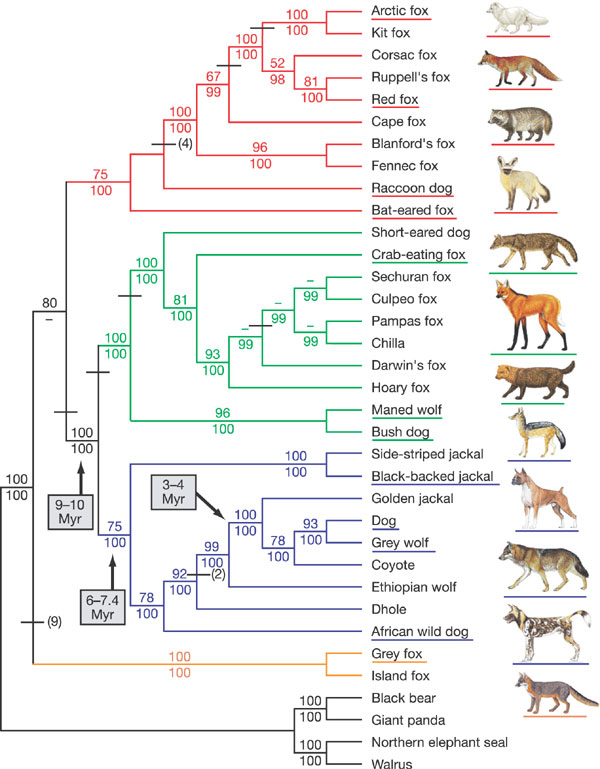
Gray foxes are actually the last survivors of a lineage of North American dogs that diverged from the rest of the dog family 9 to 10 million years ago.
They aren’t really “foxes” in the same way red foxes, arctic foxes, and swift foxes are.
The gray fox, which I think should just be called Urocyon (their genus name, which means “tailed dog,” a very apt name!), are ecologically like the European wildcat. They live on small mammals, birds, and reptiles, and unlike other dogs, readily to take to the trees to forage for food and avoid predators.
Finding a gray fox here means that I probably won’t be getting any red foxes on the camera. Gray foxes dominate reds, and coyotes eat them. With coyotes and gray foxes in the same area, my guess is that no red fox could live here without constant persecution.
Posted in Carnivorans, tagged American black bear, black bear, Northern raccoon, raccoon, West Virginia black bear on August 8, 2014 | 11 Comments »
Just a raccoon out frogging:


And this little creature:


Posted in Carnivorans, tagged ferret, polecat on July 26, 2014 | 7 Comments »
Who is the daddy?
My guess is a European polecat that mated with the ferret.
I don’t know about the extra toes bit.
Posted in Carnivorans, wild dogs, wolves, tagged Chester Moore, red wolf on July 10, 2014 | 3 Comments »
This documentary is about coyotes that have red wolf features and possible ancestry in East Texas. He could have gone with that angle and made me giddy.
Instead, well, you’ll see:
So red wolves speak of the creator?
But wait a minute…
There is a huge debate about what a red wolf is. The best genetic study I’ve seen on them suggests they are recent hybrids between a relict population of Southeastern wolves Canis lupus wolves) and coyotes. What made the red wolf was not God Almighty but the extinction of the subtropical American wolf, which was almost always black in color.
Everything about Canis speaks of evolution. Not only do we have the hybrid red wolf, but we have hybrids between golden jackals and African wolves (Canis lupus lupaster) in sub-Saharan Africa. Eastern coyotes also have a lot of wolf and dog ancestry.
Hybrid zones and muddled areas between species are exactly what we expect if there were common descent among similar species.
They are distinct species but they simply haven’t diverged enough from each other to lose chemical interfertility.
The whole red wolf debate is actually about evolution from this perspective.
I lean toward it not being a distinct species at all but a really recent hybrid. I don’t think proponents of its unique species status have produced enough evidence to suggest that is not a hybrid. Hybridization is extremely common in Canis species, and this seems much more parsimonious than the claim that it’s an ancient North American wolf– a living fossil or whatever else.
Plus, the DNA says it’s not. And by that I mean large samples of DNA, not microsatellites or just mtDNA evidence, which is actually all they have.
But the hybridization of Canis in the East is producing a new form of coyote. This is a canid that comes in many more colors, thanks to the sprinkling dog in its ancestry and much more able to hunt large quarry thanks to the bit of wolf blood coursing through its veins.
These are the questions that make wolves and their kin interesting.
But unfortunately, we didn’t get that here.
Plus, everyone knows that the Bible hates wolves. It was written by ancient herdsmen, whose livestock suffered under wolf depredations. It’s not an ecology book in the least.
European settlers killed wolves on this continent under the auspices of ridding it of a Satanic force. Wolves did prey upon man in feudal Europe, and our ancestors came here with a strong fear of the lupine.
Chester Moore and I grew up in very similar environments, but I’m glad my parents and grandparents were interested in Darwin. My dad got me watching Sir David Attenborough documentaries.
I am glad that I am comfortable with nature as it is.
Every time I look at a dog’s eyes, I see evolution.
Every time I look at a flying bird, I see a dinosaur.
I see every reason to accept the modern Neo-Darwininian synthesis. It’s all around me.
I don’t see any reason why I should accept the Bible– or any holy book– as true.
But that’s just me.
Posted in Carnivorans, Procyonids, tagged Northern raccoon, raccoon on June 29, 2014 | 2 Comments »
Even in a container with a sealed lid. Some animals have hands.
If you look closely, you can see that the raccoon is female. You can see her teats in exactly the same place you’d find them on a dog.
Another use for the trail cam has been discovered.


 | williewestfall on Bobcat scat |
 | cyborgsuzy on Forgive the gratuitous ne… |
 | retrieverman on Forgive the gratuitous ne… |
 | pondpawed on Forgive the gratuitous ne… |
 | Eugenie on Tailgate |