“People talk about birth defects from inbreeding, but just being a pug is a birth defect.”
–Steve Jones, professor of genetics at University College London.
Posted in dog breeds, dog health, tagged pug on September 25, 2013 | 10 Comments »
“People talk about birth defects from inbreeding, but just being a pug is a birth defect.”
–Steve Jones, professor of genetics at University College London.
Posted in dog breeds, dog health, tagged bulldog, Uga, University of Georgia on August 29, 2013 | 17 Comments »

This bulldog is a mascot for the University of Georgia’s football team.
Anyone who knows anything about bulldogs knows why this dog, which “Russ,” also known as “Uga IX,” is sitting on a bag of ice. Bulldogs cannot cool themselves properly, and Georgia is in America’s humid subtropical belt. That means it gets quite hot and humid right through much of football season.
It’s not the best place for a dog with such deformed respiratory and cooling, which, as I noted in my pug post, are actually the same system.
Russ was given a “battlefield promotion” when Uga VII died of lymphona when he was about year old. Uga VIII’s tenure followed the very short life of Uga VII, who died of heart failure before reaching a year of age.
This breed does not have a very good track record at all. It’s one of the least hardy dog breeds you can find, which is why it is so expensive to insure. The dogs have a legendary toughness that has largely been bred out of them through breeding them to what is clearly one of the most absurd breed standards in the entire dog fancy. These dogs were messed up over a hundred years ago– after only about twenty years of being bred solely for the show ring– and one particularly “typey” specimen couldn’t even win a walking race.
Is this the symbol the University of Georgia wants for its football team? A dog that can’t even walk two miles?
And it’s not like Georgia doesn’t have its own native bulldogs. There is the Alapaha, which is often merle, and there is the so-called “white English bulldog,” which might be better called the “Old Southern white bulldog.” Of course, they don’t look like the Ugas, but these dogs were bred to do something in places like Georgia. They were all-around farm dogs, hog-catchers, and guardians. These dogs likely barked and snarled their warnings as Sherman’s troops marched through their owners’ lands on their way to the sea.
But the tradition at the University of Georgia is to use this particular type of bulldog. They are always owned by the man who started the tradition, a prominent Georgia lawyer named Sonny Seiler. Seiler donated the first Uga to the team in 1956, and as of 2011, he had no interest in changing the bulldog at all. He told a writer for the New York Times Magazine: “Change this dog too much, and it won’t look like a bulldog anymore…. Besides, Uga gets the best veterinary care, and we do everything to keep him safe. These dogs have a good life.”
And this is precisely the problem. The dogs may be cared for amazingly well. They may have the best vets in all of Georgia at their beck and call.
But it is questionable how good a life these dogs actually leave. Remember, that extreme brachycephaly is associated with problems breathing and cooling. Bulldogs often never know what it’s like to be fully oxygenated. If you’ve ever struggle to breathe, it’s not a fun experience, but bulldogs go through it their entire lives.
So you may have an animal that is well cared-for, but it’s life is pretty miserable.
It can’t tell you that it’s miserable, and because dogs are stoic, it will put up with all the misery that has been inflicted upon by human stupidity.
The nineteenth century dog fancier Rawdon Lee called the bulldog a “burlesque” of a national symbol. The bulldog of the University of Georgia is also surely a burlesque.
But in the South, football is a religion– much more so than even the dog fancy, and it is very unlikely that this mascot will change.
They’ll just have to change them ever couple of years as they die from conditions that normally don’t befall normal dogs until they are least ten.
It’s kind of pathetic and sad in a way.
I readily admit that I don’t really understand football, but I don’t get is how people can get so wrapped up into symbolism that they cannot think for a minute about what their symbol actually is.
This bulldog is an import– developed solely by the British dog fancy and sold to people with more money than good sense.
America– especially the South and Georgia in particular– have a very strong tradition of bulldogs. Bulldog and bulldog-terrier types were once common in every little town and every little farm and plantation. These were hardy, sagacious animals that made life in the subtropics endurable. You can’t control half-wild range hogs with with a collie, unless you want a dead collie.
Football is supposed to be a celebration of toughness and a distinct American-ness that surely could be better exemplified with a true Georgia bulldog.
But that’s trying to make logic out of the illogical.
Modern football traditions are all that matter.
Animal welfare and common sense be damned.
Posted in dog health, tagged pug on August 28, 2013 | 49 Comments »

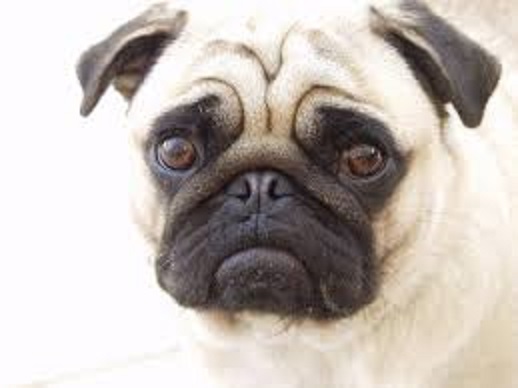
Extreme brachycephalic pug.
There are two big problems facing purebred dogs today: health conditions that are exacerbated and exposed through inbreeding and health problems that are the result of conformation.
When we complain about the health of purebred dogs, as we often do on these sorts of blogs, there is a tendency to mix the two types of problems, but there is certain amount of error that comes from doing so. The dachshund’s back issues are not caused by inbreeding, and the Italian greyhound’s autoimmune problems are not the result of selecting for a particular body type. The former’s problems come from breeding for such a long back on a dog with such short legs, and the iggie’s immune system problems come from very tight breeding at their foundation,.
It is very important that we keep these two types of purebred dog health problem distinct. The solutions for each type are very different. In the dachshund’s case, all we’d have to do is start breeding for more leg, which already exists in the working population of the breed. In the Italian greyhound’s case, we’d have to do an outcross to increase heterozygosity in its DLA/MHC genes. That means that we’d have to cross one with a whippet or maybe a miniature pinscher to correct the problem.
But there are some breeds that actually have both problems. Yes, some breeds are unlucky to have both compromised genetic diversity and extreme conformation issues that prevent them from having optimal health.
Perhaps the most common breed to suffer from both these sorts of problems is the pug. Pugs are a very popular toy breed these days, and the dogs do have a lot going for them. They tend to have fairly stable temperaments, though they are known for being stubborn and sly. They are not border collies that require tons of exercise and mental stimulation. They can live nicely in an apartment without wrecking it, and they normally are not snappy little dogs, which means they could be a choice for an urban family.
And did I mention they do have rather distinguished looks. Some people think they are quite ugly, but they do have a sort of monkeyesque cuteness that also has tendency to humanize them. Its their tendency to look like little monkeys or, dare I say it, human babies that draws people to this breed. More so than perhaps any other breed, the pug is the one that gets dressed up in little costumes and photographed for memes on the internet.
The most obvious problem pugs face is actually the result of that monkey mug.
Pugs were always brachycephalic dogs. It is one of their distinguishing features, and almost all dogs are brachycephalic when compared to wolves and other wild canids. We need to be a little bit careful in condemning shorter muzzles, because it is possible for a dog to have a shorter than normal muzzle and have no health problems.
The problem is in extreme brachycephaly.
And this is precisely the problem that pugs exhibit.
We’ve bred them so brachycephalic that the dogs now have upper respiratory systems that are entirely stenotic– “scrunched up.” Many individuals have an elongated soft-palate, which is the fleshy bit that runs from the back of the roof of the mouth into the throat. Pugs have undergone such a rapid transformation into extremely flat-faced dogs that they often still retain a normal dog’s soft palate, which winds up become a real hindrance to the upper respiratory system. The tissue winds up blocking the airway at times, making breathing that much more difficult. The nasal passages are often similarly scrunched up, making it very difficult for the dog to oxygenate itself fully. Many pugs will not sleep with their heads down, because if they put their heads in a prone position, the respiratory system becomes blocked. Dogs breathe through their noses, and if the nostrils are squashed in, they are going to have a very hard time breathing.
Now, if that weren’t bad enough, dog use their respiratory systems as their primary method of thermoregulation. Dogs pant to cool themselves. They pass air overt their moist mucus membranes, which causes evaporation on those membranes, which then cools the dog. When pugs cannot pass air over their mucus membranes efficiently, they cannot cool themselves. Furthermore, the muzzle in domestic dogs contains a cavity that is vital in passing air through the respiratory system during panting. In pugs, that cavity is extremely reduced.
The problems with the respiratory/thermoregulation system in pugs are just the most severe. Pugs still have the same number of teeth that all other dogs have. However, when the teeth come in, there is often not enough room for them in the mouth, and the teeth have to be pulled.
And that cute little skin fold above the muzzle is actually just excess skin. The pug evolved its extreme brachcephaly very rapidly, so it often still has a bit of excess skin that normally would be stretched out over a longer muzzle. That fold is just above the dog’s nose. Dogs have wet noses,and they do produce a bit of snot. That snot winds up getting gummed up into that skin fold, and if it’s not cleaned regularly, it can be a haven for bacteria, making infections rather commonplace.
The short muzzle also exposes the eyes to injury, which are bred so they will appear somewhat bugged out. It makes them look cut, but the result is pugs are always having problems with their eyes. At the most extreme, it’s not uncommon for the eyes to fall out due to some rather banal blunt trauma. The eyes can also prolapse if the dog pulls to hard on a lead, which is rather abnormal. Such bugged out eyes can have problems in simple maintenance. Often, they don’t produce enough tears to keep their eyes fully hydrated and clean, or they have eyelids or eyelashes that rub up against the eye so much that it causes ulcers.
It really isn’t that odd to see pugs missing eyes. It certainly adds to the character and to the mystique of owning a monkey-faced dog, but it isn’t something of which someone should be proud.
It’s rather horrifying.
So the pug’s “headpiece”– as the dog show people like to call it– is really quite defective.
But that’s not the only conformation problem they have. Breeding for the double curl in the tail is actually a selection for abnormally-shaped vertebrae. Breeders want the tail vertebrae to be strangely shaped so it will curly, but they can have the same thing happen to any of their vertebrae.
So it’s not unusual for them to have severely deviated spines.
Then they are the joint problems.
According to the OFA, 80.2 pecent of all pugs that it evaluated that were born between 2006 and 2010 were dysplastic.
It’s not really a working breed, so people haven’t really paid that much attention to the problem.
Hip dysplasia is also a difficult condition to classify. There are clearly both genetic and environmental causes, and it is also difficult to trace it down to breeding for a particular conformation type.
But there are also a series of problems that pugs have solely because of their reduced genetic diversity. In the UK, an analysis by Imperial College, London, found that the effective population of pugs in that country is only 50 individuals. At the time, there were an estimated 10,000 pugs in the UK, which means they have a significant amount of inbreeding.
This inbreeding, which is actually the result of the closed registry system that runs riot in the world of purebred dogs, has exposed a tendency to develop necrotizing meningoencephalitis, which is now called “pug dog encephalitis.” Only a little over 1 percent of all pugs will develop the condition, and now there is a genetic test for it. It is associated with homozygosity within the DLA/MHC genes, which is what happens when inbreeding is done without trying to maintain DLA/MHC diversity. This condition is fatal, and there is no cure.
The weakened immune system that comes from such an inbred population also makes pugs more susceptible to demodectic mange. Most dogs have no problem with demodex. Demodex mites live on dogs and normally cause no problems. However, when a dog’s immune system is weakened, the mites can get out of control and cause mange.
So here we have a dog breed that is fairly common and growing in popularity that has severe issues with its unusual conformation and its compromised genetic diversity.
And no one really seems to care.
The pug, as it exists, is no longer under the selection pressures of natural selection.
Nor are most domestic dogs.
However, in this case, not only have the selection pressures from nature been relaxed, artificial selection has run amok.
We have succeeded in producing an animal so fragile that we cannot leave it out on a balmy spring afternoon. It is an animal so fragile that it is quite prone to having its eyes fall out of socket.
It is a perverse creation, but the perversion is simply not seen.
It is almost impossible to have a conversation about changing the pug without having a discussion about outcrosses, which of course leads to the attack on puggles. Puggles are designer dogs that are the result of breeding a beagle to a pug. They were heavily milled and mass-produced in the US a few years ago, and they developed a bad reputation.
But no one is talking about puggles. What is normally suggested is that one do a simple outcross to a less extreme breed, but of course, the pug fanciers won’t have anything to do with it.
Many are under the delusion that this breed has existed in its current form for thousands of years, which even a simple Google search for old pug photos and paintings will show you that it simply isn’t true.
Further, the breed in its current form was developed in the past 400 years in Europe, not in China. For a very long time, it wasn’t even known that it was a Chinese breed, and if black pugs had not been imported to England from northern China int he 1880’s, we would have never known about their origin. Though they became established in the seventeenth century in the Dutch Republic through trade with China, no one seemed to remember where they came from.
This breed could be fixed if we thought it through a bit, but that’s unlikely to happen.
There are no “working-type” pugs, and any dogs of this type still living in China are likely to be quite rare and quite different from the Western pug.
The entire existence of this breed is as a pet. Not that there is anything wrong with breeding a pet breed, but because it is a pet, it is possible to create fantasies about them.
It is possible to delude oneself about how healthy these dogs actually are.
It possible to delude oneself into believing that there is nothing wrong with breeding for such extremes.
Without any sort of working test or ancient landrace for which one can compare the Western pug, the breed can exist as the monkey dog. One etymology of the word pug is that pug was used to describe a type of New World monkey– probably a marmoset or tamarin–and there were “pug monkeys” and “pug dogs.”
And that goes to precisely the problem these dogs face. People have forgotten that this animal is still dog, and dogs have a particular anatomy and physiology. We can bend it and distort it through selective breeding, but at some point the bending becomes a perversion. It becomes burlesque.
It becomes unworthy of the relationship between man and dog.
It is something that shouldn’t be honored.
And it certainly shouldn’t be promoted as cute.
It is a problem that no one wants to talk to about.
We have let the pug down, but no one wants to say anything about it, lest one be deemed an animal rights activist.
We could fix these problems, but then we’d have to break the delusions and fantasies.
And unfortunately, too many would rather cleave onto those than admit the reality of the situation.
Maybe the pug is doomed.
Right now it surely is.
Posted in Absolute Piffle, dog health, tagged pug on August 27, 2013 | 8 Comments »
At least with pugs, they are:
And with pugs, it’s sad to say that this isn’t first disorder they’ve had that people have thought might be cute.
Posted in dog breeds, dog health, tagged dog breeding, dog fancy, dog shows on August 2, 2013 | 24 Comments »

As long-time readers of this blog know, I think we need a new dog fancy.
By “fancy,” I simply mean the cultural institution that sets the mores and values for breeding dogs. The initial fancy was developed in the period from 1860 to about 1885 under the premise of improving strains of domestic dog. This was the time of Victorian science, which had inherited a legacy of the scientific breeding that traced back the eighteenth century agriculturalist Robert Bakewell.
This was also a time when zoology consisted of Europeans with some scientific training going to the far corners of the world in search of new beasts. If someone saw a bear with somewhat off coloration, that person usually declared it a new species. This was the age of taxonomic splitting to the extreme.
And it was applied to dogs in ways that we would later come to regret. In those days, it was common to apply those taxonomic splitting principles to dogs. Even if you could get several breeds in the same litter, it was generally accepted that one would register each puppy according to its phenotype. Perhaps the most extreme example is the Bedlington terrier and Dandie Dinmont terrier problem. At one time, one could get either breed in the same litter. If it had dwarfism, it was a Dandie. If it had legs, it was a Bedlington. At some point, the Bedlington terrier’s coat was altered through cross-breeding with a poodle, and it became much less likely to have strains in which Dandies and Bedlingtons would pop up in the same litter. In Northumberland and the Scottish borders, there were drop-eared terriers that produced long-legged and short-legged varieties, but the dog fancy decided to split them up.
And now they are quite different dogs.
Fights in breeds about the true type also led to breed splits.
Yes. It was politics. The golden retriever was split from the flat-coat for two reasons: 1. It was believed to be of Russian and not British origin and 2. the yellow dogs weren’t winning prizes at shows.
The last breed split I’ve seen that resulted from a dispute over phenotype was the division of the Norfolk and Norwich terriers. At one time, there was a breed drawn from the little terriers of East Anglia that was called a Norwich terrier. There were two varieties: one with prick ears and one with folded drop ears. If you have both ears in a breed, it’s actually pretty hard to breed for consistent ear carriage– just ask the people who breed phalenes to papillons in the US–so they decided to split the Norwich terrier into two breeds in 1960.
Splitting up types and refining them were the main activities of the dog fancy. They didn’t have a good grasp on the science of population genetics at all.
These were social climbing people who wanted to innovate and create. In some ways, their hearts were in the right place.
But they were still stuck in the limitations of the Zeitgeist.
We now know that splitting up dogs into often contrived esoteric forms called breeds and then shutting off all those breeds from almost all infusions of new blood are actions that are not going to lead to improved health or welfare. We also know that if rigorous selection is performed within those breeds, we are doing nothing more than making the march to misery move at double-quick.
The dog fancy that we have right now isn’t really that far removed from the Victorian days.
It has generally been impervious to new scientific findings that have directly challenged axioms about blood purity and rigorous selection within a closed population.
It has also been impervious to suggestions that breeding for certain phenotypes are directly responsible for creating health problems. The extreme brachycephaly of pugs and the sloping hyena backs of German shepherd dogs can be demonstrated to cause very real maladies, but these criticisms are ignored.
One intellectually lazy argument is to attack anyone who points out these facts about extreme conformation as an animal rights activist. I know the full mantra– “You’re one of those PETA types who wants to end dog ownership!”
Not at all.
When one points out the absurdity of blood purity in this day and age, the other intellectually lazy argument is to say that one wants to end purebred dogs or selective breeding.
I rather enjoy it when people who don’t wish to debate the issues simply put words in your mouth and intentions in your head that you simply wouldn’t consider in the first place.
No. I actually want to encourage selective breeding, but I want to give breeders more tools and more freedom to correct genetic problems and to innovate. Innovation is the key. People need freedom to think and to experiment.
The problem with the dog fancy is that skills and knowledge were passed on like apprenticeships. A new breeder would hook up with an older established one, and the established one would give out all the advice. That established breeder likely got his or her ideas from earlier one, who in turn got it from an earlier one. In the end, it may be that this wisdom all gets traced to someone who lived either in a time when we simply didn’t know or someone who was trying to peddle a pet theory about how to breed dogs (see Brackett’s formula for a good example of that one).
That’s not a culture of innovation. That’s a culture of tradition– often the culture of tradition for tradition’s sake.
In order to create a dog fancy of innovation we need a new paradigm, and I think this new paradigm needs to be based upon two principles
The first principle is oddly lacking in so much of the modern dog fancy. People use scientific findings. If there is a new genetic test for a disease or a recessive coat type they don’t want, they are excited to use it.
But when science questions the validity of long-standing traditions and ideas passed on from established people to their apprentices, that is when things get ugly.
There is very little critical thought, and critical thinking is key to having science as a main principle.
It can be acceptable for someone to say that if you don’t trim the fur on Keeshond’s feet, its pasterns will become weaker. (Someone did actually say this!)
If the dog fancy were more science-based as a founding principle, people would not be able to get away with pronouncements that are either not provable or are demonstrably false.
I don’t see why it’s such a scary notion, but a lot of people get nervous when you start talking like this. That’s because you may discover that some long-held shibboleth is nothing more than bullcrap.
Empathy is the other principle that is sorely lacking in the world of dogs.
I don’t know how someone can claim to love a dog and be satisfied with its constant discomfort.
But that’s exactly what you see when people breed extremely brachycephalic pugs that cannot cool themselves efficiently or breathe properly.
As soon as you start down this path, the accusations of confederacy with Ingrid Newkirk come out, and the breeders almost always say “It’s in the standard.”
And this is where the two principles come together. Breed standards are like scripture. They are written by fallible human beings.
They are also interpreted by fallible human beings, and they are misused by even more fallible ones.
At some point, your empathy for the dog has to bring to a critical analysis of the standard and the institutions that claim to be acting in its best interest.
It is at this level that the modern dog fancy has let the domestic dog down.
We can change it, but we have to be acting with the right principles.
Otherwise, we’ll fall into the trap that goes “All we have to do is have working trials replace dog shows and things will turn out fine,” which is followed by the even more absurd variant that goes “All we have to do is make sure our champion dogs pass a working test before they become full champions.”
Both of those statements are acting in the old paradigm.
They simply will not change things enough to make a real difference.
The new dog fancy cannot be the based on the old. It must be based upon principles that are worthy of the dogs themselves.
Posted in dog breeding, dog breeds, dog health, tagged brachycephalic dogs, brachycephalic obstructive airway syndrome, pug on July 28, 2013 | 12 Comments »
Snoring pugs are not cute. This poor creature suffering from stenotic nares. The nares are the nasal cavity, and stenosis just means they are abnormally scrunched up.
The dog is actually having a very hard time oxygenating itself while it is in prone position.
The entire reason why this health condition exists is simple breeding for extreme brachycephaly.
I can’t imagine going through life without being able to oxygenate my body as fully as possible, and I can’t imagine what it would be like to have my breathing obstructed every time I went to sleep.
I have had a person very close to me with COPD that resulted from a lifetime of smoking. One of the reasons why I don’t smoke and never will is that I have no desire to be in that situation. I never want to have the discussion about my health ever to involve a discussion of oxygen tanks. I never fail to appreciate how important it is for me to be able to take in full breaths of air.
But it’s one thing for a person to develop breathing problems as the result of a lifetime of smoking.
It’s another to breed for it in a dog.
It’s even more of a problem for dogs because dogs dogs use their respiratory systems as their primary cooling systems. Dogs pass air over their moist mucus membranes when they paint. This causes evaporation, which leads to cooling. When dog has such a scrunched up muzzle, it cannot cool itself efficiently.
This is why pugs and other brachycephalic dogs drop like flies on hot summer days.
The biggest welfare problems that dogs face today in the West are not neglect, dog fighting, or puppy mills.
The biggest welfare problems they face are distortions in conformation that have very real consequences for their health.
The reason why this is such a big welfare problem is that it’s not seen as being objectively cruel like those other practices. Dogs win prizes because they have a particular conformation, even if it is very bad for them.
Jemima Harrison used a pug as a good example of what this sort of breeding has produced in Pedigree Dogs Exposed:
The sad thing is that people think this is normal.
Not only do the laypeople think this is cute, dog shows reward extreme muzzles.
Dog shows are respectable and esteemed institutions, and as a result, you don’t see as much of a public outcry against extreme brachycephalic breeding as you do with dog fighting and puppy mills.
And because of this discrepancy, the welfare issues that result from this sort of selective breeding are an even bigger problem than those disgusting ones.
If we can say no more to dog fighting and puppy mills, why can’t we say no more to dogs that can’t fully breathe or oxygenate themselves?
No one is saying end brachycephaly in dogs. After all, most dogs are brachycephalic when compared to wolves, and some breeds have always had shorter muzzles.
But we’ve gone too far.
We’ve pushed the organism’s anatomy too far, and we’ve got to stop and think about where this is heading.
There is a certain banality of evil that exists with pugs and other breeds like them. I don’t wish to use that Eichmann analogy too lightly, but it seems uncomfortably appropriate.
People accept that it’s wrong to fight dogs or breed them like broiler chickens, but they are entirely okay with dogs that spend their entire lives struggling for a breath. The axiom that leads to the cruelty is the breed standard, and virtually everyone who buys one of these dogs wants a little flat-face, no matter the consequences.
In fact, it is unlikely that most people who own these dogs ever seriously consider the cruelty by anatomical distortion when they decide to get one of these dogs. These are not callus people. They are dog lovers, who often spend lots of money on their charges.
But they have allowed the flat-face to blind them.
They cannot see how much of deficit these dogs actually face when it comes to breathing and cooling themselves, and the sad part is that the deficit is seen as cuteness or even a breed trait.
It is in this realm that we’re decided to we have allowed obvious discomfort to go unchallenged, and in this respect, we now have a problem that is going to be next to impossible to fix without outcrossing– which no one wants to do.
The pug is a victim of our own caprices and vanities. It never served any purpose in the West, except to be a nice pet. We allowed it to become an object that we could mold in any way we saw fit, and now we are suffering the consequences.
We’ve lost site of this animal as a biological entity. In the eyes of many, it has ceased to be a dog. It is an animate toy.
Its canine anatomical necessities have been put on the backburner in order to mold into the image we have created for it.
And until we recognize that pugs are indeed dogs, they are going to continue to suffer.
This is not the way we treat animals we love.
And if we truly do love them, it’s time to look at things from their perspective.
Have a bit of empathy.
Would you like it if you struggled to breathe every time you went to bed?
What if your sweat glands couldn’t cool you on a hot afternoon?
We need to think about these issues before we start nattering on about what’s cute or “excellent breed type.”
These are secondary considerations.
We make breeding decisions for dogs. We write out breed standards. The dogs have no say in it, but they do suffer when we don’t put their interests first.
We’ve clearly not put their interests first when we allowed pugs to turn out this way.
It’s time to change it.
For the love the dogs and simple human decency, we must change.
***
Update: This dog has already undergone an operation for stenotic nares. It turns out that the reason for her problems are that her entire upper respiratory system is stenotic!
Posted in dog breeds, dog health, tagged pug on July 26, 2013 | 4 Comments »

Photo from Nara U.
This is the 1890’s version– back when they had a muzzle!
This is what they look like now:

This breed has not been well-served by the fancy in the past 120 years.
Like many brachycephalic breeds, they have a hard time breathing and cooling themselves, and those wrinkles have a tendency to collect gunk that allows bacteria to flourish.
The double-curled tail has created a selection pressure for deviated spines, and oh, those bug eyes have a tendency to fall out under even modest trauma.
It’s very sad what we’ve done to this breed. It’s also a good example of how dog shows lead to extreme distortions in type.
This breed has no work. It never has had any work.
There is no way to divine a working trial for them.
But because its utility was solely in how it looked, extreme conformation could be justified.
There is absolutely no need to make any claims about this conformation giving the dog an advantage at doing a task– something that even the English bulldog fanatics at least attempt!
This sort of dog should have been built upon a different standard: Can it be a healthy and active family pet?
In its current form, the pug is compromised in its utility.
No one wants a dog that has all of these potential impairments.
But the attitude among the pet buying public has been “It’s cute. So who cares?’
This attitude needs to change.
And if it does, maybe the pug will come out better for it.
The expression on the dog in the 1890’s photo is much more reflective of the breed’s temperament than the distorted modern version.
These are sly little dogs.
« Newer Posts - Older Posts »


 | Suhail on Raccoon selfie |
 | henrietta abeyta on Jed the Wolf Dog |
 | laura on Bostonian chupacabras! |
 | DAC/Alaskan wolfhoun… on The babies grow |
 | kingkarafuto on The Dogue de Bordeaux and the… |