If the tooth fits, he had to have bit!
Posted in Extinct, tagged Tyrannosaurus rex on August 27, 2011 | 26 Comments »
Posted in creationism, evolution, Extinct, tagged creationism, Eohippus, evolution, horse evolution, hyracotherium, Kent Hovind, young earth creationism on January 21, 2011 | 1 Comment »
Now Kent Hovind wouldn’t misrepresent things, would he?
Okay. Here’s the real story on the first horse being a hyrax.
The animal was originally called the Hyracotherium, which does mean “Hyrax-like beast.” Richard Owen did think it was a relative of the hyrax, and that’s where Ol’ Kent Hovind got that idea. At one time, we called these animals Eohippus, the dawn horse, but because the original name was Hyracotherium, we’ve gone back to that name.
However, Othniel Marsh realized that it was actually primitive ancestor of the horse when he found a full skeleton in 1876.
We now call this species Eohippus or “Dawn horse,” because we recognized that it was actually the first known horse to have ever existed. It is not a hyrax. Hyraxes are more closely related to elephants and sirens than to horses.
Dawn horse was actually quite a bit larger than it is commonly portrayed. It stood 14 inches at the shoulder and weighed about 50 pounds, so it was primitive, four-toed horse built along a basset hound’s frame. Modern hyraxes are nowhere near that size.
Kent Hovind claims the confusion was the other way around: The dawn horse was mistakenly claimed to be a horse and now we know it to be a hyrax.
He reverses the story to give his own half-baked theories credence. My guess is the Tulsa Zoo took down that display to shut these people up. And when they did shut up, they put it back up.
The level of Kent’s analysis comes down to one line: “If I get buried on top of a hamster, does that prove he’s my grandpa?”
And then the evolution of silverware.
Sigh.
This animal is now thought to be the basal odd-toed ungulate (a Palaeothere), and may be the ancestor of the horses, the tapirs, and the rhinos, too. Its exact relationship to these modern animals is not clear, but it is not a hyrax at all.
And if the horse didn’t evolve from the Hyracothere, it evolved from something very similar to it.
Posted in Extinct, tagged Amphicon ingens, Amphicyonid, bear dog, Borophaginae, Epicyon on January 12, 2011 |

Jess got the closest to getting this creature’s identity correct.
It is supposed to Amphicyon ingens, a species of “bear dog” (family Amphicyonidae) that lived in North America 13.6 million years ago.
Contrary to what this depiction suggests, this animal did not look like a lion with a dog’s head slapped on it.
The larger species of bear dog had features we would associate with modern bears, dogs, and, yes, big cats.
I note that one important bear-like feature is missing from this depiction– the plantigrade foot anatomy.
This depiction does a much better job of showing this feature:
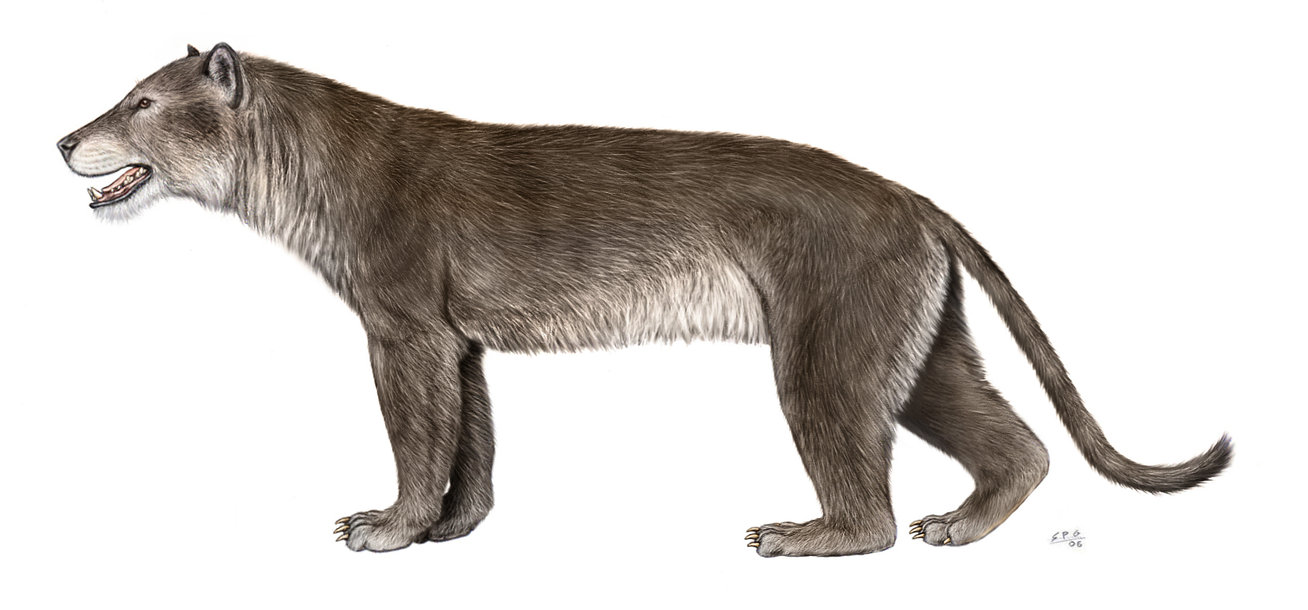
This particular depiction of a member of the genus Amphicyon looks like a hybrid between a lion and a black bear. However, the muzzle of Amphicyon ingens was much longer than either a bear’s or a big cat’s, a trait we associate with modern dogs.
This depiction of a bear dog comes closest to Amphicyon ingens– because it is an actual attempt reconstruct this species:
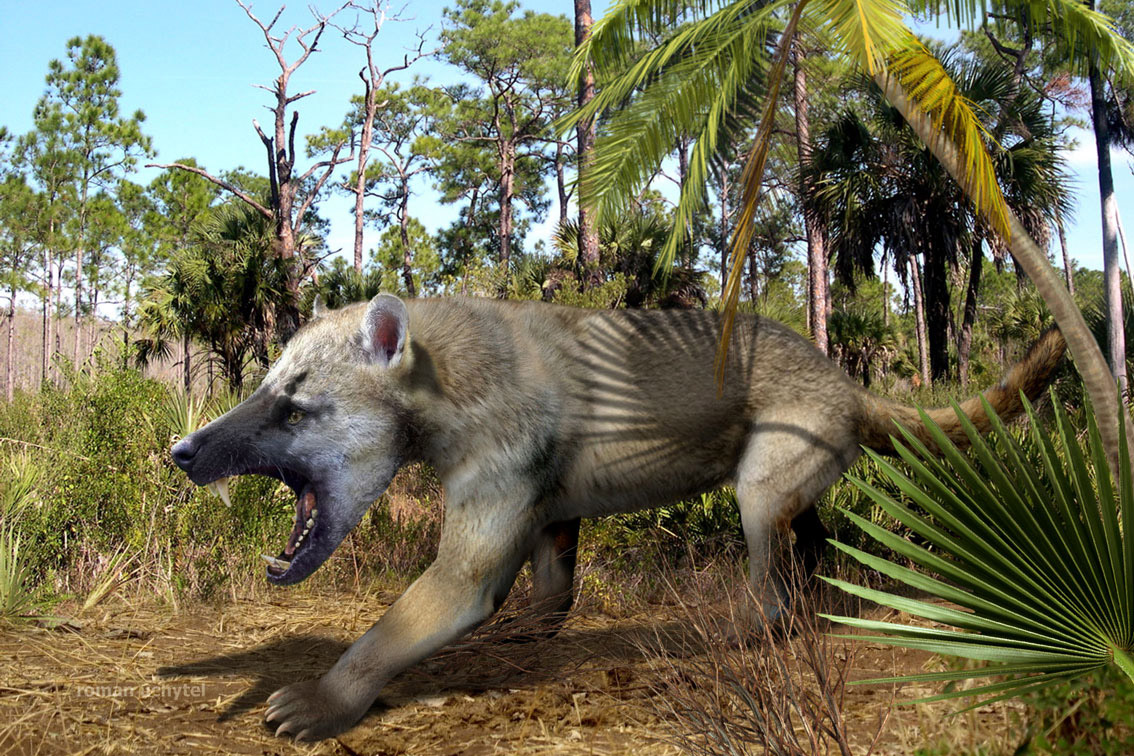
With an estimated weight in excess of 1300 pounds, Amphicyon ingens was the largest of bear dog family. They evolved from wolf-like ancestors into bear-like creatures. The wolf body-type is actually a primitive carnivore body-type. Even the early hyenas, which are feliform Carnivores, looked more like wolves than hyenas. It has traditionally been suggested that bear dogs were close relatives of bears, but because the early ones looked so much like wolves, it has been suggested that they are actually derived from early caniforms, the suborder that includes both modern dogs and bears.
These animals had to have been ambush hunters, much like the big cats. The prey in those days was big and slow. When pack-hunting Borophaginae came into North America (such as Epicyon), it is thought that they outcompeted Amphicyon.
It is an interesting theory. We do know that modern wolves tend to dominate cougars. A cougar can kill a wolf on its own, but it cannot withstand competition from a pack of wolves. Wolves are better able to use a wider array of prey sources and take up all the best hunting grounds, leaving the cougar, a deer and elk hunting specialist, to eke out an existence on the margins.
Perhaps the same thing happened in North America when Epicyon showed up. Amphicyon ingens may have been able to kill a pack of Epicyon, but because they were pack hunters, they were better able to compete in the same area. (It is possible that the same thing happened when the dingo showed up on the Australian mainland and outcompeted the solitary mainland thylacine.)
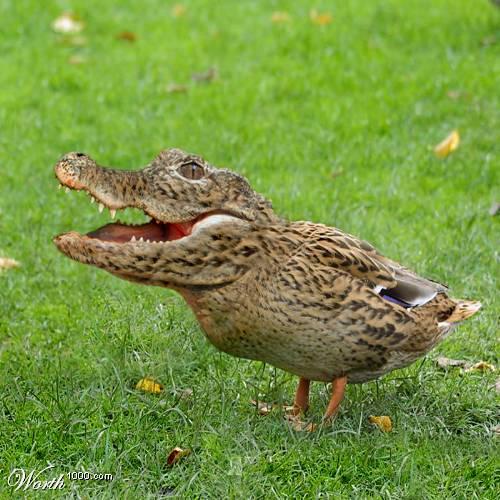
Whatever the reasons for its extinction, Amphicyon ingens was a spectacular predator. It was not a lion with a dog’s head photo-shopped onto it. That particular depiction reminds me of creationist Kirk Cameron’s bogus examples of transitional forms, the most famous of which is the crocoduck.
It’s a bad depiction. End of story.
Posted in Extinct, wildlife, tagged Flores giant stork, Komodo dragon, Marabou Stork, stork on December 8, 2010 |

A modern marabou stork from Sub-Saharan Africa. I believe Kent Hovind took a Kenyan's account of these birds as proof that pterodactyls still exist.
A giant flightless relative of the marabou stork that lived 20,000 to 50,000 years ago has been documented on Indonesian island of Flores. It stood nearly 6 feet tall, and if its behavior had been anything like modern marabou storks, it may have preyed on the Hobbit people (Homo floresiensis).
In addition to tiny hominin and giant marabou storks, the island has been home to dwarf elephants and giant rats that were about the same size as the Hobbits. The Komodo dragon was also on the island during this time, and it is still found there today.
This was once one crazy island.
Giant lizards, rats, and marabou storks and dwarf people and elephants– it sounds stranger than any island in a science fiction novel.
These animals became extinct around the time modern humans showed up on the islands, so it is possible that the arrival of our species was a major cause of their extinction. It is possible, but correlation does not always indicate causation. More study is needed.
Still, it would have been cool to have seen a six-foot marabou stork. I bet it was one of the island’s top predators and may have competed with Komodo dragons over kills. Komodo dragons kill in a unique way, not only do they have venom in their bites ,but they have a lot of nasty bacteria in their saliva. They hunt simply by biting a deer or water buffalo and letting the bacteria cause horrible infection. Because this is in the tropics, the infections move fairly rapidly. All they have to do is bite a deer or buffalo every once in a while, and they have plenty of carcasses around. It is likely that this giant marabou was deeply dependent upon the dragons to keep it in carrion. Maybe it was reliant upon the carcasses of dwarf elephant, and when those elephants went extinct, the marabous starved to death. It is often suggested that the dragons evolved to hunt the dwarf elephant, but when those went extinct, it started hunting deer and water buffalo, and those may have not provided enough meat for the stork.
Posted in Extinct, tagged American Lion, cave lion, Chauvet Cave, Lion on December 8, 2010 | 2 Comments »
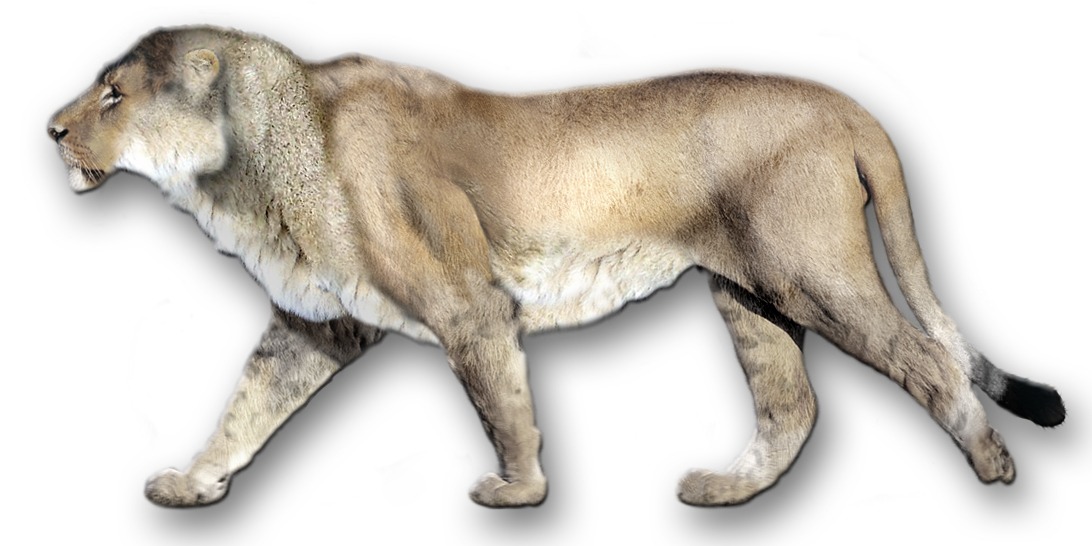
During the Pleistocene, a very large cat once roamed from Alaska to Mexico.
Whatever it was exactly is still being debated.
The current taxonomy of this species is that it is a subspecies of the lion, Pathera leo. Analysis of mitochondrial DNA from extinct Eurasian cave lions, American lions, and modern lions strongly suggests that these animals were all part of one rather genetically diverse species that, as as happened with so many other carnivore species, lost this genetic diversity at the end of the Pleistocene. The Eurasian cave lion and American lions were sister taxon, and it has been established that the Eurasian cave lion was very closely related to the modern species.
However, this same study found that Eurasian cave lions did not interbreed with modern lions, even though their ranges overlapped in the Near East and Southeastern Europe, and Eurasian lions did not interbreed with American lions where their ranges overlapped in Beringia. So they may have represented three distinct species of lion, but one must be careful assuming species status through MtDNA studies. Mitochondrial DNA tells us the inheritance through the matriline. Granted, MtDNA has its own genome and is more resistant to mutation, which makes it a useful tool in determining relationship, it is only one part of the genome.
To make things even more confusing, some authorities have suggested that the American lion was a tiger–hence the stripes in this depiction.
A recent morphological study that compared the skulls of American lions with other pantherine cats found that the American lion’s mandibluar morphology was more similar to jaguar than to the lion. The study suggests that the American lion was actually its own species, which was closely related to the jaguar.
However, the genetic evidence suggests that the American lion was a form of lion. Maybe it was its own distinct species of lion. Or maybe it was nothing more than a subspecies of a once quite diverse species that we call Panthera leo.
Panthera leo atrox or Panthrea atrox it seems clear that this animal was a lion, not a jaguar or jaguar relative. The reason for having a jaguar mandible probably result for living in the North American Pleistocene environment, which was populated by an even greater diversity of megafauna than exists on the Serengeti today. Jaguars have very powerful jaws, which they also evolved to deal with this type of prey. (Jaguars lived in North America long before they lived in South America). It would make sense that the lion of the Americas would have evolved similar adaptations to hunt similar prey.
One should be as leery of morphological studies as MtDNA studies. Morphological studies could never tell you that pugs and borzoi belong to the same species. However, genetic evidence very clearly would show this relationship.
More study is needed to determine where the American lion and the Eurasian cave lion fit in the taxonomy of the Pantherine cats. My guess is that they are actually subspecies of lion, and nuclear DNA studies, should any be able to be performed, will find more evidence of a gene flow across these types. But if not, they were all likely interfertile, and whether we consider them subspecies or separate species might always be up for debate.
We don’t have modern American lions or cave lions around to do any experimentation. We do know that male cave lions lacked manes.There are definite male lions depicted at Chauvet Cave in France that clearly have no manes. Because American lions evolved from the ancestors of cave lions, they probably didn’t have them either. There is evidence that Eurasian cave lions lived in prides, but there is also evidence that American lions did not. So there may have been behavioral reasons why these lion populations did not interbreed, even if they could.
Many questions have been raised in the research on the exact taxonomies of these two extinct big cats. One can only hope that a nuclear DNA study might be possible.]
Of course, those are old lion remains, and DNA is hard to extract. Complete sequences are ephemeral phantoms when it comes to ancient specimens.
Their exact position is simply nebulous– as it is with so many different species that went extinct in the eons of prehistory.
Posted in Extinct, wildlife, tagged greater prairie chicken, heath hen, prairie chicken, Thanksgiving, wild turkey on November 26, 2010 | 17 Comments »

Yesterday, Thanksgiving was celebrated in the United States.
We base this holiday on the harvest celebration and smörgåsbord that the English Separatists (which we Americans have always called “Pilgrims”) put on after their first successful summer in the New World.
The “Pilgrims” ate lots of different things in their 1621 Thanksgiving feast that they shared with the Wampanoag people, who had shared food with them during that first winter. Prominent among them were the “wild Turkies” that were easily dispatched. In every account of the feast that I have read, there is a mention of wild fowl, with waterfowl and turkeys getting special mention.
William Bradford specifically mentions the “great store of wild turkeys” that were served in the event in Of Plymouth Plantation:
Thus they found the Lord to be with them in all their ways, and to bless their outgoings and incomings, for which let His holy name have the praise forever, to all posterity. They began now to gather in the small harvest they had, and to fit up their houses and dwellings against winter, being all well recovered in health and strength and had all things in good plenty. For as some were thus employed in affairs abroad, others were exercised in fishing, about cod and bass and other fish, of which they took good store, of which every family had their portion. All the summer there was no want; and now began to come in store of fowl, as winter approached, of which this place did abound when they came first (but afterward decreased by degrees). And besides waterfowl there was great store of wild turkeys, of which they took many, besides venison, etc. Besides, they had about a peck a meal a week to a person, or now since harvest, Indian corn to the proportion. Which made many afterwards write so largely of their plenty here to their friends in England, which were not feigned but true reports.
Because the turkeys were so prominent in that meal, Thanksgiving in the US always features a turkey as the main course. Never mind that the turkey that most of eat is as different from the Eastern wild turkey that the “Pilgrims” and the Wampanoag ate as the St. Bernard is from the coyote.
It is our tradition– part of our national lore. Of course, before turkeys became mass produced, pork featured more prominently as the main course. Hogs were ubiquitous, and November was always the traditional hog butchering month. Mass-production of big-breasted domestic turkeys has meant that the turkey will be synonymous with Thanksgiving.
But perhaps our view of the turkey and Thanksgiving are a bit distorted. While it is certainly true that wild turkey was very common and very easily killed in the first days of English colonization of what became New England, but it did not take long for their numbers to become rapidly depleted. English naturalist John Josselyn wrote in 1672 that the “Turkie” was nearly gone from New England, and that it had been 30 years since he had seen any wild turkeys. If one does the math, the wild turkey went from being extremely common to very rare in New England within twenty years of the First Thanksgiving.
If one also reads Josselyn’s account carefully, wild turkeys had an interesting relationship with the New England Indians. The animals lived in settlements, coming and going as they please and were the original free-range poultry. They lived near their houses as tame as any English turkey.
That behavior is very different from modern wild turkeys, which are very wary of our species. They are very hard to hunt even when one illegally baits them in with corn. After all, these wild turkeys have been selected from that wild population in the same way wolves have. Only the most wary birds survived our unscrupulous and profligate depredations. At one point, only 30,000 wild turkeys remained,most of them hiding our in remote areas, where market hunters couldn’t blast them out of trees, and all the birds that exist now are descended from these extremely wary individuals.
But the story of the turkey in New England is bit ephemeral.
And while it’s true that the original European settlers of New England and the East Coast did enjoy a great bounty of turkeys, it is another bird that was likely consumed in that first Thanksgiving that would have a much longer-lasted impact upon the diet and lifestyle of those first Europeans to colonize our continent.
It is because of the importance of this bird to so many of the first colonists that we should consider its role in our history more carefully. Perhaps it deserves the title of the founding bird of our country. Our founding feather, if you will.
It is the bird poorly depicted at the top of this post and the subject of my early query.
It no longer exists in any form on the East Coast, but at the time of settlement it was unbelievably common from the New Hampshire coast to the northern parts of Virginia.
I am referring to the heath hen (Tympanuchus cupido cupido). In the early accounts, this bird is called a grouse or a partridge. Unfortunately, those terms have also historically referred to the ruffed grouse (Bonasa umbellus), and that common name makes it difficult to tell which species the writer is actually referring to.
The heath hen was very common on the east coast. Ruffed grouse tend be found a bit more inland, but they vaguely look a like. The heath hen was called a partridge by those first settlers, and when they encountered the ruffed grouse as they came inland, they likely gave it the same name. That is most likely why the ruffed grouse is called a partridge in so many part of the US.
The heath hen was found in the “heaths” that were found adjacent to the coast. “Heath” is an archaic term for what we now call pine barrens or pinelands.
In those pine barrens were a vast multitude of grouse that were so easily killed that they made up a definite staple of the colonists’ diet. They were commonly killed to feed hireed servants, slaves, and those held in indenture. They were a major source of protein, and when other game species became rare and imported livestock proved less than hardy, they could always turn to the little heath hens for meat. Without game birds, it would have been harder for Europeans to settle the East Coast, and it is from those settlements that our nation was eventually founded.
Now, these birds were not adapted to living in forests. The pinelands on which they lived were subject to regular fires, which left large open tracts of land for the birds. When this area became colonized, fires were no longer allowed to burn out of control. Unable to adapt to the lack of open tracts within the pinelands, the birds started to become rare. When European man stopped allowing fires to burn, the heath hen lost its prime habitat. The fact that they were hunted so extensively for food just compounded their problems.
But unlike the turkey, their numbers didn’t drop as precipitously. Their existence as common food source lasted at least through the first century of colonization. The birds became rare in New York in the late eighteenth century, and in 1791, the New York legislature tried to offer them legal protection– the first game law in the country’s history.
However, they were still common enough through most of their range to be hunted for food until the beginning of the nineteenth century, but by 1840’s, the birds became quite rare. It is believed that they were entirely extinct on the mainland by 1870. A relict population of 300 birds remained on Martha’s Vineyard, but these were in trouble. The birds were still occasionally poached, and a predation from the island’s feral cats was taking its upon them.
By the beginning of the twentieth century, those 300 birds had become 70. After setting up a heath hen preserve in 1908, the birds did recover. By the middle of the 1910’s, the were an estimated 2,000 heath hens on Martha’s Vineyard.
I see your eyebrows going up. Whenever you start with such a low founding population, genetic diversity issues can’t be far off. Because this was an island population, it was not as adapted to predation, and when goshawks suddenly began to colonize Martha’s Vineyard, the heath hens didn’t exactly know what to do. Then blackhead disease hit. Perhaps the lack of diversity in the Martha’s Vineyard heath hen MHC made them susceptible to the disease, or perhaps because they were an island population, they had never been exposed to the disease at all and were as highly susceptible to the disease as Native Americans were to small pox. Because chickens were found on Martha’s Vineyard for centuries before the big heath hen epidemic, it seems that the lack of diversity of MHC genes is the more plausible theory.
Whatever it was, only 600 heath hens remained on Martha’s Vineyard by 1920. For some reason, perhaps related to their low genetic diversity, clutch after clutch began to produce a very high ratio of roosters to hens. Within just a few years, the number of heath hens dropped precipitously, and because of the weird sex ratio in the clutches, the majority of the remaining birds were male. In 1927, only a dozen birds remained, and only two were female. Then, in 1928, only a single male remained. He was last seen in 1932, and when he died, the whole species became extinct.
Or so I read as a child.
I had no real concept of what a heath hen was.
I’m an Easterner, and I vaguely remember hearing about a bird called a prairie chicken on a Marty Stouffer nature documentary.
I did not connect prairie chickens and the heath hen in my mind.
However, when I put the Linnaean name for the extinct heath hen, I bet you noticed that it included a subspecies name. The reason why I wrote that subspecies name is that the heath hen is now classified as a subspecies of greater prairie chicken (Tympanuchus cupido), which although not as common as it once was, is still extant.
Some debate on this taxonomy still exists, because in the genus Tympanuchus, there are four extant species: the aforementioned greater prairie chicken, the lesser prairie chicken (T. pallidicinctus) , and the sharp-tailed grouse (T. phasianellus). They are all genetically and morphologically distinct, but they are not that different genetically. One argument goes that if the lesser prairie chicken is different enough from greater prairie chicken to be considered a separate species, then the heath hen was a distinct species, because it was somewhat genetically distinct from the greater prairie chicken and was adapted to live in a very different part of the country.
People have brought prairie chickens to the east and released them, and they have failed to thrive. It has been suggested that the prairie chickens can’t handle our climate. However, it is more likely that they can’t handle living in an area that has a mixture of cultivation and dense forests, which is exactly what most of the land in the East became.
However, the consensus now is that the heath was the East Coast subspecies of the greater prairie chicken.
Which means that it didn’t go extinct.
Only the subspecies that lived on the East Coast did.
I have thought about this story a bit as I’ve been researching endangered species conservation. Perhaps those conservationists on Martha’s Vineyard could have imported some greater prairie chickens from the West to augment their relict population of heath hens. It would have been worth a shot, and it probably would have been the only thing that would have saved them.
However, because the pinelands of the East Coast no longer are allowed to exist as they did before colonization, it is probably unlikely that the birds would have survived anyway. Because fire kept open large tracts of land in the heaths, these prairie birds were able to live in the East. The nearest population of greater prairie chicken to the heath hen was in western Ohio, where the tall grass prairie ecosystem began.
The heath hen couldn’t survive in a place that was both densely forested and intensively cultivated. Like all prairie chickens, it needs expanses of open land that are not intensely farmed. Those places are not that common anywhere in the East.
All prairie chickens are in trouble. Their numbers have dropped rather dramatically since settlement.. These birds do not thrive in areas that are intensively cultivated. They require unspoiled prairies to thrive, and those areas are simply not that common anywhere.
The subspecies of greater prairie chicken that was our founding bird has gone extinct, and if we are not a bit more careful, the other greater prairie chickens and their lesser prairie chicken cousins might follow them.
Of course, the turkey’s story wound up being quite different. Although reduced to tiny relict populations within the first decades of colonization on the East Coast, the wild turkey has made a dramatic comeback. Today, eastern wild turkeys can be found throughout New England, but they are still uncommon in the northern parts of the region (and probably always were). Currently, the population of wild turkeys is estimated to be over 7 million birds. The eastern subspecies has essentially been restored to all of its native range, which includes parts of Ontario, Quebec, the Maritimes, and a bit of Manitoba.
They aren’t quasi-domesticated, though. Although there are some wild turkeys that come into towns, they are not nearly as tame as the ones Josselyn described. Centuries of profligate hunting practices have made them wary. Paranoia is now part of their DNA.
The turkey was able to be saved in part because it was so symbolic. Benjamin Franklin once satirically argued that the wild turkey should be our national bird, which turkey conservationist instantly picked up to help their cause. And it doesn’t bug me in the least that they did that.
However, the prairie chicken folks haven’t been quite as successful at capturing the imaginations of the American public. If only they would use the story of the heath hen to their advantage to talk about the importance of these unique birds to our nation’s history, we might be able to have another native game bird success story.
If we believe we are saving our founding bird by preserving prairie chickens, then we will have the support necessary to preserve them for generations to come.
Love America, save the prairie chickens.
Posted in Extinct, wildlife, tagged Band-tailed pigeon, Columbidae, Columbiformes, Mourning Dove, Passenger Pigeon on November 16, 2010 | 1 Comment »

There is a place not far from where my grandpa grew up that was called the Pigeon Roost.
He told me once that he asked his grandpa (my great-great grandpa) why they called it that.
He told him that that was where the big flocks of “wild pigeons” would roost, build their nests, and raise their young.
I’m pretty sure my great-great grandpa knew about these birds for a very simple reason– he probably shot them.
Virtually all farmers in passenger pigeon territory shot them by the score. They were shot because they were good to eat, and they were shot because they raided cornfields.
And they became extinct.
The birds required the existence of vast colonies in order to breed. If the numbers were too low, they simply would not nest.
If too many were shot, they could not produce enough offspring to replace the ones that were killed.
Also, the clearing of the forests meant that birds no longer had good nesting places. To make matters worse, one method of killing the pigeons involved burning down their nesting trees to make them fly out in the open where they could easily be shot.
At the Cincinnati Zoo, I remember seeing a memorial to Martha, the last passenger pigeon. She died as a captive of the zoo and with her, the story of this prolific pigeon came to an end.
As a kid, I read that the closest relative to the passenger pigeon was the mourning dove, a frequent visitor to the winter bird feeders. They also nested in the big white pines that overlooked the pond. When the winter wheat that had been set out as a food plot for deer ripened in the July sun, great flocks of mourning doves descend upon the wheat, pecking out the tiny kernels of grain, which they ground up in their crops to produce “pigeon milk” to feed their squabs in the tall pines.
Sometimes I’d think of these birds as being substitutes for the passenger pigeons, but then I’d realize that even those flocks are minuscule compared to the former teeming multitude that was once the passenger pigeon.
The birds were stand-ins. Counterfeits.
But I still took some solace in the well-established fact that these mourning doves were close relatives.
Ah.
But that it turns out that assumption was wrong.
Analysis of mitochondrial DNA extracted from passenger pigeon specimens and extant pigeon species found that passenger pigeons were not closely related to mourning doves at all.
Its closest living relative in North America is a pigeon of the West:
The band-tailed pigeon, Patagioenas fasciata, which lives in the western mountainous regions of North and South America, was the passenger pigeon’s geographically nearest relative. Other members of this genus are found in forests in parts of Mexico, Central and South America and the Caribbean.
That means that the mourning dove is even more counterfeit than I once thought.
Further, the passenger pigeon was even genetically distinct from the passenger pigeon family, which means when the passenger pigeon became extinct, a whole evolutionary line and genus went with it.
A double whammy.
So not only are mourning doves not close relatives of passenger pigeons, they were a unique offshoot of the dove and pigeon family that went extinct when they did.
Of course, I bet this finding changes the plans to clone the passenger pigeon using mourning doves.
The band-tailed pigeon or one of its relatives is probably a better choice.
I guess we didn’t know what we had when the passenger pigeon was around.
Its name is derived from the French word passager, which means “to pass by.”
The vast flocks of these pigeons would fly by as they migrated through their range.
But now the bird has passed us by. We didn’t think of it as unique at all.
We killed so many of them because we didn’t think our profligacy would affect them.
If there are so many of them, we thought, there will always be so many of them. Let’s kill a couple of hundred or so to fertilize the garden!
If only we had known what we were doing,


 | retrieverman on Rottweilers are not bulld… |
 | Earth Whisperer Cons… on World’s most notorious I… |
 | Jen Robinson on Rottweilers are not bulld… |
| Nuthatch working at… on Bird buffet | |
| retrieverman on Rottweilers are not bulld… |