Feeds:

Archive for the ‘Invasive species’ Category

Check out this infographic.


Read Full Post »

It is little secret that I have something that might be called outright contempt for feral cats.

I don’t necessarily hate the cats.

But they are essentially living pollution.

If a business released a chemical pollution that caused that much carnage among small wildlife as feral cats do, it would be fined out of existence.

I do not agree with nor do I support TNR. I also don’t support allowing owned cats to roam or to be left outside unsupervised.

I have lost subscribers, and I have lost links on blogrolls for having this position.

I don’t care.

The biggest weakness of the No Kill Movement is its adherence to TNR as a population control mechanism.

It doesn’t work. Indeed, it only works with fuzzy math.

Unfortunately, there is no solution for the feral cat problem other than trapping and euthanizing the adults and trying to capture and socialize the kittens that are young enough to be socialized to people. In rural areas, it should just be expected that landowners are going to shoot cats, especially if the cats are killing game birds or rabbits.

Most of the focus on feral cats on this blog have been a discussion about their impact to birds. It’s enough that cats cause $17 billion in  damages to bird populations each year.

But it turns out that the impact of cats on birds may be nothing compare to their impact upon lizards, frogs, and snakes.

A recent study of 60 free-roaming cats in the Athens, Georgia, area found that frogs, lizards, and snakes comprise 41 percent of their prey. 

The study was able to make these findings through attaching little cameras to the cats. The cameras recorded the cats’ activities, and they were able to find out what animals these cats were targeting on their nightly forays.

Only 12 percent of their targeted quarry wound up being birds.  They were mostly targeting either frogs, lizards, or snakes or small mammals (25% of their quarry).

This sort of makes sense.

Birds are damn hard to catch. Cats don’t fly, so they would have to be expert stalkers to get close enough to birds to make a kill.

They wouldn’t have the same problem targeting green tree frogs or Carolina anoles or cotton mice.

Now, we need a broader sample of free roaming cats to make generalizations, but if these trends apply across the continent, frogs could be in real trouble.

Well, even worse trouble.

We are currently experiencing a massive die-off of frogs.

Frogs are very sensitive to environmental changes, and many are dying off as the result of increased pollution and climate change.

The last thing they need is a large number of introduced predators targeting them.

And unfortunately, that’s what we’re getting with feral cats.

And also unfortunately, we have a feral cat cult that denounces any scientific evidence that shows that feral cats are to blame for endangering wildlife.

The arguments they tend to bring up are something in the vein of “Cats is cute” and “Your a monster.”

A few will point to a New Zealand study that found that cats kept down rats at a sea bird colony. When the cats were removed, the rat population shot up, and the birds suffered as the result of increased rat predation.

That’s an interesting find, but it does not mitigate all the birds that cats have killed off in New Zealand.

In fact, people who use that finding to denounce those who think feral cat controls are necessary are being intellectually dishonest.

To save biodiversity, the cats have got to go.

And there must be stricter laws on cat ownership– including laws that make it illegal to let them roam.

Dog people have dealt with those laws for a very long time. Cats are no more special than dogs. Why should cats be given carte blanche to wander around killing our native wildlife?

My stance may not be with some people, but those are the facts.

It’s also intellectually vapid to defend feral cats by saying that predators have colonized new areas for millions of years and have changed whole ecosystems through their colonization.

It is certainly true that predators have been colonizing new ecosystems throughout the history of life on this planet.

However, no introduced predator has been given the ability to colonize so many places as the feral cat has.

Cats have been introduced all over the world through trade.

Natural introductions of mammalian predators have almost always involved a land bridge. These introductions have been relatively uncommon– at least when compared to how cats and other introduced predators have been able to expand their ranges in the past 400 to 500 years.

Ecosystems usually have had time to adapt to during more conventional introductions.

These ecosystems really cannot handle such a rapid and expansive introduction as has been the case with feral cats.

Ultimately, I’ve not seen a single argument in favor of allowing feral colonies to exist that can’t be reduced to “Cats is cute” and “Your evil.”

Unfortunately, that’s the mentality we’re up against.

***

Thanks to Pai for posting this link on the blog readers’ group on Facebook!

See related post:
Read Full Post »

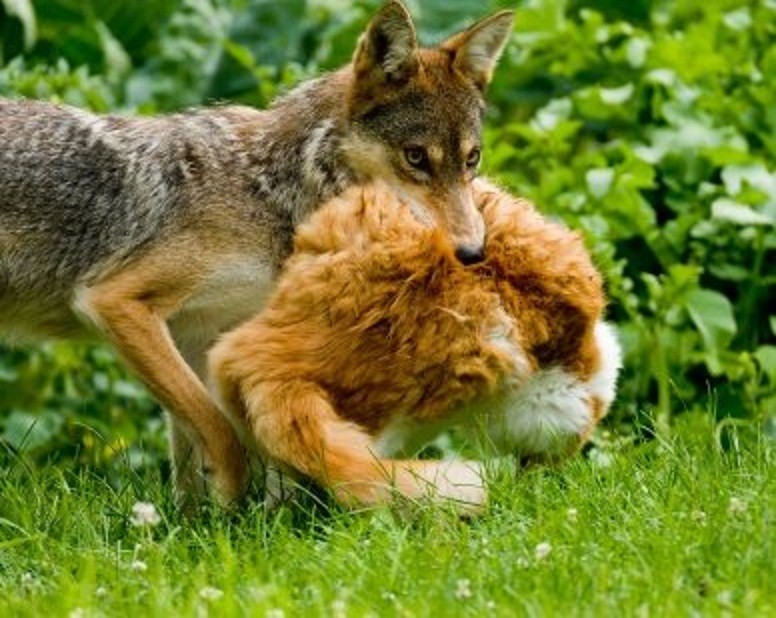
Why feral cats aren’t that much of a problem in coyote country

Of course, the coyotes don’t know if a cat is feral or owned.

All they know is cats are tasty and pretty easy to catch.

Read Full Post »

The dingoes ate the thylacines

Female mainland thylacines that were living during the Holocene (skull at far left) were much smaller than dingoes from the same time period (skull at far right). This size difference means that dingoes could be effective predators of female thylacines on the mainland and could have been a cause of their extinction.

Thylacines went extinct on the mainland of Australia before European colonization.

They were around on Tasmania up until the twentieth century.

After the Thylacoleo (“marsupial lion”) species became extinct some 40,000 to 50,000 years ago, the thylacines were the largest marsupial carnivores.

And the largest terrestrial predators in Australia. The saltwater crocodiles clearly had them licked, but outside of riparian and coastal areas and in the southern part of the continent, the thylacine was the top “dog.”

However, the reason why the thylacine disappeared from the mainland has been up to conjecture.

Several hypotheses have been propsed.  Almost all involve some discussion of the dingo’s arrival on the continent– a date that is not exactly clear in either the genetic or paleontology literature.

The initial hypothesis was that dingoes simply outcompeted thylacines. Dingoes hunted in packs, and what’s more, as variants of domestic dogs, they would have had a very close relationship with humans.

Pretty much every study about thylacines has made comparisons with those that were in Tasmania during historical times.

These thylacines weighed as much as 70 pounds, and because we have historical accounts a thylacin splitting the skulls of a bull terrier with its jaaws,  it assumes they would have been a match for even a pack of dingoes that included individuals that weighed 30 to 45 pounds. (There is, however, some recent recent research that suggest thylacines had structurally quite weak jaws, so they may not have been all that effective in a combat situation with a mid-sized dog).

However, this is a bit of an unfair comparison.

If one assumes that thylacines that on the mainland when dingoes arrived were exactly like the ones in Tasamania, then it becomes more difficult to see how dingoes could have dominated them. Only by allowing for the dingo’s advantages– such as its association with people, who were on the increase throughout the continent, and the dingo’s pack hunting behavior which allowed it access to wider variety of prey– can we see how a dingo would have dominated the thylacine on the mainland.

However,  a recent study was just published in PLoS One.  In this study, researchers examined the body and skull size thylacine and dingo remains from Nullarbor Plain and the southwestern part of Western Australia that were dated to the early Holocene.

The results revealed something amazing.

Dingoes of that time were quite a bit larger and heavier than mainland thylacine.  The researchers found:

The smallest thylacines were 19.2% and 28.2% smaller than the smallest dingoes in the Nullarbor and southwest, respectively. The largest dingoes were estimated to be 36.8% and 54.1% heavier than the smallest thylacines in the Nullarbor and southwest, respectively.

If thylacines on the mainland were typically that much smaller than dingoes, then they certainly would have been killed by dingoes.

Dingoes are derived from domestic dogs, which are derived from wolves, and we know that wolves kill jackals and coyotes where their ranges overlap.

In fact, canids  in general will kill predators that are smaller than themselves.  Red foxes kill arctic foxes. Coyotes kill red foxes.

Even today, dingoes are effective at controlling fox numbers in Australia.

So it is very possible that larger dingoes were killing thylacines.

The authors of the recent study suggest that the smaller thylacines were female, and unlike Tasmanian thylacines, these mainland individuals had significant sexual dimorphism.

If the dingoes could easily kill these smaller ones, then they were likely killing many female thylacines, and without females, the population could not be sustained.

Of course, the authors point out that all of these relationships were likely much more complex than can be concluded through simple morphological studies.

Dingoes, as feral and semi-domesticated dogs, were attached to people, and the time in which thylacines became extinct is associated with a population increase among indigenous Australians. Indigenous Australians were using fire to manage lands in order to create landscapes that were filled with prey species. They may have even been using the dingoes as hunting dogs, which would make it much easier for them to catch prey.

And if people were doing well, the dingoes likely were, too.  And if the dingoes were doing well, they could have been competing with thylacines for prey.

If their jaw structure meant that thylacines were reduced to preying on smaller animals, dingoes would have had an advantage.  They could hunt larger macropods that were out of the thylacine’s grasp, and they could very easily attack the same prey that thylacines were relying upon.

And if they were also killing thylacines, this would have been very bad for them.

After the extinction of the marsupial lions, the thylacine was the only predatory mammal of any size in Australia.

It evolved without competition.

Dingoes, as derivatives of domestic dogs that evolved from wolves, had derived from lineages that spent millions of years with lots of competition from other predators and very wily, recalcitrant prey.

The wolf had evolved pack-hunting behavior to deal with these challenges.

The thylacine, by all accounts, had not.

One way of interpreting the wolf’s success is that certain wolves evolved to have a relationship with humans. We call the descendants of these wolves domestic dogs. Dingoes are derivatives of domestic dogs, and virtually all accounts suggest that they had some sort of relationship with the indigenous people of Australia.

Thylacines had no relationships with anyone.

The cards were clearly stacked against the mainland thylacine when it went extinct.

Humans were changing the landscape through fire– which allowed human populations to increase.  But that same fire got rid of the forested habitat that thylacines preferred to use to ambush their prey.

And the success of humans also meant that the dingo’s numbers would increase.

And dingoes were much more efficient and generalized predators than thylacines were.

And the dingoes may have considered these mainland thylacines prey.

It was not a good situation for a predator that had spent so many thousands of years evolving without competitors.

And in this case, dingoes were an invasive species.

Over time, they became native, but not after being possibly implicated in the extinction of the mainland thylacine and Tasmanian devil.

It’s not a smoking gun, but dingoes certainly had the opportunity.


Read Full Post »

Labradors track down invasive Burmese pythons

Jake and Ivy are python-hunting Labrador retrievers.

Mark Derr sent me this link about some python tracking dogs in the Everglades:

The scenario sounds like a low-budget movie from the 1970s: humongous snakes are on the loose, eating everything in sight. But this is real – a problem that an American university and its canines are helping to combat.

Auburn researchers used detection dogs in the Everglades National Park to find Burmese pythons during a recent study on ways to manage and eradicate these non-native, invasive snakes, which are eating native wildlife, mostly mammals and birds.

‘The ultimate use for detection dogs is to suppress the expanding python population and to eliminate them in small areas, such as on an island. Our main concern is their impact on other wildlife,’ said Christina Romagosa of Auburn’s School of Forestry and Wildlife Sciences.

‘Interraction with humans is also a problem. The snakes, like alligators, can get in swimming pools, eat small dogs and cats, and could injure a human.’

Auburn worked last year with the Everglades Cooperative Invasive Species Management Area, or ECISMA, to test how well dogs could pinpoint the snakes’ locations so wildlife agencies could remove the snakes.

The problem started years ago, and was probably a result of irresponsible python owners.

***

Jake and Ivy, both black Labrador retrievers, helped the researchers capture 19 pythons, most between six and eight feet in length, including a pregnant one with 19 viable eggs. Burmese pythons in their native range in South East Asia have been known to reach up to 20 feet and weigh almost 200lb. The National Park Service has counted 1,825 Burmese pythons that have been caught in and around Everglades National Park since 2000.

‘We found the use of detection dogs to be a valuable addition to the current tools used to manage and control pythons,’ said Romagosa. ‘Dog search teams can cover more distance and can have higher accuracy rates in particular scenarios than human searchers. We suggest that dogs be used as a complement to current search and trapping methods.’

The Auburn study found that dogs and their sense of smell were two-and-a-half times faster than people visually searching, but people did have the advantage in extreme humidity. Searches by detection dogs are ideal in the cooler months, Romagosa says, when dogs can work longer periods of time without overheating. [A huge problem with any double-coated dog, especially a black one.]

‘Dogs can also be used throughout the year as part of a rapid response team going to a python sighting, which can be helpful in an urban as well as natural environment,’ she said.

The dogs are trained to ‘alert’, or sit down, when they got within five meters of a python.

‘When the dogs alerted to a python’s presence in the field, we would put them in the truck so they would not come in contact with it,’ trainer Bart Rogers said. ‘The dogs could even track pythons that had been present in the area hours earlier. They did not pay attention to ‘gators and other snakes, which would also avoid the dogs.’

Interestingly, the Labrador retrievers, which love to get wet, had to be trained not to go into the water.

‘They love the water but in the training we reward them for staying out of it,’ added Rogers. ‘We could train them to find pythons in water, but we are limited in that we couldn’t easily capture pythons if they are under water.’

The snakes found by the dogs have been sent to Skip Snow, a National Park Service biologist at the Everglades National Park. Some snakes were euthanized, some were tagged with radio telemetry devices for further study and tracking, and some were donated to the Nature Conservancy for use in training personnel how to catch snakes.

A driven retriever can be trained to find just about anything.

When I was a kid, my grandpa lost his wallet deer hunting.

My dad took one our dogs out and got her to fetch a wallet a few times.

Then he got my grandpa to throw the wallet a few times.

They went to the woods where my grandpa had been hunting, and she found the wallet, which had several hundred dollars in it, in less than 20 minutes.

If they can find wallets, they can find snakes!


Read Full Post »

Captive-reared New Zealand blue ducks released into a stoat-controlled region

From Stuff.co.nz:

The doors whip open and out they waddle, plunging into the rapids to test paddling skills before floating downstream to feed.

It is home time for eight whio, or blue ducks, more than three months after they were removed from their river-edge nests as eggs to be reared in Christchurch.

The nationally endangered species gets a helping hand around New Zealand, with efforts focused on eight “security sites”.

Yesterday was the fourth release of juvenile ducks at one of the West Coast sites – the Styx-Arahura-Taipo valleys near Hokitika – since the whio Operation Nest Egg project began there in 2006.

Intensive stoat trapping started in the area eight years ago to protect dwindling numbers of the rare waterfowl species, which prefers life in swift mountain streams and is endemic to New Zealand, with no close relative worldwide.

By 2004, only three breeding pairs remained in the Styx Valley, but the Solid Energy-sponsored project helped increase that to eight breeding pairs.

In September and October, eggs from two whio nests were removed from beside Doctor Creek, a Hokitika River tributary, helicoptered out of the mountains and driven by car to Christchurch to be incubated and reared at Peacock Springs Wildlife Park in Christchurch.

Curator Anne Richardson reared her demanding brood in enclosures over fast-flowing springs to ensure they developed good skills.

Yesterday, Press photographer Dave Hallett was thrilled to have the privilege of transporting the eight whio back to the West Coast.

“I’ve never driven that carefully in all my life,” he said.

“I was completely chuffed that the Department of Conservation had that much faith in me.”

Hallett, a bird enthusiast, followed the distinctive slate-blue birds from nest to release to document their progress, including capturing the surprising moment when one duckling hatched in Richardson’s hand only minutes after arrival at Peacock Springs.

Two of yesterday’s eight ducks, a pair, were freed near Greymouth, at the Moonlight Valley, to aid the Paparoa Wildlife Trust’s whio project.

The remaining six – three female and three male – were flown to the Styx Valley, a neighbouring valley to their birthplace.

Once common throughout New Zealand, now only about 2000 blue ducks remain, with the numbers of breeding pairs almost evenly split between the North and South islands.

The Conservation Department’s Hokitika biodiversity programme manager, Dave Eastwood, is “quietly optimistic” about the whio’s future, but also has fears.

“Rats and stoats are out of control. Even with trapping, they keep migrating into areas.”

New Zealand’s wildlife evolved without land-based mammalian predators.  New Zealand has native birds of prey, but it never had cats or mongooses or weasels or dogs or even rats running about until relatively recently.

New Zealand’s ground nesting birds, like these blue ducks, never evolved good nest hiding behavior, which makes them quite vulnerable to predators.

European rabbits and hares were introduced to New Zealand as game animals, and because they also did not suffer from any land-based predators, their population exploded.

Stoats were introduced to control the number of rabbits and hares, but that’s kind of like releasing lions into high crime areas to control gangs. Yeah, the lions will control the gangs a bit, but gangs are armed. The lions are much more likely to attack people who have nothing to do with the gangs.

The rabbits and hares in New Zealand descended from ancestors who had long suffered stoat predation and had evolved defenses against them. The stoats do kill some hares and rabbits, but not enough to significantly reduce their numbers.

However, the stoats do a much better job killing these native New Zealand birds, which evolved without any sort of land-based predators. They have virtually no defenses against them.

I don’t know how long these New Zealand conservationists can keep the stoats at bay.  They are going to have to be constantly trapping them in order to keep them under control.

And they aren’t going to trap all of them. Stoats are carnivorans and are quite intelligent animals. Some are craftier than others. These crafty ones will avoid traps, and they will pass on their craftiness to their offspring– both in terms of their genetics and what the mothers teach their young.

Eventually, the only stoats that are going to be in that region are those that are really trap-wise, and then I don’t know what they will do to control them.

It may be a losing battle in the end.

But it is worth the fight.

Because it’s the only option.

Read Full Post »

Errant serval mistaken for ocelot in Arizona

This serval was found wandering in southeastern Arizona. It was thought to be an ocelot. The ears gave it away.for me.

A supposed ocelot was photographed in southeastern Arizona. There have been at least two confirmed ocelots in Arizona. (And a jaguar has been spotted in Arizona, too.)

But this one was not an ocelot after all. It’s actually an introduced species that might even be able to colonize Arizona.

KOLD reports:

After further review, the Arizona Game and Fish Department said the reported rare sighting of an ocelot was another species of cat called a serval.

A serval is a popular African cat in the pet trade, the fish and game department said.

The Department uses a three-tiered classification system to rank reported sightings from the public based on the level of physical evidence available, the department said.

The presence of physical evidence such as scat, hair, tracks and/or photos and video can lead to a Class I designation of “verifiable” or “highly probable.”

A second-tier classification is one that lacks physical evidence, but is considered “probable” or “possible” because the sighting was made by an experienced or reliable observer that usually has wildlife or field experience.

The third tier classification is one that does not have sufficient physical evidence or sufficient details, or is otherwise of questionable reliability and would be considered “highly unlikely” or “rejected” as evidence for occurrence.

Friday’s report of an ocelot was classified as “highly probable” based on the photos and the paw prints taken at the location of the sighting. The officer responding was unable to locate the animal or retrieve additional physical evidence such as hair or scat.

Game and Fish shared the photographs with department biologists and other ocelot experts for an independent analysis. The effort helped definitively determine if it was an ocelot, hybrid or other large cat, as well as compare it to photos from previous sightings to determine if it is the same or a different animal from those sightings.

“Upon closer examination, some key identification markers make a stronger case for this being a serval, or serval hybrid rather than an ocelot,” said Eric Gardner, Nongame Branch Chief. “Although the pictures are blurry, two show that the animal has long ears, long legs, and appears to display only solid spots instead of the combination of solid spots and haloed rosettes seen on an ocelot.”

“This is a textbook example of why the Department attempts to makes such a clear distinction between a report of any rare wildlife sighting versus one with properly examined physical evidence. Positive identification by species experts or genetic analysis is required before any report is entered into our Heritage Data Management System as confirmed. It appears that this one may go down as ‘close but no cigar'” Gardner said.

There have been only two sightings of an ocelot in Arizona this year.

This animal is obviously not an ocelot. The ears gave it away for me.  But if you’ve never been to a nice cat house at a zoo, it’s hard for the average person to tell the difference. A spotted, somewhat larger cat with a long tail must be an ocelot.

Ocelots have rounded ears.

Ocelots also don’t have solid-colored spots, and their base color isn’t pale yellow.

Servals are very common on the pet market in the United States.

They are actually bred to domestic cats to produce a savannah cat– which I would call a savanna cat. Savannah is in Georgia.  The savannas are in Africa and northern South America. The serval lives in the savanna, but I suppose someone in Savannah could own a serval.

Servals couldn’t survive in the actual deserts of Arizona, but they could live near some of the larger river systems of the state.

Of course, you’d need more than one or two running loose in the wild for them to colonize, but servals are really common on the pet trade.

Arizona has pretty lax exotics laws, so servals could potentially colonize the state through escaping individuals or those that are turned loose when their owners decide they are too difficult to care for. This is also not the first serval to be found in Arizona. A three-legged serval was found wandering near Tucson in 2010.

If you think this sounds a bit far fetched, keep in mind that the only “wild” true antelopes in the United States are gemsbok, a type of oryx native to the Kalahari. They were intentionally introduced to New Mexico as a game species, and they have thrived.

I don’t think it is so crazy to think that servals might be able to develop self-sustaining colonies in parts of the United States. I’ve long thought that it would be just a matter of time before we had self-sustaining populations of Asian leopard cats, which, like the servals, are mainly kept to produce a hybrid with a domestic cat.  The Bengal cats that result from the cross have quite a following. (Most Bengals and savannahs on the pet market are usually more than a couple of generations removed from their wild cat ancestor. Fertility and temperament issues exist with the earlier generations.)

So Arizona is full of cats.

I am wondering how long until someone sees a jaguarundi, and after close inspection, it turns out to be a Burmese.


Read Full Post »

« Newer Posts - Older Posts »

Follow