Advertisements
Feeds:

Archive for May, 2009

Farley Mowat’s St. John’s Water Dog

Richard Wolters found the last two St. John's water dogs in Newfoundland. The breed was extinct by the early 1980's.

Richard Wolters found the last two St. John's water dogs in Newfoundland. The breed was extinct by the early 1980's.

As you may know, one of my favorite authors is Farley Mowat.  I normally hate romantic stories of any sort, but I like Mowat’s writing. Thus, I picked up Bay of Spirits, a memoir about  his courtship of his second wife along the rugged coast of Newfoundland, with more interest in Newfoundland than the actual central love story. I was reading along until I came across a mention of a dog:

Perhaps the most momentous event that winter was the aquisition of Albert, a young water dog from La Poille.  As big as a Labrador retriever,  he was a sway-backed creature, black as ebony except for his white chest, and equipped with webbed feet, the tail of an otter, and the attitude of a lord of the realm. He quickly became an integral member of our little family both ashore and afloat, where he demonstrated he was a proper seadog: sure-footed, ready for anything, and afraid of nothing.

Farley Mowat, Bay of Spirits: A Love Story p. 303.

If one takes a look at Albert’s photograph, which appears on that page, it is obvious that he was a St. John’s water dog. Indeed, when he was purchased in the 1960’s, his kind was beginning to die out.  The breed was  not nearly as numerous as it was in the eighteenth and nineteenth centuries. The Newfoundland government decided to promote sheep grazing and wool production in an attempt to diversify the economy in the 1880’s. In 1885, the Newfoundland Sheep Protection Act went into effect. This act placed a high tax on all dogs living on dogs living there. After all, dogs are major hazard to anyone raising sheep, and reducing dog numbers is an important way to promote sheep farming.

Of course, this act was terrible for the water dogs. The dogs were now an economic liability for the fisherman, and they soon began to disappear.  Those that survived were very often sent to the mother country, where they contributed to founding the modern Labrador retriever. However, that option soon dwindled as Britian imposed a quarantine on imported dogs. However, the Labrador bloodline was augmented with imports from Newfoundland as late as the 1940’s.

Why someone as enthralled with Newfoundland’s history as Farley Mowat didn’t try to save the water dog is a good question. It’s obvious from his writing that he loved Albert very much, and in Sea of Slaughter and The Farfarers: Before the Norse, the dogs are mentioned as being very much a part of Newfoundland’s “native fauna.”

The dogs went extinct in the early 80’s. Richard Wolters found the last two dogs, both brothers and of advanced years, on the island. They were 13 and 15 respectively, and they were last of their kind. Why someone didn’t breed them to Labradors or other retrievers to try to save them is beyond me. If I had found the last two St. John’s water dogs, I’d have them both bred to Labrador bitches. To me, this animal would have been too important to let go extinct. It is from this animal that all of our beloved retrievers descend.

This is one of those animals that we should have had more foresight to preserve. However, I regard the St. John’s water dog as a landrace, not a breed. It only survived as a working animal. I would hate it if the dog survived only so it could be paraded around as a cartoon version of itself in the show ring. If that were the only future for the St. John’s water dog, maybe extinction wasn’t such a bad thing.

The importation of this dog was a major boon to the development of retrievers, and their contribution cannot ever be underestimated. Their blood courses through the veins of my golden retrievers, providing them their aquatic natures and their webbed feet. When I read Mowat’s work, I can see him walking along a beach on the Newfoundland coast tossing a stick for Albert to retrieve, just as I once did with my working-type golden on those thickly forested wild ridges of my West Virginia youth. And maybe in that one sense I am connected to this writer’s work through our love of this old retrieving water dog. His  love coming from experience with the real thing, and mine coming from a red-golden descendant.

Some footage of Albert exists, although it’s only of his hindquarters and tail:

Source.

Update: Farley Mowat did try to save the St. John’s water dog. Albert was bred to a Labrador. Four puppies were born. Two dog puppies survived. One went to Prime Minister Trudeau and the other went to Premier Kosygin.

Advertisements

Read Full Post »

The Russian Tiger Dogs

The East Siberian laika is the main hunting dog for many people from Eastern Siberia to the Russian Far East.

The East Siberian laika is the main hunting dog for many people from Eastern Siberia to the Russian Far East.

A recent post on Forteanzoology blog showed some paintings of some dogs baying a tiger. The paintings are from the Edwardian period (1901-1910, the reign of Edward VII). The artist is Helen Fielding, and the setting is a forest near Blackpool in the north of England.

The two dogs baying the tiger look to be of the Nordic type.  To me, these look as out of place as the tiger. Common pets from the reign of Queen Victoria onwards were the Pomeranian and the Wolf Spitz or Keeshond. These  are Nordic breeds, but they have rather profuse hair. They both descend from the multipurpose spitz dogs of Central Europe, dogs I’m sure my ancestors knew well. These dogs often had herding instinct and were close relatives of the reindeer- herding spitzes of Russia, Finland, and Scandinavia.

These dogs have smoother coats than these “farm spitzes.” In fact, they make me think of dogs that were actually used to hunt tigers. Now, don’t assume that I’m talking about the tropical and subtropical races of tiger.  Think Russia.

Remember, there is a Russian subspecies of tiger. Its range now consists of frigid country in the Russian Far East near in the Amur-Ussuri region.  We often call this animal the Siberian tiger. It’s not really accurate, because the Russians themselves don’t call this region “Siberia.” That’s why I prefer to call it the Amur tiger.

However, there is some research that suggests that the extinct Caspian tiger is actually the same as the Amur tiger. However, neither species lived in what modern Russians call Siberia. So I’m going to call it the Amur tiger, because that’s the only place you can find them.

The cats once ranged down into Manchuria and the Korean Peninsula. Today, they live in the wilderness in this remote part of the Russian Far East and adjacent China.

In the old days, the tigers were hunted. Once they were considered a mortal threat to human life and enterprise, and the early Russian settlers killed scores of them. Then the Russians found they could sell their pelts. Later, they were deemed vermin by the Soviet government and killed by foresters. The Soviet government also exported their pelts, and the Chinese also bought their penises for what the Chinese consider a traditional viagra.

Later, the Soviet government decided to take endangerd species seriously, and they banned hunting them. When the Soviet Union collapsed and the economic went south, the people living in that part of the world began poaching them. The tigers are critically endangered.The Chinese use all sorts of tiger parts for their medicine, and because China is nearly devoid of tigers, the black market pays well for tiger parts.

Now, what does this have to do with dogs?

Well, I grew up during glastnost and perestroika, and we got tons of Soviet and Eastern bloc documentaries that were shown on television, usually mixed into English-language documentaries or re-dubbed with English narration. I remember one documentary about the “Siberian tiger.” There was footage of some  foresters hunting a tiger with dogs.

Here it is (at the beginning):

(The subtropical part of this area is on the Sea of Japan, before you ask. Again, I don’t call this area Siberia.)

The dogs hunting the tiger are very similar to the dogs baying the tiger in the painting.

These dogs are Laikas, specifically the one we call the East Siberian Laika, even though they can also be found in the Russian Far East. This breed is a relative of the more common Siberian husky, which is a sled dog. The two breeds come from a common stock. One was bred to hunt game. The other was bred to be a sled dog. The former is more like an Akita, while the other is more like a very independent golden retriever.

These dogs descend from a landrace dog that varies from region to region.  The sled-hauling dogs are different from the hunting dogs. Sled dogs can’t be aggressive with each other. The last thing you want is a dog fight in a sled dog team. The Siberian husky is derived from a particular strain of sled-hauling East Siberian Laika that was found along Anadyr River, which empties into the Bering Sea. During the Alaskan Gold Rush, the dogs were imported from across the Bering Sea, where they proved to be superior sled dogs. In fact, the Anadyr dogs were so fast compared to the North American Arctic sled d0g landrace, that the breed nearly replaced the dogs we call the Qimmiq and the Malamute.

The ones that hunt tigers have to very bold and a little aggressive. The tigers are well-known in this region as dog-killers. They consider dogs to be one of the best prey species they can find. So much do they like dog meat that they approach armed hunters just to prey upon the dogs walking with them. If you are hunting a 600 pound predator considers you to be delicacy, you have to be a little tougher than the average dog.

Now, I don’t know why the artist chose dogs of the laika-type to be the tiger hunters. Perhaps, she had heard of Russian or other northeast Asian people using dogs of this type to bay tigers. Maybe someone had imported a Siberian tiger dog to England, and she was able to purchase it.  I don’t know.

However, I find it very interesting that she chose that particular type of dog to bay the tiger. It has a some basis in reality.

Read Full Post »

A new species of lizard discovered at the Westfall farm

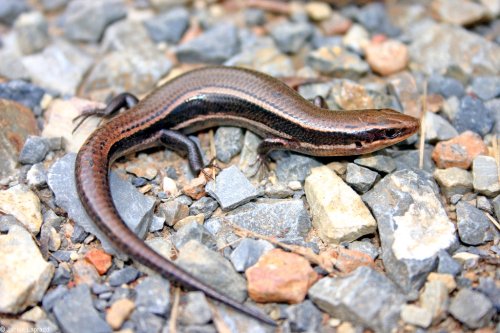
coal skink

Let me clarify some things here: the species isn’t new to science. But it is new to my native habitat.

It’s a northern coal skink. They normally are found in the higher elevations of West Virginia, but this one has found a nice home on a high ridgetop forest in the middle of the Allegheny Plateau.

I first thought it was the more common five-lined skink, but it was the wrong color and lacked the blue tail that is the trademark of that species.

So now we have three species of lizard on the farm, along with five species of snake, two species of turtle, seven species of salamander, and five species of frog.

Read Full Post »

The Northern Coal Skink

coal skink

Originally, we had only two species of lizard at the farm. Now we have three.

Yesterday, I saw what I thought was an unusually colored five-lined skink.

However, it was a bronze-colored lizard. Five-lined skinks are not bronze colored. You can actually count the five yellow lines going down their backs.

This lizard looked very like a five-lined skink but for its coloration.

I didn’t think anything of it until I caught a skink in the basement. It was also of this bronze coloration.

Then I knew I had something.

This species is new to my particular area. It is found more commonly in the higher elevations of West Virginia, but this particular farm is on some unusually high ridges in the unglaciated Allegheny Plateau.

So now we have three lizard species on the farm instead of two. The Northern fence lizards and the five-lined skinks had better make some room.

Read Full Post »

Some good music and political at that

Source.

About James McMurtry.

Read Full Post »

My new favorite show

He was doing a show bull sharks this week, hence my posts on them.

Read Full Post »

My new favorite show

He was doing  a show on bull sharks this week, hence my posts on them.

Read Full Post »

« Newer Posts - Older Posts »

%d bloggers like this: