As most of you guessed correctly, the big humped cattle-like beast from yesterday’s “ID the species” post is a Gaur (Bos gaurus). It is pronounced “gower” (with the “ow” pronounced like the word “cow.”) They are found in the tropical and subtropical forests of southern Asia.
It is the largest species of cow. Indian gaur bulls have been known to weigh more than 4,000 pounds.
It does hybridize with domestic cattle, for it is a close relative of both domestic cattle and the extinct aurochsen. If crossed with cattle, the hybrids are fertile, and it is suspected that gaur genes can be found in some zebu or indicus cattle breeds.
The gayal may is often considered a domestic form of gaur. However, it may have a significant amount of cattle ancestry.
I am going to do a post on the natural history and domestication of cattle in the next week, and this post should be a sign of things to come.
The Manchester (“black and tan”) and English white terriers were crosses between some sort of terrier and either a whippet or Italian greyhound. They were celebrated in the ratting pits, and they were popular pets for a time.
The English white terrier went extinct.
The Manchester breeds are still around.
I wonder if any of these dogs were crossed back into Italian greyhounds.
The ears on this dog seem to indicate a possible toy Manchester or toy white terrier ancestry.
Rachel Page Elliott was a very important person in golden retrievers in this country.
She provided a scientific analysis of dog gaits, something that had not yet been attempted.
Gait is very important for working conformation, for a dog with an inefficient gait cannot perform its purpose comfortably or without becoming exhausted.
I have her analysis of the proper movement for golden retrievers somewhere in one of my breed books.
She based a lot of her analysis off her dog, Goldwood Toby UD,. This dog was purchased in Minnesota to be working retriever on the coast of Maine. He was titled in obedience, but he was very much a working retriever.
***
I particularly like the footage of the two goldens eating out the same dish.
That’s actually how their temperament is supposed to be.
I must say that Marty Stouffer was my hero when I was growing up.
I used to get so excited when Wild Americacame PBS that I literally bounced off the walls.
Marty always used very elevated diction on this show, and I think this sort of rubbed off on me. I like big words.
***
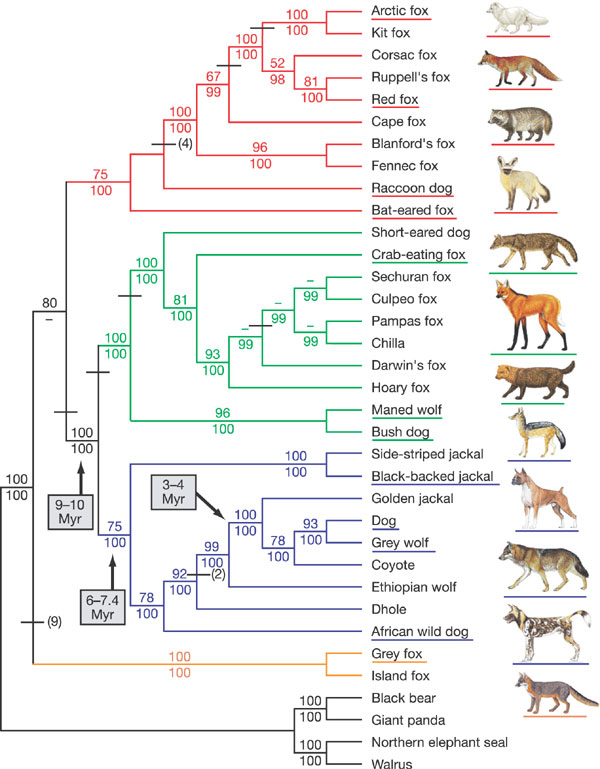
I am not sure exactly what a red wolf is, but it is a primitive form of wolf that has experienced significant hybridization with the coyote. Whether that primitive wolf is Canis edwardii or a derivative of some early form of Canis lupus I cannot say. I don’t think it is a coincidence that the red wolf looks a lot like an Indian wolf, which is considered the oldest extant subspecies of Canis lupus.
***
The red wolf is not the smallest wolf in the world. That title goes to the Arabian wolf.
But once there was an even smaller wolf. The Honshu wolf or Yamainu stood only about a foot at the shoulder and often weighed less than 20 pounds.
***
Red wolves have been reintroduced to the wild. In fact, the closest wild wolves to my present location are red wolves, which are running free at the Alligator River National Wildlife Refuge in Eastern North Carolina.
These wolves are free, but they are heavily managed. The big problem is that coyotes have shown up in that part of North Carolina, and the wolves and coyotes continue to interbreed. We spend a lot of time and money keeping coyotes out of that range.
***
I disagree with the Fish and Wildlife Service on some issues with the red wolf. I don’t think the native wolf to my location is the red wolf. It is more likely Canis lupus lycaon, which is another primitive wolf of some sort that has a significant amount of hybridization with the coyote.
The red wolf is strictly subtropical subspecies (or species).
***
The date for dog domestication is still up in the air. 15,000 years is the average estimate of when the dog phenotype began to take over the camp wolf population.
But it is likely that camp wolves were joining hunter-gatherer bands at least 40,000 years ago.