
From The American Naturalist, vol. 20, 1886:
Much more interesting for the purpose of our investigation here is the Otocyon lalandii, the spoon-dog of South Africa, so called from the peculiar formation of the skull. Its habits show an approximation to the foxes, yet as regards dentition it does not show this affinity, inasmuch as it possesses [unusual] molars, and also shows the most remarkable differences in the relative size of the single teeth. As already said, the spoon-dog is, in many ways and as regards dentition, shaped after the fashion of the dog type, and can thus scarcely be dragged out of this connection, and we are compelled to look upon it as a still existing primary form of dog. The whole palaeontology of the vertebrates shows that the many-toothedness of mammals is an inheritance from their lower ancestors, and that any increase of the teeth within a class has probably never taken place.
As our dogs, with their… molars, have no doubt been descended from fuller-toothed animals, Otocyon must be regarded as the still-living representative of the early type of dog, which in other characteristics shows more affinity to the fox genus. But as there also exist species of the group Canis asaree [Pampas fox] with very small frontal depressions, it is, as Huxley says, very difficult not to imagine that these too must be traced to ancestors of the Otocyon type. From this species, therefore, we should have to derive the two lines which diverge into the fox on the one hand, and the wolf on the other. We are supported in this view by the observation that the South American Canis cancrivorus [crab-eating fox] often possesses the fourth molar, and thus shows itself to be another remnant of the primary form. A fourth supernumerary molar of this kind is not a monstrosity or pathological phenomenon, but an atavism or reversion of the same sort as the socalled wolf’s tooth in horses, which was explained as a premolar which existed in the primary genus Anchitherium.
Hence the key to the derivation of all the dog tribe is to be found in their relation to the spoon-dog (pg. 372).
–Oscar Schmidt
The “spoon dog” is listed as the genus Otocyon (“ear dog”). The current scientific name is Otocyon megalotis, and the subspecies that is found is southern Africa is Otocyon megalotis megalotis. The discussion of the spoon dog’s skull shape and greater number of teeth could point to only the bat-eared fox as the species being discussed here.
The dentition is not necessarily indicative of this fox being like the ancestor of all dogs. We now know that this ancestor was Hesperocyon, which looked more like a gray fox/civet hybrid.
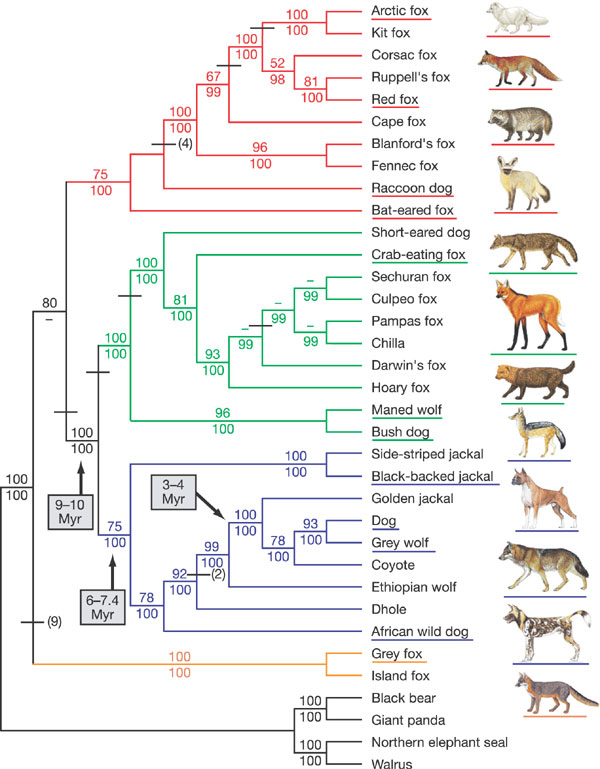
It is an older species of wild dog, but there is some debate on how old it is and where it fits in the dog family. For many years, the literature suggested that it was a basal canid. New genetic research suggests that it fits within the vulpine foxes within the dog phylogenetic tree.
They are not closely related to the two South American “foxes,” as that canid phylogenetic tree clearly shows. The South American “foxes” and other wild dogs are actually closely related to the true dogs, the genus Canis and its allies.
So the bat-eard fox is likely just a specialized species of vulpine fox.
The notion that having more teeth means that an animal is more primitive is really quite anti-Darwinian. Bat-eared foxes are specialized foxes that have adapted to live on mostly insects. They have more teeth, but those teeth are smaller. And they are designed to crunch bugs.
Other wild dogs have evolved teeth that are more in keeping with a carnivorous or mostly carnivorous diet.
Although I might have some reservations about Schmidt’s analysis, which is very out of date, I don’t have any problems with that name. “Spoon dog” sounds so much cooler than “bat-eared fox.”
I can imagine that zoos that display them would get a lot more attention if they were displaying “spoon dogs” instead of bat-eared foxes.
Spoon dog, spoon dog
I just like saying it.
It rolls off the tongue so much more nicely than “bat-eared fox.”





[…] The spoon dog Share this:TwitterFacebookRedditPrintDiggStumbleUponLinkedInEmailLike this:LikeBe the first to like this. […]
[…] English, this species has been called the spoon dog. It was so-named because its spoon-shaped […]