This time in the summer!

Posted in wild dogs, wildlife, tagged arctic fox, red fox on May 27, 2011 |
Posted in Taxonomy, wild dogs, wildlife, tagged arctic fox, hybrid fox, red fox on May 26, 2011 | 3 Comments »
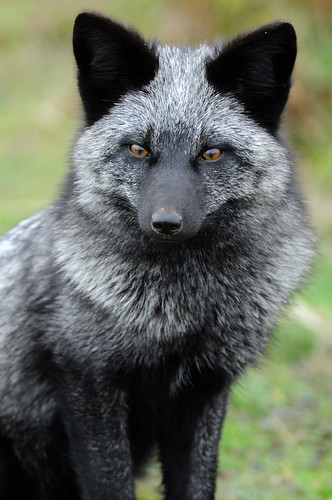
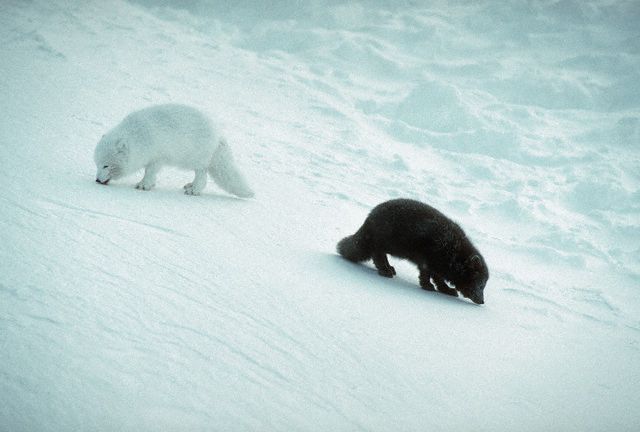
The most common phase for captive red foxes in captivity is the silver variety, and the most common phase for the arctic fox is the blue phase. Thus, most hybrids are silvery blue in color.

My guess is this is hybrid is the same phase combo, just in winter pelt.

However, the red fox in this hybrid was likely a cross fox-because it looks like a very freaky cross fox!

It could even almost pass for a swift fox, which is a very close relative of the arctic fox– a much closer relative to it than the red fox is.
Perhaps they could produce fertile offspring, for it is well established that a fertile hybrid zone existswhere kit foxes and swift foxes share territory in New Mexico. At one time, they were regarded as belonging to the same species, but it has since been determined that swift foxes and kit foxes are as genetically divergent as swift foxes are from arctic foxes. That means that the swift fox could produce fertile offspring with an arctic fox– but I doubt that anyone would try to do this breeding experiment.
I should note that because of their relationship to red foxes and swift and kit foxes, the arctic fox is no longer in its own genus. It is now in the genus Vulpes, with the vast majority of the other true foxes.
Posted in wild dogs, wildlife, tagged arctic fox, red fox on May 26, 2011 | 3 Comments »

These two foxes can hybridize and produce sterile offspring– in captive situations.
However, as far as I know, there have been no cases of red foxes mating with arctic foxes in the wild.
This is getting to be a bit of a problem for the arctic foxes, because as the arctic warms through climate change, the red foxes can more easily colonize arctic fox territory. And when the reds show up, they kill the little snow foxes.
Is is a bit of a shock to see such a cute little fox in the jaws of the fierce and cunning Reynard.
Posted in Identify the species on May 26, 2011 | 13 Comments »
This will be a good one!

There is also a reason why she has a litter, but all will be revealed soon.
Please leave your answers in the comments.
Posted in St. John's Water Dog, working dogs, tagged St. John's Water Dog on May 26, 2011 |

St. John’s water dogs were used to haul loada. Traditional accounts claim that only the Greater Newfoundland was used as draft animal, but in Bay of Spirits, Farley Mowat mentions how useful the “black water dogs” were in hauling loads of wood into the outports of Newfoundland in the late 50’s and early 60’s. In earlier years, vast numbers of the dogs were used to haul cod and other fish from the harbors to the salting plants.
In the later years of the breed, the dogs were not used for fishing. Instead, their utility was as draft animals and as “meat dog” retrievers. The people in the outports shot a lot of ptarmigan, ducks, and sea birds when they were not going to sea, and the dogs worked as blue-collar retrievers.
Don’t get caught up with the size. If you look closely, this dog is standing beside a child. The dog is probably no more than 80 or 85 pounds in weight.
Posted in Galliformes, Retriever history, wildlife, working dogs, working retrievers, tagged Bianchi's pheasant, black retriever, common pheasant, Dean Wolstenholme, pheasant, white-winged pheasant on May 25, 2011 | 3 Comments »
Painting by Dean Wolstenholme the Elder:

This dog is a good example of a purpose-bred mongrel retriever that lies at the base of every one of these breeds we call “retrievers” today.
It could have had anything in its ancestry. Collie or collie-type, St. John’s water dog, setter, some sort of water spaniel could all be in there. Even terrier or greyhound are possibilities.
This dog reminds me of Portuguese water dog with the “improper coat” or possibly a wetterhoun with a lighter build. Both of those dogs would fit this animal’s description. My guess is the dog got this tail from some English water spaniel strain that happened to have it– for it may be that the curled tail might be a distinguishing trait of the old water dog landrace.
This dog should not be called a flat-coated retriever, a wavy-coated retriever, a curly-coated retriever, or a Labrador. Those dogs, as we came to eventually know them, were established from the time period from the 1850’s to about 1900. Modern Labradors really don’t start to develop in their current form until the 1880’s, which is about the same time that the wavy-coat began its transformation into the modern flat-coat.
This dog is none of those things. It is an early purpose-bred mongrel retriever.
***
The pheasant the dog is retrieving is also of interest. It does not have the exact same coloration as a Caucasus-type common pheasant, which was of the type that was originally introduced to the British Isle.
Let me make some things clear. The common pheasant (Phasianus colchicus) is a widespread species of pheasant that originally ranged from Georgia to China and as far south as Pakistan and Vietnam. In the Caucasus type, the cockbirds have no ring on their necks. In the East Asian subspecies, the cockbirds have this ring– and are called ring-necked Pheasant. The cocks in Central and South Asian subspecies have white wings, and those in the Mongolian subspecies have both white wings and a white ring around their necks.
I think it is a white-winged type of common pheasant– either a purebred or one that has been mixed with more common “native” English stock.

Bianchi's pheasant is type of white-winged common pheasant that is native to Pakistan and Afghanistan.
The type of white-winged common pheasant found in Afghanistan or Pakistan is called Bianchi’s pheasant, and these would have worked their way into England via trade with the East India Company.
This particular bird would have been just what a shooting nobleman would want to have on his estate. “Look at this exotic thing from India! We’re shooting it! Aren’t we cool?”
It would have been a symbol of personal and national prestige– especially when one realizes its from relative early date. This was during the days in which the East India Company ran India (including what are now Bangladesh and Pakistan). The British Crown had not officially claimed India, as it would eventually do in 1858– following the Indian Mutiny. India was actually run by private corporation with private armies (Blackwater wasn’t the first to come up with this idea.) If this is a Bianchi’s or mongrel Bianchi’s, this painting would have been an early flaunting of British prestige in India.
I guess we’ll never know the full identity of the pheasant. We’d be much more likely to find out about the dog’s identity than that of the bird.
So both animals in this painting have rather interesting aspects.
An early purpose-bred mongrel retriever fetching a Bianchi’s pheasant. Amazing!
Posted in Uncategorized, wild dogs, wildlife, tagged Darwin's fox on May 25, 2011 | 3 Comments »

The red wolf controversy may be the best known of all canid taxonomy debates. Wolf taxonomy in general is quite contentious. Not only have “Eastern wolves” and “red wolves” been proposed as distinct species, some populations of the pallipes wolf in India and the some of the wolves of the Himalayas have, too. These two species were declared based upon mitchondrial DNA evidence. However, these animals are virtually indistinguishable from other pallipes wolves, which are the larger subspecies that is found from the Levant to the Indian subcontinent. It is likely a source for the domestic dog, and and the recent genome-wide study of wolf populations found that the Indian wolf fit within the Southwest Asian (SWA) group.
But wolves are unusually widespread and an unusually genetically diverse species. As a species, they are actually not endangered. They are merely endangered within certain parts of their range, and certain species, like the Mexican wolf, which has unjustly played second fiddle to the “red wolf” in North American wolf conservation circles, is quite endangered.
But what about a species whose range is confined only to a tiny archipelago and to an area that just happened to be declared a national park?
Such is the case of the Darwin’s fox (Lycalopex fulvipes) of Chile.
For decades its exact species status was highly contentious.
This fox is actually not a true fox at all. There are no true vulpine foxes in the whole of South America. What exists instead are various smaller canids that actually share closer evolutionary linkage to the true dogs in the genera Canis, Cuon, and Lycaon. Various genus names have been proposed for these “foxes,” including Pseudalopex, which means “false fox.” The current name is Lycalopex, which is a combination of the Greek words for wolf (“lycaon”) and fox (“alopex’). Literally, it means “wolf fox,” which is a much better reflection of their taxonomic status.
Everyone knew that the Darwin’s fox was one of these foxes, but whether it was a unique species or not was quite contentious.
Charles Darwin collected the first specimen in 1834, when he dispatched one on San Pedro Island in the Chiloé Archipelago.
He was able to make his kill by sneaking up on one and hitting it in the head with a geological hammer.
These foxes are quite opportunistic, and because they suffered very little predation on their island homeland, they became very unwary creatures. However, other species of South American “false fox” have these same traits; both the chilla (L. griseus) and the culpeo (L. culpaeus) have been known to beg for food from people in broad daylight. This trait was shared by the extinct Falkland Island’s wolf, which was thought to be one of these foxes, and one of the original genus names that was proposed for them was Dusicyon, meaning “foolish dog.” It’s very foolish to let an English seminary dropout sneak up on you and hit you with a hammer!
The scientific community eventually came to regard the Darwin’s fox as a subspecies the chilla. The chilla is sometimes called the South American gray fox, a name that should be dropped immediately for a very simple reason: the Urocyon gray fox of North and Central America also ranges into Colombia and Venezuela. The Urocyon gray fox isn’t a true fox either, but it is quite different from both South American foxes. It represents a unique evolutionary lineage of wild dog that is not closely related to any other extant species– even though it looks very similar to the vulpine or true foxes. (Its only other living relative is the other “fox” in the genus Urocyon, the island fox of the California’s Channel Islands (U. littoralis).
One of the reasons why it was regarded as subspecies of the chilla is that it was believed to be found only on the Chiloé Archipelago. Island subspecies are often quite different from their mainland forms, and the darker colored fox on the islands was believed to be nothing more than a variation of the lighter gray chilla.
This darker coat led to the discrediting of the the possibility that this fox was the same as the Chilla. In 1943, Wilfred Osgood thought the Darwin’s fox’s pelt was closer in terms of its color and characteristics to the Sechuran fox (L. sechurae) of the Peruvian and Ecuadorian deserts. In 1995, Christopher Yahnke confirmed this finding.
Around that same time, a dark colored population foxes that had been previous identified as chillas in Chile’s Nahuelbuta National Park on the Chilean mainland was determined to be the same thing as the Darwin’s foxes of the Chiloé. The fact that these two foxes were very similar suggested that the differences between the chilla and Darwin’s fox could not be ascribed to the peculiarities of unique insular evolution.
In 1996, Yahnke and Robert Wayne of UCLA compared mtDNA sequences from the Darwin’s foxes, the culpeos, and the chillas. It was instantly apparent that the mtDNA sequences of the Darwin’s fox were quite different from the chilla and the culpeo, which meant that the Darwin’s fox was truly a unique species after all.
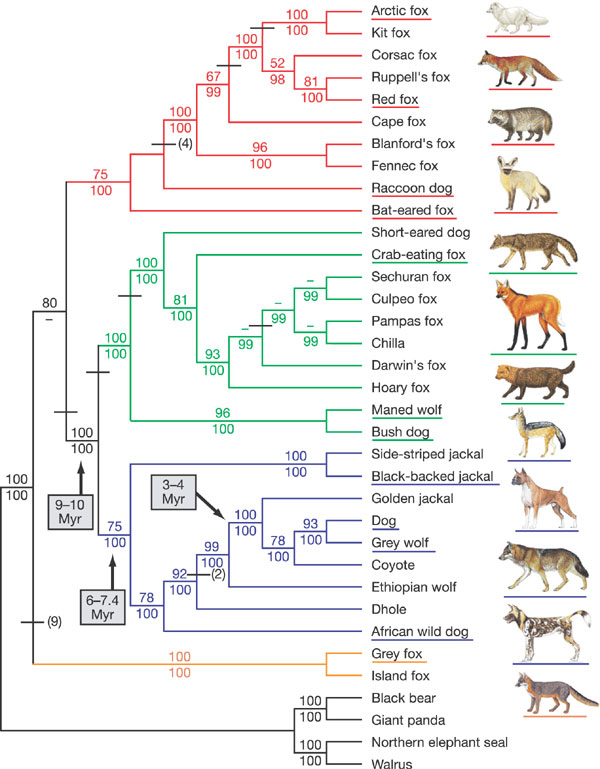
The exact location of the Darwin’s fox within the dog family was not fully established until 2005, when the dog genomic sequence was released. Using SNP analysis, the researchers were able to reconstruct the entire dog family phylogenetic tree. The Darwin’s fox was found to be an older species than all of the Lycalopex species, except the hoary fox of Brazil.
Thus, Darwin’s fox is the oldest species of “fox” in the Southern Cone. It likely was once quite widespread in this region, but it evolved to live in the temperate forests that once dominated the landscape. These forests have disappeared, both through the forces of various periods of climate change and human deforestation, leaving only a relict population on the mainland. The Nahuelbuta population consists of only around 50 individuals, while the insular population is about 200-250 foxes, so these unique wild dogs are quite critically endangered.
The story of the Darwin’s fox tells us how important it is to get taxonomy right.
If we had continued to assume that the Darwin’s fox was nothing more than a dark chilla, then it could have become extinct without anyone understanding exactly what it was.
It reminds me very much of the situation that exists with wolves. Because so much of the paradigms of the conservation and scientific community have wrapped themselves into the red wolf and Eastern wolf hypotheses, valuable resources have gone into trying to preserve proposed species that may not be unique at all.
Those resources could have gone into Mexican wolf conservation– and Mexican wolf reintroduction has had many problems. Right now, the Mexican wolf recovery program is on the chopping block. It could probably use some of the money and personnel that has already been allocated to the red wolf recovery program, which is mostly concerned with trapping coyotes in red wolf range– to keep the red wolf pure! Of course, it’s now been revealed through a genome-wide analysis that the red wolf is actually a coyote with some wolf ancestry. It just has a bit more wolf in it than the typical Northeastern coyote. Coyotes are not endangered anywhere.
But because we got the taxonomy wrong, we have spent all of this time, money, and effort into conserving the red wolf, instead of the Mexican wolf. Granted, the politics for red wolf reintroduction was better. That part of Eastern North Carolina in which red wolves were released is not major cattle or sheep farming country, but the regions where Mexican wolves were reintroduced are. Further, the actual habitat chosen for Mexican wolf reintroduction wasn’t ideal wolf territory either– and it may have been outside the Mexican wolf’s historic range.
From this analysis, it is now obvious that we should have been much more worried about Mexican wolves than the so-called red wolf.
It would have been a shame if we had not examined the Darwin’s fox’s genetics. Pelage color and morphological analysis take one only so far.
But you can’t argue with DNA.
The Darwin’s fox is an ancient South American “wolf fox” that is native to the Southern Cone, and now it’s now restricted to a very narrow range. It is a living fossil of sorts, a claim that was once made about the red wolf.
But the Darwin’s fox is the real McCoy.
« Newer Posts - Older Posts »


 | retrieverman on Rottweilers are not bulld… |
 | Earth Whisperer Cons… on World’s most notorious I… |
 | Jen Robinson on Rottweilers are not bulld… |
| Nuthatch working at… on Bird buffet | |
| retrieverman on Rottweilers are not bulld… |