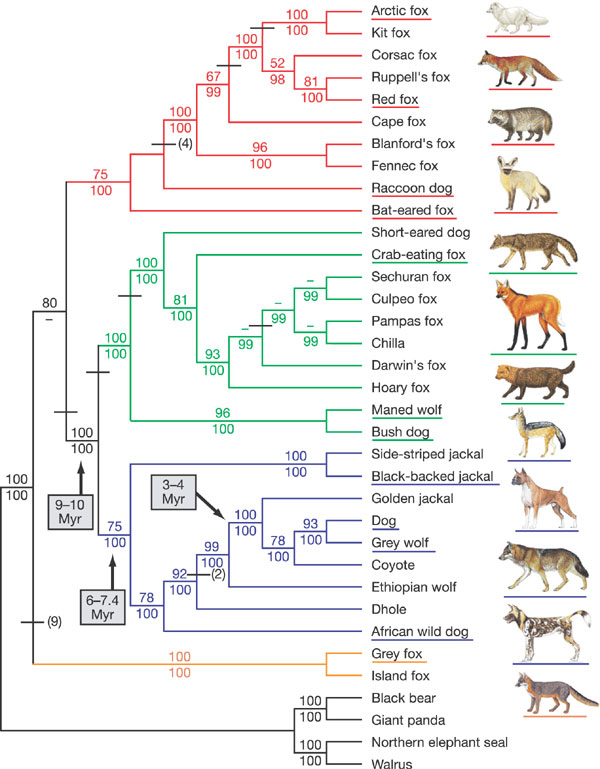
Kinda like coyotes.
Posted in working retrievers, tagged Nova Scotia Duck-Tolling Retriever on September 23, 2011 |
Posted in working dogs, working retrievers, tagged Nova Scotia Duck-Tolling Retriever, Patrick Burns, terrierman on September 23, 2011 | 10 Comments »
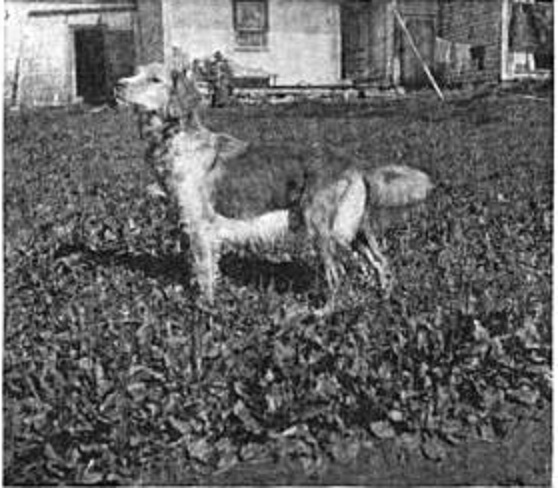
A typical tolling dog from Nova Scotia, 1917.
Now, after you’ve read the accounts of the English and Dutch decoy dogs from yesterday, I’m sure you want to know where Nova Scotia fits in all of this. Is there a connection between the Nova Scotia duck tolling retriever of today and the decoy dogs of England?
Well, it is difficult to make a direct connection, for the earliest confirmed attempt of a Nova Scotian breeding a dog for this purpose was by man named James Allen. The story goes that in 1860, James Allen of Yarmouth County, Nova Scotia, bred an English wavy-coated or flat-coated retriever bitch to a “Labrador-type dog .” Now, we know pretty clearly what a Labrador-type dog in that part of the world was– a St. John’s water dog. However, I don’t think the female wavy-coated retriever was exactly what everyone think she was.
She was said to have been purchased from an English schooner, which seems to be a weird place for a retriever to be. In those days, retrievers were owned almost exclusively by the gentry, and when a dog of the same genetic make-up and origin as a retriever was owned by a commoner, it was normally called a Newfoundland or Labrador. Further, if we are thinking that this dog was a member of the wavy and flat-coated type that Dr. Bond Moore and Sewallis Shirley were “improving” into a standardized breed, we might want to reconsider, for in the 1860’s through the 1890’s, the vast majority of wavy/flat-coated retrievers were large, heavily-boned creatures, like Zelstone or Paris. If the bitch were of the type the Paris or Zelstone represented, breeding her to a St. John’s water dog would produce puppies that looked a lot like St. John’s water dogs. Paris was said to have been entirely of St. John’s water dog ancestry, and it is well-known that Zelstone was primarily of that extraction. It wouldn’t have been an outcross at all, and it wouldn’t have produced smaller dogs.
This bitch was said to have been liver or red in color, depending upon your source. There were red and yellow wavy-coats at the time, but these were far from common.
It seems to me much more likely that she was an “English retriever,” a term that could have meant lots of things, not the least of which is that she could have been a “ginger ‘coy dog.” Such dogs would have been relatively common in England, and it is likely that some people were using them as retrievers. Perhaps the schooner that brought this bitch to Nova Scotia had brought her along with the hope of doing some duck and seabird hunting along the rocky coast. After all, egging and market hunting were common activities along the Maritime coasts, as was duck and sea bird hunting. A dog like this could have been brought along just fill the stores of the ship, which would be longing for fresh meat after the long voyage across the North Atlantic.
Yarmouth County is on the Bay of Fundy, which is an excellent fishing ground, and for its wide variance in tides. The people who lived there, like so many people in Atlantic Canada, were tied to the sea and to the land for survival. Hunting and fishing were not games. They meant life itself.
Perhaps James Allen heard from the ship that this little retriever was of a type that could toll in ducks. Maybe he didn’t believe at first, and then they showed him. And that may have been how he got the idea.
There is usually a discussion in these texts that the Nova Scotians discovered on their own that ducks could be enticed with a fox-like dog. Sometimes, a Native American group is suggested as a source for that information. The simple fact is that using decoy dogs to catch ducks would have been common knowledge throughout England, and the decoy dogs would have been common enough to have occasionally wound up in the Americas. It seems to me that the English would have been a source for this knowledge than the Nova Scotians, who themselves might have known about the technique before they left to settle in the Maritimes.
Allen and later other breeders began developing a strain of tolling dogs, using whatever they had available. Some say that cocker spaniels were used as the primary outcross, and that may be. However, the decoy dogs in England were often mixtures of spaniels and small collies, and it might be that some of these cocker spaniels were known decoy dogs or cocker/collie crosses. The fact that St. John’s water dogs were used in the outcross also would have also increased the size, as would the possible input of the traditional farm collie of Nova Scotia.
Whatever their exact origin, there was a defined strain of reddish-colored retrieving dog in Yarmouth County, Nova Scotia, by 1900. And contrary to what some wags might say, they were actually used to toll ducks into the gun.
I came across this account of a toller being worked in an issue of Forest and Stream which is dated to October 1917. The article includes an account of a man who gunned over these dogs in Nova Scotia. This is an account that “self-styled experts” who deny the history of this breed might not want to read. Tolling is real, and it is was used on both sides of the Atlantic. In Europe, it was used for decoy traps. In Nova Scotia, it was used for the gun.
The account begins with a story of a fox in Nova Scotia catching ducks in this manner, and it then goes into intimate detail how a tolling dog was used in Nova Scotia– by someone who actually did it!
The idea of tolling ducks came from the fact that the fox has been known for many years to possess the power to attract wildfowl by reason of his color and his movements along the shore, and many a fat duck has paid the penalty of his curiosity and furnished a meal for foxy old Reynard on the shores of our inland lakes. It was my delight and privilege to see a fox at work on one occasion. We were hunting moose near the Boundary Rock in Nova Scotia, and as our canoe turned a bend in the Coufang River, I saw directly ahead of us and in plain sight, four blackducks. Wondering why they did not fly at sight of us, I glanced ahead of them, and there on the top of a flat rock which projected into the water lay a fox with his nose between his paws Every second or so he would raise his brush and give it a flip from side to side. The ducks were swimming directly toward him intently watching that whitetipped tail, and not more than fifteen yards away from his waiting hungry jaws. Just then my hunting companion coming down the river in the canoe behind us, and catching sight of the fox, shot at him. The bullet from his Winchester hit the rock beneath him and spoiled what otherwise would have without a doubt ended in a little tragedy, and would have been a sight which very few have ever witnessed.
I have always felt perfectly certain that that fox would have carried away with him one of those four birds, a victim of curiosity. But what a transformation that bullet worked! Into the air went fox, ducks, and pieces of granite boulder, and my hunting companion remarked as he lowered his rifle between his knees, “I guess that rock was red hot, the way that fox took to the air.”
If you are a dog man, the first time you see a Tolling dog, your attention will at once be arrested, and after looking critically at them, you may remark—as hundreds have done before—what kind of dogs are those, Chesapeake Bays, or what? If time is no object, the answer will probably be that they are Tolling dogs, and when the explanation is forthcoming that they are used to toll ducks within range of the gun, your questions will come thick and fast, such as: Do they go in the water? —How far will ducks come to the dogs?— Do the dogs know they attract the birds? —Will they retrieve the birds you shoot?— But if time is limited, you would likely get the answer: Oh, they are duck dogs, or just dog, I guess.
We will suppose you are a duck shooter and are aso skeptical, and came from Missouri and want to be shown, and it is finally agreed that we repair to where we know ducks congregate. It is not yet daylight when we reach our “blind” on the edge of the sandy shore of the bay. This blind is one I have tolled many a fine shot from, and is composed of three or four old lobster pots, which have been cast ashore in the surf, and a few old roots ot trees—the whole covered with dead seaweed, and just large enough to conveniently hide us and the dog. Making ourselves as comfortable as possible, and pulling our coat collars up and our wool caps well down (for the month is December and terribly cold, the lakes are frozen and the ducks are now in their winter feeding grounds), you turn your head and see the yellow flicker of a lamp through the kitchen window in the farmhouse across the great salt marsh behind us, where we enjoyed the warmth from the big wood stove an hour ago, as our breakfast of fresh eggs and biscuit, washed down with steaming tea, was eaten, and you half wish yourself back there again. It is “star calm,” not a breath of air and very frosty. Our dog is curled up tight, his nose covered by his fox-like tail, and he is the only one of us three who is comfortably warm. But just listen to those blackducks as their trembling quack reaches us from out there in the bay! Buff hears them, too, and quick as lightning his ears prick as he raises his head. If you touch him now you will feel him trembling, but not with cold, only suppressed excitement. And now the east begins to pale, and presently objects are dimly discernible. Those old stake butts out there stuck up through the sand look like a flock of geese, while in the gray light the bridge spanning the North Creek looms up like a church spire. We hear the winnow of wings as ducks fly from the salt creeks where they have spent the night, and as they join their companions in the bay in front of us they create quite a commotion among them.
Presently we see a black line on the glassy surface of the water, which slowly develops into a flock of twenty birds or more. The tide is almost up to our blind this morning, and everything seems to favor us. The ducks are now in plain sight—foxy old beggars. Some of them know the danger zone of this shore from years of constant persecution. About two hundred yards away they flap their wings and preen their feathers as the rising sun begins to warm them, and now I guess we will “show the dog.” Reaching into the back pocket of my hunting coat, I pull out a hard rubber ball. Just look at Buff, who has been watching my every movement; see the pupils of his eyes dilate as he spies the ball! Did you ever see such concentration as he watches that sphere of rubber! Next to his master it is the dearest thing on earth to him. One bounce of it upon the kitchen floor will lure him from the finest dish of roast beef scraps and gravy without a moment’s hesitation.
I can divine your thoughts without much study now. You are thinking “what a shame to scare those ducks” and that perhaps they may come on shore again as the tide begins to fall, and you cannot help feeling certain that every duck will “jump” as soon as he sees the dog. But wait, you watch the ducks, and whatever you do, don’t shoot until I give the word, for it is the sure ruination of a Tolling dog to shoot over him while he is outside the blind. If you do so, your dog will soon want the first shot himself, and when the birds come close, he is likely to plunge in after them without waiting for the gun.
Patches of sand stretch out upon each side of us and afford a footing for the dog, and we can play him from either side of the blind. I toss the ball and away goes Buff; picking it up, he canters back and drops it in my hand. Out again, go ball and dog. I watch your face and it is a study, as through the “peekhole” in the seaweed you anxiously watch the birds and this is what you see: With stretched necks and wondering eyes, every duck looks intently at the dog, and as the ball falls in among some dead seaweed, causing him to use his nose to find it, his bushy red tail works and wiggles above the beach grass, and a dozen birds turn and swim for shore, their necks a second ago stretched so long now folded in, and with soft meamp-amp, meamp they swim rapidly toward us with just a gentle breath of wind behind them. Buff plays beautifully, returning with the ball even faster than he romps after it. How round the birds look with their necks drawn in, giving them a stupid appearance, and the sunlight shimmering from the yellow bills of the drakes. Now as the dog comes near us again, the hot scent of duck strikes his sensitive nostrils; and stopping with upraised paw, he looks toward them, but a chirp brings him back to us. Not for worlds would he refuse to “play.” See him tremble as we push up the safeties of our guns. Here are the birds right against us, though not well bunched, being strung out across our front. They are only thirty-five yards or so away when Buff drops the ball into my open palm for the last time, and I whisper “Down.” Now there is one of two things to do, we may either rise up and shoot, picking out our birds and trying to stop one with each barrel, or remain quiet until the ducks begin to get uneasy, and not seeing the dog, start to swim away, when they will invariably bunch.
If you can forget the freezing nights and blustery days when you have almost perished waiting for a shot, or perhaps the long crawls through slush or mud when trying to stalk these wariest of all their kind, then let us each try and make a double and be satisfied. But if you have only occasionally had a flock shot and would like one now, let us hold our fire, which we decide to do. See that old drake stretch his neck and swim up and down, looking with the keenest of all eyes, and turning slowly from us; the birds swim together, their heads turned sideways, looking over their shoulders at the blind. I nod, and the two pairs of 12-bore barrels poke out above the fringe of seaweed of the blind. As we raise to shoot, Buff peers over the blind beside me. With a whimper and stiffened sinews he awaits the report. Both shots snap out as one, and into the air seven terrified birds spring straight up. three of their number falling to our second barrels. There are two cripples, one of which swims about in little circles, shot through the head in front of the eyes, and wading off as far as hip boots will allow, we each kill our bird.
Buff by this time has almost reached the nearest drifting victims. Watch him swim! There is only one breed of dog could catch him now, and that the Tolling dog. No need to tell him to retrieve. Dropping his bird on the sand he plunges in again and again until the eighth and last duck is safely recovered. Buff takes a roll in the sand and a shake, and trotting up to me, rubs against my leg, and while he looks up into my face, I stroke his wet hair—wet only on the outside, for no water ever penetrates to the skin through that otter coat —and if he and I were alone I would take his honest head between my hands and whisper in his ear, “Good boy,” while with a funny little growl in his throat he would say in his own way, “We did the trick.” He always looks for this following a successful toll.
***
It is well known that ducks will not toll to windward. They will come to the dog across wind, from the windward, and also when there is no wind. Blackducks toll with their heads drawn down, bluebills with their heads up and necks stuck out. butterballs on their tails almost, and all the mergansers with heads erect and necks straight up. Perhaps the Tolling dog is most deadly when shooting ducks before they leave the lakes in the fall, and when the birds are young. I have seen young blackducks swim so near the blind that their pads could be distinctly seen beneath the water. Bluebills are said to be the easiest of all birds to toll, but although I have had many fine shots at them in this manner, my personal experience teaches me that the blackduck tolls the best, and I have seen wary old birds in the month of January act like perfect fools at sight of a well-played dog. They seem to be hypnotized, and when once their gaze has become centered upon the dog, will scarcely notice moving objects.
It is as natural for a Tolling dog to retrieve and play with a stick or other object thrown as it is for a setter to point, or a coach dog to follow a team. Most duck shooters use a stick to toll their dogs with, and some a lot of sticks, but the properly trained dog needs but one object to work upon (pg. 463, 490-492).
So the story of the Nova Scotia duck-tolling retriever is exactly as is commonly stated. This is a beautifully written account of how the dog would toll in the ducks from the water, which is not the way ducks are normally hunted. Normal duck-hunters call in the ducks with calls that are designed to bring in the birds on the wing.
With the tolling dog, the ducks come in on the water, and then they are shot. This works almost exactly the same way that the decoy dogs enticed the ducks into the the elaborate traps in England. It’s just they aren’t being led down a pipe. The dog in this case is leading the ducks to the duck blind.
Now, I do know that this whole story sounds like malarkey.
But seeing as this account is by someone who did it– probably many times– I think we can assume that this is exactly how tollers were used.
See earlier post:
Posted in dog breeds, dog domestication, golden retriever, working dogs, tagged German shepherd dog, golden retriever, Hovawart, Raymond Coppinger, Shiloh Shepherd on September 22, 2011 | 10 Comments »
One of the most important aspects of the Coppinger model for dog domestication and, as a corollary, dog behavior is that physical appearance is intimately linked to behavior. The fox farm experiment on which he bases much of the model is that spots and floppy ears are hallmarks of domestication, and if we take a look at modern dogs, those that look the most like adult wolves will be more aggressive and wild and those that are most juvenilized in appearance will be more docile and trainable.
In a section in which he discusses aggressive behavior, he makes a rather interesting, though I think quite flawed, suggestion. The breed in question is the German shepherd dog, which is often used for protection. If we were to breed out the aggression in German shepherd dogs, how would we do it? Well, Coppinger has a solution.

So to breed aggression out German shepherds, we should just try to breed them to be like yellow Labs?
Well, not so fast.
I will provide two examples of two different sets of breeds to show you how this is not case.
Here are your first pair of dogs:

125-pound golden retriever from North American pet lines.

Blond hovawart.
These two dogs look like they could be litter mates.
However, let me ask you another question: Say that you’re a burglar, and you want to break into a house that has one of these dogs in it? Which do want to burgle?
You want to burgle the house with the 125-pound golden retriever. The hovawart will tear you up.
Hovawarts are a recreation of a German estate and farm guard dog that was common in the Black Forest. It was recreated with a lot of German shepherd blood, and the dogs behave more like German shepherds than the golden retriever that they superficially resemble. Hovawarts also come in black and tan and solid black colors, but the blonds really look like golden retrievers.
If Coppinger thinks the way one breeds aggression out of German shepherds is to breed them to look like Labradors, these particular breeds suggest otherwise. Here are two breeds that look very similar to each other, but they behave very differently. The recreated Hovawart is said to have some Newfoundland in it, which might account for some the superficial similarities. Golden retrievers and Newfoundlands do share a recent common ancestry.
( I should note that the golden retrievers in Germany rarely approach the size of the North American pet dogs, so it’s actually very easy to tell German golden retrievers from hovawarts, which are very common as pets.)
Now, someone did breed the aggression out of German shepherds.
This is a run of the mill German shepherd dog:

A typical German shepherd dog.
Here’s a strain of shepherd that has had most of the aggression bred out of it.

Shiloh shepherd. This breed is derived from German shepherd dogs that have been selected to be docile and gentle.
The Shiloh shepherd is derived from the German shepherd, but it has been selected to be very docile and gentle. The strain was founded in the 1970’s, and the breed is almost entirely German shepherd dog in ancestry. It has just been selected to be more gentle than the typical German shepherd, and unlike the more typical German shepherd, they are not generally considered suitable for schutzhund or protection dog work.
Notice something?
These dogs look nothing like yellow Labs, but they are closer to Labradors in temperament than the typical German shepherd dog.
Both of these pairs of dogs strongly suggest that one cannot tell the temperament of a dog by looking at it. Just because a fox has spots doesn’t mean that it’s genetically tame, just as the appearance of the dog doesn’t always indicate what the temperament should be.
Posted in wildlife on September 22, 2011 | 3 Comments »
Posted in Retriever history, working dogs, working retrievers, tagged decoy dogs, duck trap, Dutch Decoy dog, English decoy dog, Kooikerhondje, Nacton Decoy, Nova Scotia Duck-Tolling Retriever, trapping ducks on September 22, 2011 | 20 Comments »
This is Heidi, the decoy dog at the Nacton Decoy in Suffolk. These images appear in Bill Tarrant’s Hey Pup, Fetch It Up!: The Complete Retriever Training Book (1993). She appears to have been a spaniel/collie-type cross, but she vaguely resembled a Nova Scotia duck-tolling retriever.


In this book, there are photos of her actually tolling the ducks into the trap. These photos, I would think, should put to death the notion that this is somehow a made up claim. The English, the Dutch, and the Nova Scotians would not have used dogs to bring entice ducks into traps or to the gun if it didn’t work. It sounds fanciful that ducks would be attracted to a dog, but it is a behavior that has been observed many times. Why would these elaborate traps, which are called decoys, have ever been built and maintained if the dogs were not of great use in bringing the ducks in?
Why does it work? Tarrant had no clue, nor did Sir Peter Scott, the renowned British ornithologist and waterfowl conservationist, who had a very close relationship with the Nacton Decoy. At the time Tarrant was documenting the decoy, Scott’s Wildfowl Trust was operating it. Although Scott was into the Loch Ness monster, this particular zoological phenomenon was and is well-documented. Ducks will follow a dog for some unknown reason.
That last paragraph is probably key to how this behavior works.
Most predators rely upon surprise to catch their prey, and if we are talking about a terrestrial predator trying to catch a bird, surprise is very important. If a fox knows the duck see it, it is less likely to try to stalk them. If the fox is seen before it launches an attack, the ducks merely take to the sky, where no fox can follow.
The reaction of ducks to dogs was first discovered in the Netherlands, where it was later introduced to England:
If the decoy dog had been known to Caius he would have included it with delight in his list of bird-taking dogs. But though he mentions the ‘subtlety’ of ducks, and that the water- spaniel, of which he gives an accurate description, was used to retrieve them when wounded, he says nothing of the more artful devices of the decoy-man’s dog. He notes that the water-spaniel was especially useful for fetching back arrows which had been shot at water-birds and were floating, and that the dogs were so clever that they often picked up other people’s lost arrows and brought them as well as their masters’ arrows.
It is clear from this that decoys were not known at all as early as that, and that the belief that they were a late introduction from Holland is correct. The decoy dog’s business is to run in and out of the screens which lead to the pipe, and so to induce the ducks to follow him. A mistake or momentary disobedience by the dog might lose the best ‘ take’ of the season, yet so intelligent and well trained are these dogs that they practically never do wrong.
–C.J. Cornish, “Dogs That Earn Their Living” in The Cornhill Magazine (1900).
The Dutch decoy dog has become a standardized breed, but the English decoy dogs were always considered mongrels. Randomly-bred dogs of various types were used in the decoys. Heidi actually looks like something between a Nova Scotia duck-tolling retriver and a Kooikerhondje, but she came “from the dog catcher.” Other decoy dogs from Nacton were quite different from Heidi. The point was that the dog should be reddish in color and have a bushy tail. It could be of any ancestry, just so long as it was biddable and playful.
Dog historian Col. David Hancock, M.B.E., shows that such dogs could be used to draw ducks into the gun, and that hunters using guns didn’t have to use small red dogs to do so. He points out that even a large dog like a golden retriever could be used to toll ducks in.
Some wildfowlers [duck hunters] hunting the open shoreline have used decoy dogs to lure ducks within shooting range by throwing sticks for the dog to retrieve and arousing the natural curiosity of the birds. The skill of the hunter lies in throwing the stick for the dog the right distance at the right moment so the ducks aren’t frightened away by the menace of an advancing dog, but made curious by the enticing waving of its bushy tail. The dog makes a normal retrieve of the stick, but does so in a playful manner with plenty of tail wagging. This decoy dog does not entice the birds by deliberately frolicking about, as foxes have been seen to, but is used essentially as a retriever of sticks. However, this playful retrieve does lure the duck within range of the hunter’s gun.
I see many resemblances to the Golden Retriever in the Canadian decoy dog, both in their sunny nature and their perpetually waving tails. A Golden was quite recently used as a decoy dog in East Anglia, charming many visitors. So the next time you throw a stick for your Golden Retriever, you may be re-enacting the role for which the dog’s ancestors were greatly valued, not merely idling away time and providing exercise. We may not, in these sophisticated times, need all of the wide-ranging skills of our dogs, but each must be exercised and we should honour their innate desire to be active, their instinctive interest in hunting and their inherent talent for serving mankind.
Hancock points out that decoy dogs were about the only way commoners, who didn’t have ready access to firearms, would have been able to procure ducks for the table. These traps were so effective that they essentially fed consumer demand for wild duck meat for centuries.
The skill of the decoy dog lies in giving the inquisitive ducks only fleeting and seemingly tantalizing glimpses of its progress – usually its tail’s progress – through the reeds and undergrowth. The decoy dog takes great care never to give the ducks cause for suspicion. Before the use of firearms and indeed when their range was very limited, these dogs must have been enormously valuable to duck hunters. For the humbler hunters, they likely represented the difference between eating or starving. In the 19th century, just 10 decoys around Wainfleet produced 31,200 head in one season, mostly for the London markets.
***
At the end of the 19th century, “ginger ’coy dogs” were frequently seen alongside the Lurchers in gypsy camps, especially in East Anglia. James Wentworth Day, the celebrated country sports writer, refers to them in his 1938 The Dog in Sport, linking them with the ‘Fen Tigers,’ the rough countrymen who cut sedge and dug peat from the Fens and were skilled wildfowlers. In his mammoth “ultimate dictionary of over 1,000 dog breeds,” Desmond Morris describes the Red Decoy Dog as a small rufous dog employed to lure wildfowl into nets. He suggests that their behaviour in doing so was modelled on comparable behaviour in foxes.
Because no pedigree breed in this mould has been handed down to us, very few contemporary references are made to these gifted and once invaluable dogs. Rather, as with ancient water dogs, they are rarely acknowledged in the histories of our gun-dog breeds. Both decoy dogs and water dogs were usually handled by humbler hunters such as farm labourers and gypsies. Very little has been written about them.
This type of commoner would have been exactly the same sort of person who would have settled in British colonies, like Nova Scotia.
Although we tend to think of Nova Scotia as being settled by Scots, there were plenty of English settlers. Some of these people were likely wild poachers, who just decided to leave England for the wild country across the Atlantic. Perhaps they were threatened with transport to Australia. Perhaps they just wanted to go some place and live off the land. But this demographic is exactly the same type of person that wound up settling in North America– and doing well. It is likely that these dogs were part of the market culture in Nova Scotia, which was big up and down the East Coast of North America.
It doesn’t take much imagination or logic to see how these decoy dogs could have founded the Nova Scotia duck tolling retriever.
One of the reasons why tolling is not normally used to shoot ducks is that the ducks come swimming toward the dog. It is generally considered unsportsmanlike. Shooting into a body of water is also illegal in many places. However, market and subsistence hunters probably won’t have that same moral or legal restrictions.
So a tolling dog would have definitely been of use.
If this behavior is well-established and has been observed by true experts, like Bill Tarrant, Desmond Morris, and Sir Peter Scott, we might conclude that a Nova Scotia duck-tolling retriever is exactly what its name implies. One does not base hunting strategies, including ones that are this successful, upon on mythology.
So although the use of dogs to decoy ducks sounds fanciful, it is real.
And in the Netherlands, kooikerhondje are still being used for this purpose, regardless of what the “self-styled experts” say.
Posted in creationism, tagged creationism, marsupials, Noah's ark, young earth creationism on September 21, 2011 | 12 Comments »

Thylacoleo carnifex, the "marsupial lion," is just a big cat with a pouch, according to creationists. And I guess Sylvester was right-- the kangaroo is just a giant mouse with a pouch!
One big problem that creationists have is biogeography.
If all animal life on earth is derived from animals that were on the Noah’s Ark, why is it that the place where it went aground, supposedly Mt. Ararat, Turkey, isn’t the greatest biodiversity hot spot? This mountain would have been the place where all life would have begun to repopulate the earth, and it is likely that more species would be found near the point of origin than places thousands of miles away– like Brazil, a place Noah never even heard of!
The other big problem is that there are no marsupials in Mesopotamia. Most marsupials are in Australia, and many are in Central and South America. And there is one species that is found north of the Rio Grande in North America. If these animals were on the Ark, why didn’t they populate any place outside of Australia or the Americas?
Well, the creationists thought this one through.
Remember, creationists usually claim that Noah didn’t actually have one of every species on the Ark. That would be too silly. How could Noah have put that many species on a boat? No. Noah put two of every “kind.” A kind is deliberately nebulous term, but in an essence, it is not a species. It includes like species, but unlike other taxonomic groupings, like species or genera or order or kingdom, there are no levels of a kind. It can group together whatever species it wants. It is entirely up to the creationist to group species into kinds.
And that’s exactly how they deal with the marsupial problem.
On the site Revolution Against Evolution, an author named Robert Byers groups together the placentals with the marsupials that look like them into the same kind. The marsupial traits are just adaptations that “evolved” after the flood. Remember, creationists often believe in evolution within kinds, but a kind can’t become something else. Byers explains how this works:
Creation theory has an equal and even more plausible explanation for the seeming anomaly marsupial concentration and exclusivity of Australia in the present and past as indicated by the fossil record. In addition, an equal and also more plausible explanation exists for similar animal groupings in the past, shown in the fossil record, who looked similar to present and past creatures elsewhere but said to be unrelated by modern science. This second matter is not so well known by the public and even well-read creationists.
Present evolutionary biology and palaeontology contends that over great lengths of time natural selection brought about same kind of creatures at different times on different parts of the world from totally unrelated non descript rodent like creatures. These include bear, dog, cat, horse, and elephant shaped creatures with no biological relation whatsoever evolved in numerous places around the world from different ancestral tiny creatures. They call it called convergent evolution. This is a great theme in evolutionary biology.
Creationists can confidently present a better argument than before for the suitability of present and past animal distribution based on a model accepting the Biblical flood and its aftermath animal dispersal.
The fossil record shows same shaped creatures in different areas of the world with minor differences. These creatures while shaped like other creatures in the world have minor similarities to each other in each particular area that they live in. And so a bear and cat shaped creature would have a similar ear bone arrangement or foot arrangement in that area. And while evolution will say that the ear or foot arrangement indicates common ancestry, creation theory can on contrary contend these creatures are just bears and cats the same as elsewhere who due to some influence in the area, adapted some minor ear or foot arrangement. All bear and cat creatures descended from the pairs from the Ark.
This all leads to the seeming anomaly of Australia with its exclusive marsupial fauna. Australia is not an aberrant anomaly but rather a revelation of the true story or equation of post flood animal migration and adaptation.
These minor similarities of marsupials and bone structures in the creatures of Australia are irrelevant as to their origin and ancestral relationship. The origin and relationship of these creatures is the same as all creatures similarly shaped elsewhere on the earth now or in the past. Marsupial dogs and cats are the same kinds as regular dogs and cats, and likewise related to dogs and cats (in the fossil record but now extinct) also with minor regional body differences that lived in certain places on earth.
Only the marsupial mole, same as the placental mole elsewhere hints at the common adaptations after the flood.
The marsupial creatures of Australia are the absolute same ones as elsewhere that filled the earth after the flood. The same body type is the evidence of ancestry and not minor matters as reproduction. The present attempt of science to group animals and their relationships by reproduction methods or minor bone structures has been the error of modern evolutionary biology and palaeontology.
To the organized creationist community I make this contribution believing that it is true. Yet also believing a previous problem can be turned into an exciting example to creationists, Christians, and the scientific world how faith in the accuracy of the Bible and study of what data there is can place creation theory in the forefront and eye to eye with the truth of origins with anybody.
Now. This is about as valid as the old Sylvester cartoons in which he encounters a baby kangaroo while out mousing. Sylvester then assumes he’s come across the largest mouse in the world.
The insanity of this statement really is amazing.
Yes. There are marsupials that look like placentals. The marsupial moles look like placental golden moles. And the thylacine looked like a species of wild dog, even though it behaved more like a cat and was restricted to hunting much smaller prey than a similar-sized placental wild dog.
But to say that the thylacine was the same kind as the dogs in the order Carnivora totally denudes the concept of kind. Genetic evidence, which another big problem for creationists, clearly shows that placental mammals and marsupials split a very long time ago. The current thinking is that placentals and marsupials diverged 160-180 million years ago. That’s a long time ago.
If we look at the actual evidence, humans are more closely related to dogs than dogs are to thylacines, even if dogs look more like thylacines than humans. Humans are are also more closely related to lions than lions are to the “marsupial lion,” Thylacoleo carnifex.
These statements are well-backed up in genetic studies and in analyses of the fossil record.
So how on earth could this concept of “kind” mean anything? If dogs and thylacines are the same kind, how on earth could that ever be a useful way of categorizing species?
This might be the most bizarre creationist claim I’ve yet encountered.
Furthermore, marsupial moles looking like golden moles and thylacines looking like dogs are only the two best examples of marsupials resembles placentals. Koalas really don’t look like bears, and the marsupial lion was very, very different from a big cat. The teeth of the marsupial lion were different from any other mammal living or extinct.
So this is one big croc of fail sauce.
Or something else.
Posted in dog breeding, dog domestication, working dogs, tagged Central Asian ovtcharka, Tobet on September 21, 2011 | 7 Comments »

In Raymond Coppinger’s book on dog origins and behavior, he states that livestock guardian dogs, if they are to be successful, are to show virtually no predatory behavior.
Active herding dogs, like border collies, exhibit predatory behavior towards the stock. In fact, it’s well-established that border collies can easily turn into sheep killers if not carefully managed and trained.
In this view, it is impossible for a dog to be a livestock guardian and herding dog, and in the United States, this is a commonly held assertion. In fact, I held this belief until just a few days ago, when I was confronted with two pieces of evidences. One was a herding Caucasian ovtcharka who belongs to Lindsay Tompkins, who also raises shiba inu. The other was a this post by Dave of the former Little Heelers blog, which has moved to the new Prick-Eared site.
On this site, he has posted a very interesting piece called “Wolf Killing Collies.” In the post, he embeds two videos of dogs in Kazakhstan herding cattle and horeses. Although the post titles leads one to assume these might be traditional herding breeds, the dogs in the videos are Central Asian Ovtcharka, livestock guardian dogs that are know for their courage in fighting wolves and also each other. The ones in Kazakhstan are called Tobet, and they do guard sheep and other stock. But when they are needed to herd, they do herd.
Why these dogs are capable of doing both tasks is a major problem for the Coppinger model. For the Coppinger model to work, both herding and livestock guarding have to be mutually exclusive. Livestock guardian working behavior, according to Coppinger, would have to be devoid of all predatory behavior.
But it’s obviously not the case.
***
Ask this wild boar if a livestock guardian has no predatory behavior:


 | williewestfall on Bobcat scat |
 | cyborgsuzy on Forgive the gratuitous ne… |
 | retrieverman on Forgive the gratuitous ne… |
 | pondpawed on Forgive the gratuitous ne… |
 | Eugenie on Tailgate |