Feeds:

Archive for May, 2012

Multiple species as the ancestors of the domestic dog: Why this meme won’t die

Fennec foxes are not the ancestors of Chihuahuas. If you believe this, you’ll believe anything.

As we’ve looked more closely at dog DNA and compared it to other Canid species, a very consistent fact has been confirmed time and again.

Domestic dogs are very closely related to Eurasian wolves.

Most of the genetic literature on dog origins is hotly contested.

But the ancestral species is not.

Dog DNA is wolf DNA.

It may be  that the wolf is the sole ancestor of the domestic dog.

However, there are four species that are chemically interfertile with each other.

The dog and wolf species, Canis lupus, has produced fertile hybrids with Ethiopian wolves (Canis simensis), golden jackals (Canis aureus), and the coyote (Canis latrans).  Dingoes and New Guinea singing dogs (which should be called “New Guinea dingoes”) are feral landraces of domestic dogs and belong to the dog and wolf species.   We know that all of these animals are chemically interfertile only thorugh circumstantial evidence. Because dogs are derived from wolves and have mated with Ethiopian wolves and produced fertile offspring, we know they all can. Ethiopian wolves are the most distantly related species of the interfertile Canis from the dog and wolf species. If they can interbreed and produce fertile offspring, then they all can.

Thus far, no one has found any genetic markers in domestic dogs from any of these other interfertile species. They might be there. In fact, they likely are.

But any genetic material found from these species is very likely to be trivial.

The only dogs that are known to have the blood of species other than wolves in them are things like the Sulimov dogs, which have golden jackal blood in them, and the intentionally and accidentally bred coydogs.

We might even find genetic material dire wolf or other extinct Canis species in domestic dogs, especially if we’re looking at DNA samples from ancient dogs. (There is some evidence that dire wolves were domesticated by the Clovis people.)

But none of these facts would change what the primary ancestor of the domestic dog is.

Their DNA is overwhelming the same as Eurasian wolves.

Thus, we should think of dogs as being domesticated wolves.

That’s what the evidence shows. One can split hairs and say that dogs have a different ecological niche than wolves and classify them as their own species– which is classically Canis familiaris. But the phylogeny of Canis familiaris stems so closely and so directly from Canis lupus that it makes more sense to call them Canis lupus familiaris.

But for whatever reason, these facts are rejected everywhere.

And not just in fringe publications or on e-mail lists where lots of lunatic “experts” like to hang out.

Perhaps the most recent author of any authority to make claims that domestic dogs are derived from multiple species is Stanley Coren.

In The Intelligence of Dogs, Coren contends that a wide variety of species played a role in developing the domestic dog.   He repeats the falsehood that basenjis and Rhodesian ridgebacks are derived from the African wild dog (Lycaon pictus), even though this animal has never interbred with a domestic dog and probably cannot.  And even if it could, the offspring would likely be sterile, as we’ve seen when silver phase red foxes have been bred to blue phase arctic foxes.

Coren’s book came out in the mid-90’s, and we’ve since learned many thing about dog origins since then. However, Coren repeated the same claim that basenjis were derived from African wild dog in How to Speak Dog, which came out in 2001.

By that time, I don’t think anyone was seriously considering the African wild dog as a potential ancestor to any domestic dog breed. In fact, by that time, there were moves among conservationists working to save this species to change the common name for this species. Calling them “African wild dogs” was causing lots of confusion. People were considering them feral dogs, and in some areas, they were being killed as an invasive species.  The truth is that they are likely a descendant of an early wolf-like Canis relative– Xenocyon lycaonoides–  that once roamed over most of Africa and Eurasia.  The African wild dog and the dhole maybe the surviving descendants of this early wolf-like species.

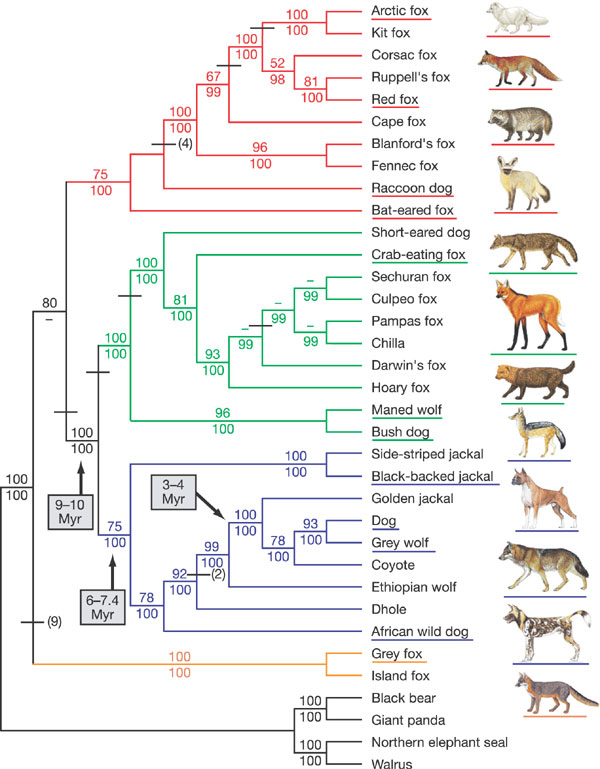
Coren also claims that jackals are an ancestor of domestic dogs. But the phylogenetic tree that was drawn from sequencing the dog genome revealed that jackals are not monophyletic. Golden jackals are in a clade with wolves/dogs, coyotes, and Ethiopian wolves. The other two species of jackal– the black-backed jackal (Canis mesomelas) and side-striped jackal (Canis adustus)– are even more distantly related to the clade that includes wolves/dogs, coyotes, and golden jackals than the dhole and African wild dog are.

These two jackals cannot cross with dogs. Lots of people claim they can and will often point to domestic dogs in Africa with jackal-like features. Those dogs are not evidence of cross-breeding. No one has confirmed a black-backed jackal/dog hybrid with any DNA test.

These hybrids exist only in urban legends.

But if these memes won’t die even with experts like Stanley Coren, they have a lot of legs among the laypeople.

If you want to see what I mean, check out the comments on my post about why Chihuahuas can’t be derived from fennec foxes (Vulpes zerda).  No, they can’t be– even though they look so much alike!

Here are some gems:

I’d be interested to know what kind of “research” Claire was engaged in. My guess is she was playing with Google, and looking up romantic breed origin myths. That’s not really research.

I answered Claire that Chihuahuas and other small breeds have a gene that makes them small, which is very closely related to a smallness gene that is found in Middle Eastern wolves. One subspecies of Middle Eastern wolf, the Arabian wolf (C. l. arabs) is often quite small, sometimes weighing only 25 pounds.

As I noted earlier in this post, no one has found any genetic markers or genes from other species in domestic dogs, and what’s more, they’d have to come from species with which dogs can interbreed.  Dogs cannot interbreed with any kind of fox in the genus Vulpes.  If arctic and red foxes produce only sterile offspring when hybridized, the chances of them ever being able to breed with anything as distantly related as a dog have to be a zero percent.

Then comes Phoebe. Phoebe tries to through God at me.

Phoebe appears to be functionally illiterate. The study I quoted came out in 2010, not 1993.

There are no proven facts that Chihuahuas are derived from anything other than wolves. All the evidence shows they are toy dogs, and at least with AKC Chihuahuas, they are primarily derived from European dogs.

The origin and ancestry of Chihuahuas is not a theological question. It is not a matter of belief or opinion. It is a hypothesis that we can test empirically. And when we test these hypotheses, their results are not determined by the belief of the majority.

If the majority of Chihuahua owners think their dogs are derived from fennec foxes, this does not make them correct.

If the evidence shows them to be derived from wolves, then the majority Chihuahua owners are wrong.

And then there is Cindy, who just quotes some website. Everything on the internet is true, right?
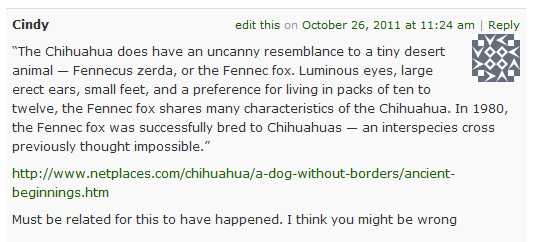
Yeah. That website totally falsifies all the peer-reviewed papers that show that Chihuahuas are derived from wolves!

But the final one is the best one!

Murray Richardson seems to think lots of bizarre things about dog taxonomy!

Almost everything he claims to be fact in that comment is false.

Chihuahuas have unusual teeth because they are brachycephalic. They don’t have rooms in their mouths for all their teeth. They would have normal dog dentition if they had normal mouths. Strike one!

Chihuahuas and all dogs have round pupils, as do wolves. Vulpine foxes, like fennec foxes, have cat-like pupils. Swing and a miss!

No North American wild fox has any dog DNA. That “fact” was entirely rectally derived. Strike three! You’re out!

And Chihuahuas don’t need to drink water? WTF?!

When was the last time anyone crossed a fennec with a maltese?  I don’t know, but people do keep fennecs and dogs togehter. Fennecs are a relatively common exotic pet in the United States. I’ve never heard of any crossbreeding or if dogs even respond to a fennec vixen in heat. Domestic dogs don’t respond to red foxes in heat, so why would they respond to the fennec?

I hoped that Murray Richardson was just pulling my leg.

But I was wrong.

Because he came back with this canard.

Facepalm.

Murray seems to believe that all wolves are very large animals, probably because the only ones he’s seen on TV have been of the several subspecies that are native to Canada, Alaska, and parts of the Northern US.

There actually are wolves that are much smaller than these rather famous subspecies. Arabian wolves, which have a similar smallness gene to small domestic dogs, aren’t like these animals at all. A 25-pound wolf can easily become a 3-pound Chihuahua through selective breeding.

After all, we’ve bred tiny horses through selective breeding, along with very small pigs. I don’t know of anyone making claims that these little animals have to have been derived from different ancestors.

Why can’t selective breeding produce super-small dogs?

I wonder what it is about Chihuahuas that makes people believe something so patently absurd.

But I think the unfortunate thing is that so many experts have given license to this nonsense.

Charles Darwin thought that several species begat the dog.

Charles Darwin lived long before we looked at DNA or even knew what it was.

He didn’t know everything.

He was not a religious prophet.

He was a scientist who was constrained to his time and place.

Konrad Lorenz also believed that most dogs were derived from jackals (which he called “aureus dogs”) and that others were derived from wolves (“lupus dogs.”)  He later dropped all of this nonsense after listening to the vocalizations of dogs, wolves, and golden jackals.

But by then, he’d already written several books in which he had posited this theory, and it had already been accepted by so many people that one can still run into people who will parrot this lupus and aureus dog dichotomy.

In the end, I think people still have a hard time accepting that dogs are derived from wolves.

Wolves are the only large predator that we have managed to domesticate.

It’s the only domestic animal that is derived from an ancestor that has occasionally considered humans to be prey.

Paradoxically, it’s also the domestic animal with which we have the most intimate relationships. Even cats don’t open themselves up to us in the profound ways dogs do.

How can we have an intimate relationship with an animal whose wild ancestors occasionally hunted humans?

That’s the cognitive block that keeps people from accepting the lupine origins of domestic dogs.

For much of human history, killing off wolves was seen as a great service to civilization.

It’s only been in the last 40 years that we’ve changed our views about wolves.

At the same time, breeding and training dogs that are useful for humanity has also been considered useful for civilization.

Accepting that the useful dog is derived from the much-maligned wolf is really quite difficult.

And that’s a major reason why people have such a hard time accepting that the wolf is ancestor of  rhe dog.

The other reason– and the one I think is driving these Chihuahua loons– is that owners of a particular dog breed like to believe that their dogs are super special.

Nothing makes them more super special than to say they derive from an entirely different wild ancestor than other dogs.

It becomes almost a theological discussion when trying to convince them of their error.

These sorts of theories and postulates should be severely ridiculed and debunked when one comes across them.

They are as bad as any kind of creationism, and they prevent any sort of rational discussion about what a dog actually is.

These theories are just mythology.

And there are already too many myths about dogs and what they are floating around.

These particular myths are relatively harmless, but accepting these really poorly thought-out theories means that one might be willing to accept ones that do result in lots of harm to the welfare of the animal.

The notion that Chihuahuas don’t need water because they are derived from fennec foxes really would have a welfare consequence.

I can just see all these Chihuahuas dying of hyperthermia or dehydration because their owners buy into that particular cock-and-bull story.

Facts are stubborn.

And just because you believe a falsehood with a lot of fervor doesn’t mean that it stops being a falsehood.

It just means you like to be wrong with a lot of fervor.

And you look like a fool!


Read Full Post »

Snapping turtle kills chipmunk

Source.

Read Full Post »

Inbreeding avoidance behaviors may spell doom for the African wild dog

African wild dogs (Lycaon pictus or Canis pictus)  are in a lot of trouble.

They once ranged over much of Sub-Saharan Africa, where they were part of an extensive guild of large Carnivorans that targeted the large herds of ungulates that once ranged over this part of the continent.

With European colonization, these animals were deemed pests. They were thought to be livestock killers of the worst sort, and it was also thought that they regularly preyed upon people– a claim for which there is very little evidence.

It was also assumed that these creatures were nothing more than feral domestic dogs.  The old name for this animal was Cape hunting dog, a name that sort of implies that these dogs were nothing more than feral hunting dogs that had run off from native settlements.

But even after colonization ended, Africa’s human development challenges mean that these animals can now only exist in fewer and fewer places.  The current populations of this species are also highly fragmented, which means the historic gene flow that once occurred over a broad swathe of territory no longer happens.

This gene flow occurs rather unusually in this species. African wild dog males almost never leave their natal packs.

However, bitches do leave within between the first and third year of life. There is a lot more competition for mates with bitches in this species than with dogs. With so much competition for mates, the younger females usually just leave to find their own mates in other packs. Like wolves, only a single female normally breeds, and if a second female breeds, it’s not unusual for the main breeding female to steal her pups and raise them in her den.  So if a bitch wants to raise her own litter, she’s got to leave.

Bitch dispersal prevents inbreeding in African wild dogs, but because they no longer can disperse over larger distances, the populations within an area are becoming more related over time.

Like many wild canids, African wild dogs exhibit inbreeding avoidance behavior.  Dogs from the same pack very rarely will mate with close kin from the same natal pack.

A recent study that was published PLoS ONE found that African wild dogs also won’t mate with aunts, uncles, nieces, nephews, or grandparents from the same natal pack, even if they encounter each other several years later. In the South African study stample, 0nly a single breeding pair was confirmed to have been between two third order or closer relatives.

With this amount of inbreeding avoidance, the authors looked at computer models to see how long it would take such a population to become extinct solely upon the basis of its inbreeding avoidance behavior. Populations that avoided incestuous breedings between a parent and siblings and between siblings were estimated to become extinct in 63 years. Those that avoided  mating with second order relatives were estimated to become extinct within 37 years, and those that avoided third order relatives were estimated to go extinct within 19 years.

With African wild dog existing in such fragmented populations, their extreme inbreeding avoidance behavior may very well spell doom for them.

Inbreeding avoidance has been a very useful for wild dogs as they have evolved. With the exception of the island foxes and domestic dogs, inbreeding is not a frequent occurrence among members of Canidae, and it has contributed to greater genetic diversity in many wild dog populations than might otherwise be assumed.

But there is also a paradox to this inbreeding avoidance.

If animals have such a resistance to doing so, they are unlikely to do so should their numbers drop significantly and the only available mates be close relatives.

And this can kill them off far more rapidly than the effects of an inbreeding depression.

Further, we know that lots of wild Carnivons have survived extreme genetic bottlenecks.

Cheetahs are the textbook example. Their population experienced a massive crash about 10,000 years ago, losing over 90 percent of their genetic variability.  Cheetahs were able to survive this bottleneck and were thriving until about a 150 years ago.

Northern elephant seals are another example  of a Carnivoran surviving an extreme genetic bottleneck.  Whalers would stop by the seals’ breeding beaches to augment their cargo, and by the end of the nineteenth century, there may have been as few as 20 northern elephant seals left.  There are now 100,000 of them, and there is no evidence of any deleterious effects of inbreeding on the population, though they may be more susceptible to disease, pollution, and climate change issues.  Of course, northern elephant seals harem breed, and only a few males of the species wind up siring the pups at any given time– a kind of natural popular sire effect. It’s very likely that elephant seals within the same populations were always in some way related, and because the animals had evolved this type of breeding system, they may have evolved a certain amount of inbreeding tolerance that hasn’t been observed in any species of dog, which almost universally reproduce within a bonded pair.

Inbreeding avoidance behaviors do keep populations genetically diverse.

But it can be an Achilles’ heel.

If a population is so adverse to inbreeding, it won’t be able to continue on if the only possible mated pairs are relatives.

Inbreeding avoidance behavior can be a boon to the long-term survival of a species.

But it can also be a great hindrance.

Read Full Post »

White jackal pup

This is white black-backed jackal pup from the Gauteng Province of South Africa.

(Source for image)

It looks very much like a tyrosine-positive albinoid Dobermann.

Read Full Post »

Phylogenetics fun

AronRa discusses primate and “reptile” phylogeny.

Source.

Why all apes, including humans, are monkeys.

And why turtles aren’t reptiles.

Read Full Post »

When Japanese chin were their own species

I’m about to quote from book that contains a description of a Japanese chin, which is called a “Japanese pug,” that some might find offensive.

Please note that I am not anti-Japanese chin.  This is a brachycephalic breed, and unlike many other breeds of this type, the Japanese chin has had this morphology for a long time.  They arrived in the West with these particular features, and among toy breeds, they haven’t changed as much as some others.

That said, this breed was not exactly well-received among male naturalists of the nineteenth century.

And the text I’m about to quote comes from a naturalist of that time period and demographic.

I quote this text for two simple reasons:

First of all, it how extreme brachycephalic dogs actually are.

And secondly, it shows the pitfalls of using morphology alone to determine taxonomic status.

The text I quote mentions an analysis by a scientist named Cope. I am assuming that this “Cope” is Edward Drinker Cope, a nineteenth century American comparative anatomist.

Cope apparently thought that the “Japanese pug” was so morphologically dstinct that we would have to call it a distinct species.

In fact, Cope thought that this animal deserved its own genus!

Cope’s classification of this animal is mentioned in The Standard Natural History, Volume 5 (1884) by Friedrich von Hellwald, an Austrian geographer and historian.

Some breeds of dogs are by many regarded as abnormalities or monstrosities, as the bulldog, pug dog, and Japanese pug, which have the bones of the muzzle defective; the turnspit, again, is remarkable for its short legs. In the Japanese pug the characters of degradation are so extensive and so numerous that, were the breed wild, it would unhesitatingly be placed in a distinct genus, and Cope has described it as such under the name of Dysodes pravus. The teeth of this pug differ from those of ordinary dogs in the constant absence of the first inferior premolar and of the last inferior true molar, the false grinders ranging in various individuals from four above and three below on each side to two above and two below, while the molars are either one above and two below, or two above and one below. The incisors, which at birth are normal, are shed at the age of six months, the last tubercular molar of the upper jaw disappears with age, and the first superior premolar is rarely present, and doubtless shed before maturity….

The hair of this variety is long and not curled, the color usually black and white, and the size that of a rather small black and tan terrier. Many examples of this singular dog have been brought to this country, and it has recently become fashionable in England to possess one of these pets, which even in Japan are said to be uncommon and expensive. Cope says of it: “It does not appear to possess the senses of sight and smell in the same degree as the species of Canis. It cannot follow its master through a crowded street, and is readily lost, even on open ground where opportunities for sight are good. As house-dogs they are cleanly, and intelligent in certain directions.” They do not learn tricks easily, but seem to understand their master’s disposition and wishes; are vivacious, and are not disinclined to bite those they do not like. The very large eyes, excessively short muzzle, and inflated forehead give this dog a look of intelligence which its habits do not bear out — it has, in fact, been degraded by an artificial life and fed upon vegetable food until it has almost ceased to be a carnivore (pg.  428-429).

Some of these “degradations” may have been the result of the predominantly rice-based diet that these dogs were fed. They may not have been fed good quality protein, which would affect mental development and the sensory abilities.

However, I don’t think that’s really what’s most interesting.

Using morphology alone, at least one well-educated comparative anatomist thought that that Japanese pugs, which we call Japanese chin, were more than their own species.

They belonged to their own genus!

In the von Hellwald text, other dog breeds are listed as distinct species, but all are listed as being members of Canis.

Today, we’d find such classification bizarre, for now it is clear enough to see that all dogs belong to same species. And they all descend from the wolf.

For a variety of reasons, domestic dogs have been able to produce a variety of bizarre phenotypes. Indeed, the skulls of domestic dogs vary more than one will find across the whole rest of the order Carnivora!

At one time, it was assumed that dogs were derived from multiple ancestral species.  It was assumed that such diversity in phenotype could only be created by crossing different species.

Today we know that domestic dogs have the wolf as their primary– and perhaps sole– ancestor. With the exception of dogs that are known hybrids, no one has yet found golden jackal or coyote genes in domestic dogs.

So in the nineteenth century, it was possible that a dog with such extremely different morphological features could be classified in such a way.

We now know that Japanese chin are fully domestic dogs in their ancestry and lineage. They readily bred with toy spaniels and pugs in Europe, and they also were crossed with pekingese dogs.

There is nothing about them that would require one to list them as a different species.

And to place them in their own genus– well– that’s quite absurd.

But at the time, it was acceptable to think of them this way.

So if morphological methodologies could lead people into such errors, we should be careful about relying upon morphology to determine taxonomy and phylogeny.

If all we have are bones or fossils, then we have to make educated guesses.

But if we have the DNA, it’s better to use molecular analyses in order to avoid such bizarre classifications.

Yes. Japanese chin are dogs.

But at one time, they were were not only their own species, they were their own genus:

Dysodes pravus.

The name means “stinking evil.”

Not a nice name for any dog.

Especially for one that was supposed to be this unique!

***

Now, I had a bit of trouble finding the actual text in which Cope made this analyais, but when I found it, it turned out that Cope came to his conclusion through the examination of eleven living specimens.  His analysis appears in The American Naturalist, Volume 15Cope describes the unusual dentition of the final 8 specimens– one of which was half poodle!

This species of Canidae was characterized in the Proceedings of the Philadelphia Academy for 1879 (July), under the name of Dysodus pravus, and the diagnosis was based on four skulls and one skeleton. In the Naturalist, for 1879, p. 655, appeared notes on three living specimens examined by the writer in San Francisco, which confirmed the characters previously ascribed to the genus and species. Subsequently I had the opportunity of examining eight additional specimens in San Francisco, of which three were born there, and two certainly and others are probably, Japanese born. The characters of these are as follows:

No. 1. Premolars 2/2, molars 1/2; first premolar a minute cusp; two years old; Japanese.

No. 2. Premolars 3/3 ; first and second superior minute.

No. 3. Premolars 4/3; first and second superior minute cusps; first inferior do.; nine months old; American born.

Nos. 4 and 5. Exactly like number 3.

No. 6. Premolars 2/2; an old dog from Japan.

No. 7. Premolars 2/3; young; daughter of No. 6.

No. 8. One-half poodle; premolars 2/2; molars 1/2; four and a half years old.

From the above it can be seen that the absence of the first inferior premolar is constant, as is also, I may add, the absence of the last inferior true molar. In only three specimens was the first superior premolar present, and then as a cusp-like rudiment; and these are young dogs American born. The tooth is doubtless shed before maturity. Finally, even the poodle mixture did not restore the two lost inferior molars; and two superior molars are also missing, as in the typical Dysodus pravus. In all, the superior incisor teeth were present. Thus, though this species shows a remarkable tendency to shed the molar teeth with age, its normal dentition, when perfectly preserved, differs materially from that of the genus Canis.

This species has some marked peculiarities of habits. It does not appear to possess the senses of sight or smell in the same degree as the species of Canis. It cannot follow its master through a crowded street, and is readily lost, even on open ground where opportunities for sight are good. As house dogs they are cleanly, and intelligent in certain directions. They do not learn tricks easily, but seem to understand the disposition and wishes of their master very readily They are often very vivacious and energetic, and not at all indisposed to use their canine and flesh teeth on persons whom they do not especially regard (pg. 233-234).

Cope was trying to see if environmental factors had produced the unusual dention, which is why he examined the American-born dogs and the half-poodle.

He didn’t seem to understand the lack of these teeth were actually the result of extreme brachycephaly.

These dogs have these teeth, but they are not visible in the mouth.  They remain withdrawn into the gum, much like the wisdom teeth of humans.

So Hellwald’s view that the teeth were the result of evolving for a vegetarian diet isn’t even substantiated in Cope’s text.

Cope just thought that the teeth were gone, and because the teeth weren’t there, we had to be looking a different species– with its own genus.

Never mind that this “species” could have produced intergeneric hybrids with domestic dogs!

Read Full Post »

Albert

The image above is of Albert.

Albert was a St. John’s water dog who was actually born in Newfoundland.

He was among the last of his breed. Well, he was among the last of the lines that were free of modern Labrador retriever blood.

And he had a famous owner.

This particular dog belonged to Farley Mowat, a well-known Canadian naturalist and author.

The above photo comes from Bay of Spirits, Mowat’s memoir about his time falling in love with Newfoundland– and then having a very bad falling out with it.

Albert is described as follows:

Perhaps the most momentous event that winter was the aquisition of Albert, a young water dog from La Poille. As big as a Labrador retriever, he was a sway-backed creature, black as ebony except for his white chest, and equipped with webbed feet, the tail of an otter, and the attitude of a lord of the realm. He quickly became an integral member of our little family both ashore and afloat, where he demonstrated he was a proper seadog: sure-footed, ready for anything, and afraid of nothing (pg. 303).

“La Poille” is on Newfoundland’s Sou’west Coast. It is normally spelled “La Poile,” and it is not very far from Burgeo, where Mowat lived from 1962 until about 1968.  Albert would later be featured in an episode of the the CBC series Telescope in 1970.

By then, the Mowats had taken to summering on Quebec’s Magdalen Isands, which are located in the Gulf of St. Lawrence. In the film, Albert and his mate– aptly named Vickie– are shown retrieving from the surf. Albert also receives a bizarre bedtime story from his master, which would give any dog nightmares!

Mowat tried to use Albert as a way of saving his breed.

Mowat believed the water dog of Newfoundland was closely related to the Portuguese water dog, a linkage that, thus far, hasn’t been revealed in any genetic studies.  Like many breed historians, Mowat tried to trace these water dogs through their poodle lineage, eventually arriving at herding dogs that were native to Central Asia. These linkages have not been confirmed in any genetic studies, but they are still pretty interesting.

In order to save the breed, Mowat tried breeding Albert to a Labrador, but because none of the puppies had the characteristic white spots, he abandoned the project.  There were only four pups in the litter, and both bitch pups died.   The two dog pups were given to Canadian Prime Minister Pierre Trudeau and Soviet Premier Alexei Kosygin.

These dogs were multipurpose hauling, hunting, and fishing dogs.

They are primary ancestor of all the retrievers, except the Nova Scotia duck-tolling retriever, which may have a bit of this blood. However, it is mostly of collie extraction.  All the others, including the large Newfoundland dog and its variants, are derived from variation upon this landrace.

There still are black retriever-type dogs in Newfoundland, but these dogs heavily outcrossed to modern Labrador retriever lines, which were introduced from North America and the United Kingdom as “improved” hunting dogs.

When people say that Labrador retrievers come from Newfoundland, they aren’t exactly wrong. However, all the larger retrievers descend from this stock, and the modern Labrador retriever was developed in the United Kingdom in the 1880’s.

The dogs are derived from animals from Newfoundland, but the “improvement” happened in the United Kingdom and on Chesapeake Bay.

Albert is an idea of what a dog from this landrace looked like– at least what the last of his kind looked like.

One can create a dog that looks very much like him if one crosses a Labrador retriever with a border collie.

But the cross is  an imposter.

Albert’s kind was developed on the land and on the sea.

Natural and artificial selection honed his kind.

A dog derived from the cross of a border collie and a Labrador retriever never experienced those generations of selection.

It would just look the same.

Nothing more.


Read Full Post »

« Newer Posts - Older Posts »

Follow