
American black bears may have cognitive skills on par with those of non-human primates.
The BBC reports:
Three captive bears took a series of number-based tests on a touch-screen computer, research published in the journal Animal Behaviour showed.
They had to choose between two different-sized sets of dots and were rewarded with food for correct answers.
“People don’t generally understand them to be as intelligent as they probably are,” said Jennifer Vonk, the researcher who led the study.
Although bears have the largest relative brain size of any carnivore, their cognition is not well understood.
Dr Vonk, an assistant professor in psychology at Oakland University said that the North American black bears were first trained to understand the process and equipment involved in the tests.
“This is the first published work with bears working on a touch screen,” she said. “It hasn’t been done with any large carnivores.”
The experiment then involved presenting the bears with two sets of dots or “arrays”.
“Basically we were looking to see if they can understand to choose less or choose more,” she said.
They touched the screen to select one or other of the arrays, and were given food if they got the answer right.
One bear was rewarded for touching the screen with a greater number dots, and for the other two bears, a correct answer was an array with a fewer number of dots.
The team wanted to ensure that the animals were not merely estimating magnitude, a skill that has been shown by many animals.
“We’re really trying to differentiate between the ability to perceptually discriminate amount from actually quantifying a number of items,” explained Dr Vonk.
So the team varied the pattern of the dots and the shaded area on which the arrays were shown, and in some tests the dots were also moving.
“If there’s more dots and less area covered – it’s a better indication that they actually do something analogous to counting rather than just estimating the amount of something,” Dr Vonk said.
Although the study found that bears did better when the size of the area corresponded to the number of dots, they also found that the bears were capable of compensating for an area that was smaller or larger than normal for the number of dots it contained.
“What was important is that we showed that they could work against that in some of the tests,” Dr Vonk said.
Black bears in the wild are often solitary, non-social animals, so the results suggested that animals that do not live in a group may have the ability to make number-based judgements.
“This is really the first test of a species that has not evolved to live socially to see if they can individuate items,” she said.
“I think we can’t really say that they’re absolutely counting at this point but it does look like they’re attending to the number of items and not just the area.”
Similar tests on primate species allowed the scientists to compare the ability of the black bears with non-human primates.
For at least one of the bears, they found a pattern that matched.
These results are among the first to show that bears may have cognitive abilities that are equal to primates.
“I’ve been working for a while with these bears… but simultaneously I was working with a chimpanzee,” said Dr Vonk.
“I find that their abilities so far in terms of categorisation and forming more abstract concepts seem quite comparable.”
The techniques used to research the bears’ skills could be used in the future to look at bear cognition in more depth.
“It really opens up the door to asking all kinds of comparative and cognitive questions with a species that really hasn’t been investigated in that way before,” she said.
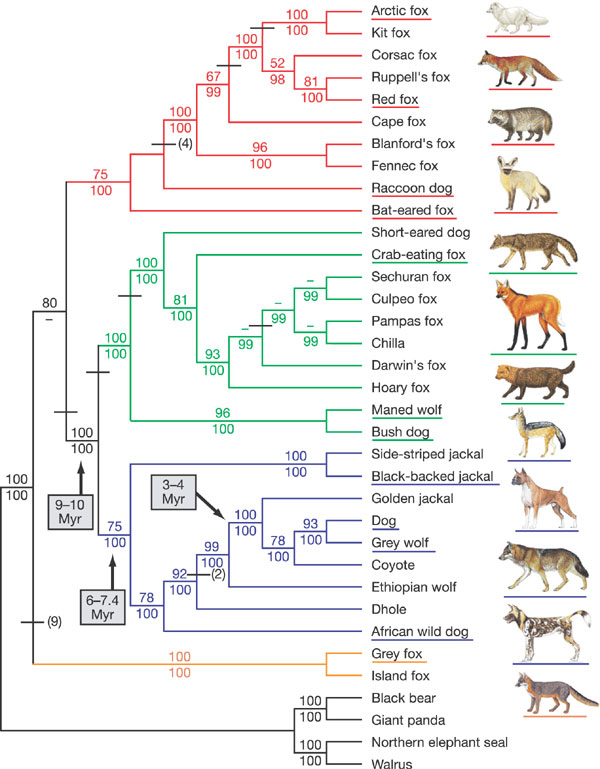
With the exception of hyenas, all the brains in carnivorans seems to be concentrated in Caniformia.
Now, black bears probably aren’t able to cooperate in the same way that wolves and social canids are.
My guess is that no bear has the abilities of certain voice-responsive domestic dogs.
But bears clearly are intelligent.
One needs to be a little cautious of brain size claims as a justification for intelligence. Even if we base the brain size on a relative basis, there are certain shrews and rodents that have bigger brains in proportion to their body size than people do.
But even with keeping that issue in mind, bears have to have a lot of intelligence to survive.
They are the largest terrestrial omnivores, and they have to know when certain foods are available. Perhaps their counting abilities are the result of them needing to know when these foods are in season.
These animals have very long childhoods. Black bears stay with their mothers until their second year, often leaving when they are about 18 months old, and brown and polar bears stay with their mothers until they are two or three.
These longer childhoods mean that they have a lot of time to learn things.
So we really should not be surprised that bears have intelligence.
They are in the particular part of the order Carnivora that has lots of intelligent animals in it.
Their intelligence may have been underestimated because bears are not truly social.
Sociality does not always mean intelligence. After all, there are plenty of fish that travel together in school that are quite limited in intelligence, and octopuses are solitary but possess an intelligence on par with domestic cats.
Further, orangutans are largely solitary, but they may be more intelligent than chimps and gorillas.
Humans are a social species, and we are very intelligent.
However, I think that we assume that sociality equals intelligence because sociality is a major part of how and why we are so intelligent.
This assumption causes us to miss animals that have evolve remarkable cognitive abilities even though they aren’t as social.
That’s unfortunately what has happened with bears.
Virtually ever expert who has dealt with bears in the field knows they are very smart, but it’s only now that cognitive scientists have tried to look at bear intelligence empirically.





??? “Humans are a social species, and we are very intelligent.” ???
Well, at least we have a high opinion of ourselves and communicate a lot.
Yep, therein lies the rub–by human standards we humans are very intelligent. But by dog standards, bear standards or even grasshopper standards….?
It all depends on how intelligence is measured. Is a gifted violinist more intelligent than someone who is tone deaf? Is somebody who is good at taking tests more intelligent than someone who is dyslexic? Is your average rugby player more intelligent than an autistic child? Is a creationist Mensa member more intelligent than Charles Darwin?
Ted Kerasote made this same sort of argument in Merle’s Door.
Who was smarter: Shakespeare or Einstein?
Think about that one for a minute.
or Da vinci / Einstein. Is the criteria innate smarts, or how they were applied and what impact they had? Humans tend to have a high opinion of human intelligence, but about the only unique things we’ve done is for SOME (not all) to invent writing and figure out how to make fire. You’ll find lots of SF stories use these two as the definition of “sapience”, but they both are based on a certain requirement regarding environment (does an aquatic animal NEED fire?). Writing is iffy as it clearly developed pretty late in human history and is certainly not universal.
Is smarts “best at problem solving”, “best at self awareness” or simply “best at dealing with the environment’s requirements?”. They give different answers.
I imagine there would be considerable difficulty in designing accurate intelligence testing for large, potentially dangerous carnivores.
I remember that video of a dancing brown bear in Pakistan that was actually keeping time to the music
Dancing bears really bother me.
They “dance” by having pressure put on rings that are put through their noses and palates that are connected to ropes.
I’ve seen the dancing bear in question. He was “talented” but it still bothered me.
Well, here is one bear that dances with out a ring
I have no trouble thinking that black bears are as smart as a “smart” dog. In fact, I think there is a sow living near me who has taught her cubs to hate scout cameras the way that she does.
If you have ever been to Yosemite and seen the mandatory video they show about how bears can get into almost anything if they smell food, you can see how smart they are. They use not only their might but their brains to problem solve puzzle toys like Volkswagen Beetles.