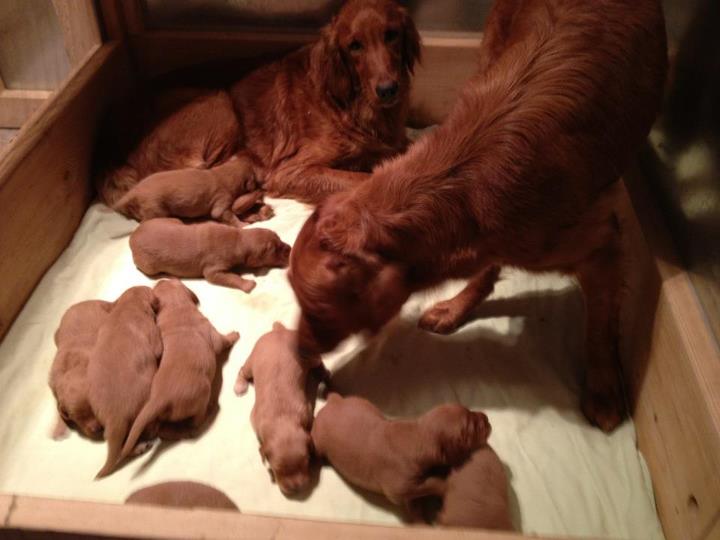
Djanick Michaud of Zomarick golden retrievers has a new litter.
And like many golden retrievers, these particular goldens have very strong parenting instincts. If you peruse the photos on his site, you can see that even his big stud dog, Sir Hobson, likes to parent little puppies.
In general, golden retrievers like puppies, and if one golden retriever in a “pack” has a litter, the whole rest of the pack will often try to offer its services as babysitter.
Even though they have very strong parenting instincts, goldens tend not to guard newborns. Some do, but most do not.
And so it’s really not unusual to find a whelping box with several dogs in it besides the mother.
This says a lot about the true golden retriever temperament. They are usually very good with other dogs, and one normally doesn’t have problems with the bitches raising their puppies.
I think most dogs would like to parent puppies that aren’t their own, but normally, the mothers are too protective of them to trust another dog near them.
With this particular breed, there is a convergence of strong parenting behavior and general social tolerance that makes this possible.
***
I’d be remiss to say that only golden retrievers exhibit this behavior.
Jess has some photos of her Italian greyhounds in the same whelping box as salukis and her Afghan hound hybrids.
Wolves do help assist in the raising of puppies.
But as far as I know, there are no records of bitch wolves allowing other wolves into the den where her newborn puppies are.
There may be a case or two somewhere, but from what I’ve read in all the available literature, bitch wolves won’t let their packmates into the den. Even though they may want to help care for the puppies, the other wolves aren’t getting into the den.
I don’t think the majority of domestic dogs are as tolerant as the cases I’ve mentioned in this post.
I’ve never known a Jack Russell bitch that wasn’t in some way quite protective of her newborns. I knew one in particular that really didn’t like any other dogs in the same room as her newborns. People could handle her puppies, but she wasn’t about to let another dog near them.




A close friend of mine had two litters born wirhin a day or two of each other. The whelping boxes were in opposite corners of the big country kitchen, and the two moms seemed to ignore each other (they had always gotten along just fine). When the litters were a few days old, my friend had to run out to the store. When she returned, she found one box empty– all the pups were in one box with one mom, the other taking a nap next to the box. Thence forward, they took turns “on duty”– one with the pups, the other taking a break. All ten pups turned out healthy and (very) well fed. Nothing like having two moms!
Same happened with a Doberman breeder I know. They both whelped within a week of one another and keeping the pups seperate wasn’t going to happen. One would take her entire litter over to the other box and they would take turns nursing all 15 puppies.
They were littermate bitches however… I don’t know if it made a difference.
The two mom’s thing can go much further. In the Labrador lines I worked with, it is common for related bitches to share parenting duties, including feeding. The sister / mother / cousin will get in with the pups. The pups start suckling. This brings in milk, even though the girl in question hasn’t whelped. This seems to be pretty widespread, and has extended to bitches feeding kittens. See discussion at: http://www.dolforums.com.au/topic/237274-my-other-bititch-got-in-with-puppies-not-belonging-to-her/page__st__15
My shepherds were the same way. I don’t raise litters anymore, but when I did, my male always took a lively interest in the puppies and helped tend them. (I never kept more than one stud dog at a time). I think that having the male, or “aunties”, involved makes a more settled, better socialized puppy.
Wpw what beautiful intense pigmentation in the parents. Just beautiful.