
So says a new genetic study that examined samples from 4,283 individual sharks. It found 574 species, and 79 of these are likely new species.
These new species are actually cryptic species. A cryptic species is one that is suddenly discovered from a population of what appear to a species already known to science, or it can happen when two populations that have been classified as the same species turn out to have quite a bit more genetic diversity than was previously thought.
For example:
For example, Naylor’s work suggests that the endangered scalloped hammerhead (Sphyrna lewini) is actually two separate species. “Scalloped hammerheads in general have taken a huge hit, so it may be even worse than has been documented if there’s more than one species out there,” he says.
Now, this is really an interesting find.
I’ve often wondered if our traditional classification of shark species would withstand molecular genetic analysis.
It doesn’t look like it will.
For example, I’ve often questioned whether all the sand tiger sharks (Carcharias taurus) are all really of the same species. These sharks are found only near coasts, and they are found in quite isolated populations in different parts of the world.
I bet there isn’t much gene flow between those populations– if any– and they likely have been reproductively isolated for a fairly long time.
Sharks have been around for a long time, and even modern species have had more than enough time to experience multiple divergences from a common ancestor.





Looks can deceive.
Sometimes the spliters get it wrong. Sometimes the lumpers get it wrong. Sometimes it takes a long time for speciation to occur (I remember, when I did biogeography, documentation of a Fagus ssp. where the European and North American populations had been separated since the Miocene and were still interfertile). Sometimes it seems to take only a few thousand years.
To me the interesting question is “what caused speciation”. One school, vicariance biogeography, says it’s always physical separation of the two populations (allopatric speciation). Oceans are generally continuous and don’t easily create absolute barriers to genetic exchange between populations. Wonder what happens to split a shark populations into non-breeding sub populaitons. Are we looking at the results of populations split off in inland seas back in geologic time? Or have the sharks speciated sympatrically (ie without a geographic vicariance event)?
We know it’s a lot of different things. You can also have sympatric speciation, where two species evolve from a common ancestor within the same region. The cichlids of Lake Tanganyika are a very good example. They are all derived from a common ancestor, but they’ve evolved to so many different niches that they are now very different species.
It always amazes me that so many native American plants have close (often interfertile) Asian counterparts. One would be hard-pressed for example to find a genetically pure American Crabapple, Mulberry or Bittersweet vine, not to mention those genetically manipulated plants like the American Chestnut.
As for speciation, geographic barriers are only one way to ensure genetic isolation. Polyploidy, radiation to fill econiches, as well as changes in fertility timing, behavior, pheromones, optical cues, local pollinators, etc., etc., all can work just as well as agents for speciation.
I think that we sometimes get wrapped around the axle in our efforts to organize and classify things. Its easy to forget that taxonomy, though a useful tool for us, is irrelevant to the actual living organisms we’re trying to classify.
BTW Jen: biogeography sounds like a fascinating career choice. :^)
Speciation in Lake Tanganyika cichlids is quite rapid:
http://www.plosone.org/article/info:doi%2F10.1371%2Fjournal.pone.0001730
African Cichlids have always fascinated me. The situation in Lake Tanganyika when the ancestral cichlids arrived was apparently analogous to that of the Galapagos when the ancestral finches arrived, or of Madagascar when the ancestral primates and mongooses arrived. There were no competitors to fill the many empty econiches so those original species quickly evolved to fill them.
The 64$ question is of course if these different animals could interbreed or not. Nature can be far more accomodating than one may think. I was just reading about the “red deer” people in China who may or may not be yet another Homo species/subspecies or might be variants or the result of interbreeding H. sapiens with Denovians. Nature accomodating such crossings would be evolutionarily a plus, as crossbreds might well result in more fit animals (or complete flops. But one does wonder if an occasional fertile mule might not be a plus overall for horses if donkeys had some genetics that are a plus for horses).
There have long been recognized two species of blacktip shark. The more common of which is actually quite common off the East Coast. There is an endemic Australian species, and very recently, it was discovered that the two are interbreeding, though I’ve seen no word on the fertility of the crosses.
I’ve often wondered whether the trace Neanderthal genes found in those of us w/ European and/or Asian ancestry might not be the result of incomplete infertility in hybrids between archaic H. Sapiens and Neanderthals. The benefit of adding cold- & high latitude-adaptive Neanderthal traits to the genepool of hot climate-adapated H. Sapiens living in Europe would be substantial. But, if the two were completely interfertile, one would expect that we would retain more of the Neanderthal genome and phenotype than we apparently do.
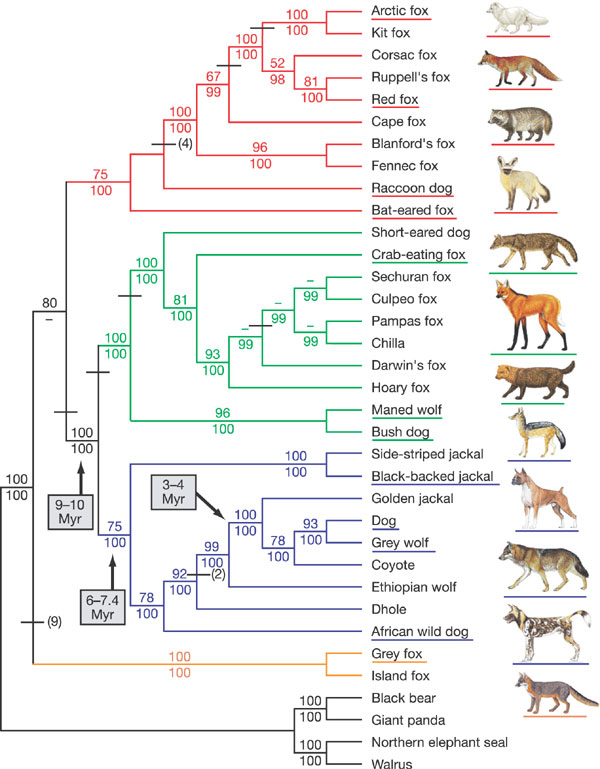
Coyotes and dogs are quite interfertile, but coyotes with dog ancestry don’t have that much dog in them. There can be behavioral barriers between interfertile species.
I’ve seen different literature that claims that some coyote/dog hybrids have fertiltiy issues, but I’ve also seen other literature that says they don’t.
I’ve read that both fertility and health are compromised when F1 dog/coyote crosses are bred to each other. If true, this, along w/ the fact that there are more wild coyotes than there are feral dogs, would explain why the coyote genes prevail.
I’ve read that, too, but I’ve also read the opposite.
Some of these fertility and health things could be the result of inbreeding. For example, breeding dog/coyotes to their littermates. If you do that over time, you’ll get an inbreeding depression, regardless of what ancestors were.
Sharks are not like cichlids. Cichlids are all in the same family and evolved in the Quaternary. There are several orders of sharks . . . at least in the Wikipedia version, the most recent of these dates to the Jurassic (ie, a hundred million and some years for sharks vs a million and some years for cichlids). Cichlid phylogeny, evolutionary biology and ecology are well studied (see http://www.hindawi.com/journals/ijeb/cichlid.evolution/ ) while shark taxonomy is a mess and while a few species have been studies in detail, ignorance about shark ecology deep. Seems quite possible that cryptic speciation, if it’s there (not clear to me that these authors have actually proven that the sharks are different species), dates back to Tethys, the Western Interior Sea, the former inland sea in the Amazon Basin . . . I’m sure there have been others.
I didn’t say that cichlids and sharks were the same.
My point was there were different types of speciation beside allopatric speciation.
Sorry . . . didn’t mean to imply you said they were the same. Tact isn’t my strong point and I can get obsessed with concepts. The contrast between the two groups pulls up a concept I find quite satisfying.
From texts read 30+ years ago, I had the sharks pegged with plant groups like the ferns, which have a long, rich fossil record and seem to have diversified before Pangaea broke up . . . while cichlids were grouped with groups like the genus Inga, which has undergone explosive speciation in the same time frame as Australopithecus evolved into various Homo ssp.
Have had a good time rummaging around to see if these impressions stand and find that though much has changed since I studied this sort of thing, the basic concepts have been robust.
Btw, found what I consider a great resource for the shark side of this question:
http://www.elasmo-research.org/education/evolution/evol_s_predator.htm
It provides a pretty much jargon-free walk through evolution, classification, etc.