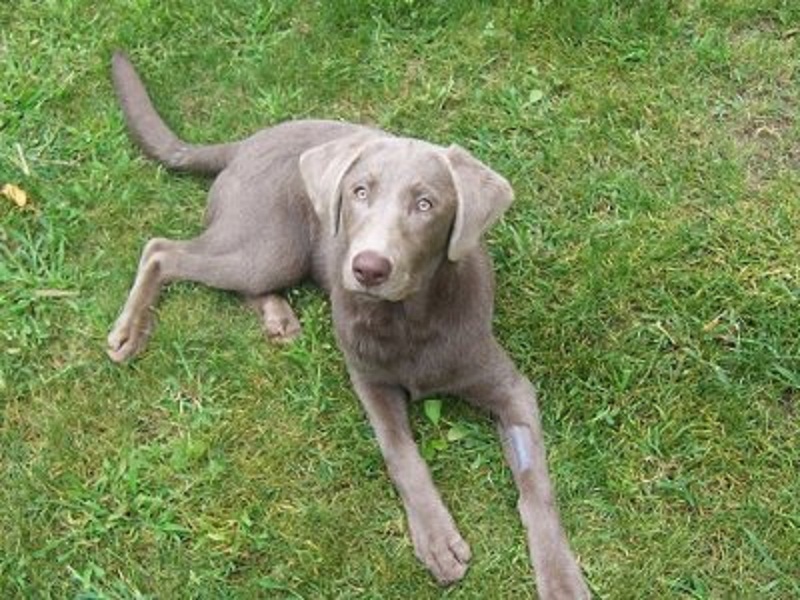
On my recent post in which I worried about the potential for a breed split in golden retrievers over color, I linked to a post in which I suggested that silver Labs become a distinct breed.
I was asked why I made these two contradictory statements.
There are two reasons: the cream color in golden retrievers has long been established in the breed and it is possible to develop a way for cream colored dogs to be accepted in the North American breed.
This doesn’t exist with the silver and charcoal Labs.
The Labrador Retriever Club requires that silver (diluted chocolate) and charcoal (diluted black) dogs be registered as either chocolates or blacks.
But their color does not meet the description of black or chocolate in the AKC Labrador standard— and that’s a big problem:
” Black–Blacks are all black. A black with brindle markings or a black with tan markings is a disqualification…Chocolate–Chocolates can vary in shade from light to dark chocolate.”
I don’t believe you can say that charcoal Lab is black. It looks blue.
And the silvers don’t look like “light chocolate” either. They look steely gray.
And because they don’t look like the colors under which they are registered, how on earth would they ever win at a dog show?
If the Labrador Retriever Club says that they won’t recognize these two diluted colors as they are, then how can we say they have a future in the breed.
Now, the problem is there is a demand for diluted Labradors.
Demand doesn’t go away because a breed club decides the color is wrong. Have a look at white German shepherds if you want to see where that leads.
In the end, I think the only thing that can be done is for dilution factor Labradors to become their own breed.
And if they become their own breed, they can do outcrosses to ash Chesapeakes and weimaraners to increase genetic diversity.
This dilution also exists in Newfoundland dogs, which strongly suggests that it’s been in retrievers since the time they were working dogs in Newfoundland.
But if there is no room for these Labradors within their breed, it sounds like they might be better off on their own.
I suggest they call the breed the silver retriever, even if it includes charcoal ones.
We already have a golden retriever. Why not a silver one?




I have always thought the breeding for color thing has become too important in purebred dogs.To the point where some dogs are disqualified for color alone! (shock and dismay, here).. Instead, people should include them all as retrievers and just considered the colors as lines within the breed. which people can stay within or not. As long as the retrieverness is not lost, what matters the color?, Dogs aren’t cars where color can be a whim, yet wanting fancy colors has led to deaf and blind collies and great danes.and will do so in every breed that wants the merle color so bad, they breed for it.
Strangely enough the white German shepherd tends to have much better hips and normal gaits. and have maintained them.since they were outlawed. for color alone. That little fact could save the breed, if people could get over their color prejudices. Doggie racism…..
Within the Labrador Breed, they do not want a dulited gene. They want all true solid bold colors. If they continue to breed without a diluted gene for 100 yrs, then the diluted gene would disappear, until someone outcrosses illegally and brings in a diluted gene. This happens all the time.
Ask yourself why is the silver or white or any odd color of any breed the one that folks are wanting? its because there isnt one, or it is rare.. that is what makes that dog sellable. put a spin on it and sell them right and left.
The breed club needs to stop this. To put only non breeding papers on the dogs that dilute. That would be the correct thing to do. I agree with you that the rare colored Labs could and should be a rare breed just because of color. This would keep the True undiluted dogs in the breed as it should be. Then breeders and the public would know exactly what they will get when they breed.
my thoughts…
I don’t think it didn’t exist before. It exists in two close relatives– the Chesapeake (which was traditionally crossed into this breed as recently as the 1940’s) and the large Newfoundland.
Breed clubs can try to stop it.
But you can’t stop demand.
Demand will always produce animals like this.
It’s just like trying to outlaw alcohol. You just can’t do it.
Breed clubs don’t have that kind of power. They’d like to.
But when a breed is this common, most people don’t give a rat’s rectum about what the breed club says.
But, breeds as a whole are breeding for ‘something.’ Some breeds are bred to work, others are bred because they make great looking accessories.
Why not breed for colour? (Playing Devil’s Advocate here)
All breeds were created for some reason or another; why is colour considered something not worthy to breed toward, but lack of hair (Xolo) is?
I don’t know why this went here… I was meaning to reply to lois. LOL
The thing that irks me about breeding for novelty colours is that they are usually bred for one purpose and that is lining the pockets of the breeder with no concern for the pups they sell or the buyers once the money has crossed their palms. Unusual colours go for big money. Breeding purely for something atypical almost always means health/conformation taking a back seat. You are also restricting genetic diversity if you breed specifically for an uncommon gene like a dilute colour and are certain to be amplifying other genes that may be far more detrimental to the dogs than being a pretty colour. Of course, in the case of labs and retrievers, if someone has slipped a little weimaraner in there, it would negate that somewhat.
Don’t get me wrong, I believe no good dog is a bad colour. But that doesn’t mean I think they are somehow special for it and hanker after one either. What people find desirable in a dog is very subjective. It’s human nature to like something a little different and some people will pay the premium to have it to showboat with.
Oh yes, I know all about the love for something different. In my breed, the Doberman, we have the dilutes and the “white” Doberman.
In the Americas, dilute Dobermans are allowed to be shown, but they aren’t over in Europe.
I honestly believe the standard of the Labrador should be changed to reflect the dilution that occurs. Perhaps, as someone else stated, they shouldn’t be allowed to perform in the conformation ring, but in other venues instead.
However, the likelihood of the standard being changed is about as likely as pigs suddenly taking to the skies.
There are black and tan labradors. Brindles too. If achondroplasia was common in the breed, would people be campaigning for stumpy labradors to have as much right to compete in the showring as any other lab?
Breed standard have to draw a line somewhere otherwise there would be no point in having them. Someone is bound to disagree with them. In the UK at least, there is nothing stopping any dog from competing in other activities or even promoting their breed at Kennel Club events. A long haired ‘bearcoat’ shar-pei attended Discover Dogs at Crufts for years. He was quite a celebrity too.
I was thinking of the dilute Dobies when I read this. The problem with dilute genes in Dobies is they actually do have some health problems like alopecia (Color Dilution Alopecia), also known as Doberman Syndrome and Blue Dog Disease, which is a form of Follicular Dysplasia. I would be all for allowing for some extra terminology in the Lab standard that recognizes these colors, if it is known that they will not produce more disease in these animals.
“until someone outcrosses illegally…” ILLEGALLY??? :)
I wish the Lab people would stop calling their brown dogs “Chocolate” and call the color “Liver”, like almost every other sporting breed.
Blue and liver colored German Shepherd Dogs exist too, both as solid colors and with the full range of shepherd markings. The dark charcoal-colored shepherd can be very difficult to distinguish from black, especially as adults. They are currently disqualified from conformation showing because they don’t have black noses. Quite a few breeders have the blues and livers; as working dogs and pets they are the equal of any other GSD. To the best of my knowledge, no one has yet suggested making them a separate breed (although there have been several attempts to create a separate breed for the white GSDs).
I think that as “pure” breeding continues and the same genes are sloshed around and around the old pool, it’s inevitable that odd colors and other recessives will crop up. If the breed clubs were honest (persih the thought!) they would admit that these “aberrations” occur and register them, perhaps with a coded registration so that their descent can be tracked. A Lab is a Lab is a Lab … the gray dogs have appeared before, & breeders either sold them as pets without papers or quietly culled them.
My opinion of these dilutes? They are beautiful and the Labrador people should be proud to include them. (So should the shepherd people, come to that).
“…and register them. . .with a coded registration” This is exactly what has been done with the albinoid Dobermans (which are the result of a mutation that produced one “white” female). and other descendants of this same female, who may carry the albinoid factor.
I would agree with you except that I don’t see a problem with diluted dogs not being shown. Just because diluted dogs crop up in litters and are sold to satisfy the pet market doesn’t mean those dogs have to have a chance to be shown through the breed clubs – and if a breeder wanted to demonstrate the quality of that dog, they can be used for obedience or other dogs sports and left intact because they are not mixed breed dogs.
Of course, I’ve never heard of non show-quality dogs being culled or not registered. There are a multitude of traits that disqualify a dog from success in the show ring, and most breeders have no problems selling those puppies as pets. I’m pretty sure that either the standard should be opened up to these mismarked dogs, or that they can continue to be sold as pets – 99% of puppies produced never make it in the show ring anyway so I’m not sure what difference this would make to the breed.
There’s some evidence that the dilutes have some health issues associated with them. These aren’t as severe as the Merle gene, but there is evidence of some issues (http://homepage.usask.ca/~schmutz/dilutions.html — “Some blue dogs appear to be more prone to skin problems and hair loss, and perhaps skin allergies than dogs that are black. Some breeds have more problems in “born blue” dogs than others. The current phase of our study is to try to understand this difference. The hair loss and skin problems which occurs in blue dogs is called “Black Hair Follicular Dysplasia” in some breeds and “Color Dilution Alopeicia” in other breeds. In the past it may sometimes have been called “Blue Dog Syndrome” also.”)
As far as I know, no one has found Color Dilution Alopecia in silver Labs. It doesn’t exist in all dilution breeds. It’s actually pretty minor health concern, except for if you want the dog to swim in cold water.
Color Dilution Alopecia doesn’t exist in GSDs either, as far as I know. I have seen it only in a few blue and fawn Dobes. GSD dilutes’ coats are the same as those of non-dilutes and whites. There is some variation across the breed, because they are so numerous, and various types of coats are seen, but the color of the coat doesn’t appear to be related to its density or quality.
It seems Dobermans are the main breed to be affected by CDA. Weimaraners are a completely diluted breed, yet we don’t hear of CDA often among them. At least, I haven’t.
There’s a longhaired type of Weimaraner that is gorgeous, too. They are more common in Europe than in the USA. Their coat reminds me of the coat of a field-type Golden: long, with feathery furnishings, but not extreme in any way.
Dobes are some of the major sufferers from alopecia, but really has NO ONE found it in silver labs or is it just extremely rare?
Seems to me that if a strain of Labs gets its dilute genes from out-crossing to Weimaraners, then it too will not have a problem w/ CDA. Which then goes back to the question: Why not show them? I can remember back when every Lab I came across was black. Now I’m just as apt to encounter a Yellow or Chocolate or even White Lab. If a blind person encounters a Dilute Lab (s)he isn’t gonna notice any differences between it and its black litter mates.They still act like Labs and have Lab conformation, so what’s the hang-up?
One explanation for the silver colour: http://labradornet.com/silverlabsanalysis.html
My take is that it’s not from Weimaraners. It is has either been in this population for some time, and the silver pups were always culled and never publicized.
It also exists in Newfoundlands and Chesapeakes, and subsequent tests of these silver dogs have found no Weimaraner genetic markers (although genetic marker tests are not necessarily the best.)
If you see an ash Chessie, I don’t think there’s any question that this is the most likely source.
If not from them, then it was in the St. John’s water dog population from the beginning.
Here is a “beige” Newfoundland (a diluted liver): http://www.watercubs.com/en_articles_coatcolourgenetics_greybeige.htm
Here are Chessies: http://a8.sphotos.ak.fbcdn.net/hphotos-ak-snc6/166125_487123067962_224495362962_6213323_8164840_n.jpg
It seems to me if that if this color exists in two breeds we know to be very closely related to Labs, then it makes much more sense that the color comes from the ancestral population or from an outcross to one of those breeds than from a weimaraner, which isn’t a retriever and doesn’t act like Labrador (it’s actually a big game hound that became an HPR.)
There are certainly some “silver labs” that have Weimaraner in their ancestry. Some years ago the place where I worked had a black Labrador bitch come in for boarding, because after she had been bred (to a Labrador), the neighbor’s Weimaraner jumped the fence and tied with her. But “of course all the pups were purebreds” because “the first sire always is the actual father” doncha know. . . The resulting litter was all registered. This was before the days of routine DNA testing.
I agree. It was only a matter of time before the blue(gray) Labs appeared. They are getting more exposure now, because of the internet, but there have always been rumors of their existence.
Somewhat off-topic question – how is the Curly-coated retriever related to the lab? Did the curly coat just occur in the general retriever family, or did it occur in Labs?
Asking because I recently came across a book from 1938 (The Blue Book of Dogs, by John Hokzworth) which describes the Labrador as having a smooth face and a body covered with tight curls.
Colors go in and out of fashion, and sometimes they are completely eradicated by selective breeding. Collies used to come in black/tan, black/white, and some old books refer to “mouse colored” which might have been some sort of dilute.
There were wavy-coated Labs. Some still pop up in some lines.
However, the curly as we know it now is a St. John’s water dog crossed with a water spaniel of some sort. The coat that it has is very hard to breed for, so they actually were sequestered in the retriever gene pool early on.
One of the theories that goes out is that a type of water spaniel, called the TWeed water spaniel, which we know was used in the founding line that became the basis for the golden retriever breed, was actually a St. John’s water dog/water spaniel cross, and it was also used to create the modern curly. It was also used in the line of smooth-coated retrievers that became the modern Labrador.
If the dilute genes are not absolutely identical in each breed (ie, that the “d” or “b” genes have no breed-specific components), then one needs to question why one breed would have issues regarding dilute color and another doesn’t. If they do differ between breeds, then a DNA test may find if the Lab gets their dilute genes by way of Weimaraners, Chesapeakes or some combination of contributors).
If there are no health issues, then there are two other concerns. 1. a division into multiple breeds based on color does result in several smaller gene pools rather than one larger one. Given the inbreeding issues of most breeds, I would question the value of separation strictly for that reason.
2. function. One of the reasons white GSDs aren’t desired is functional. A military or police dog that stands out as a target (as white dogs do), is not useful. The value of a white herding dog (as opposed to white LGDs) is another issue (sheep are color discriminators. Consequently, it’s useful to have your LGD and your herding dog be different colors). I don’t know if there are any issues with lighter colored dogs in the field. Has anyone actually studied it? A dog that blends in with the existing landscape would likely be less disturbing to birds than one that stood out against it. On the other hand, you might see your dog more easily.
Since the evidence is clear that various color genes do much more than just color the coat, I would expect that there WOULD be behavioral and some other differences – they might be good differences or bad ones, but I would expect there to be differences.
For a pet or “conformation” dog, these things might be irrelevant. On the other hand if lighter colored eyes are more susceptible to cataracts, and other issues, maybe not.
Starting a new breed with a narrow gene pool isn’t a good idea. Getting a breed club to back down from a long and adamantly held position is a big ask.
If you’re going to get silver labs established as breeding populations, why not go in to have a brindle-gene breed, and . . .
I’ll settle for leaving bad-enough alone.
Because you don’t have enough brindle or black-and-tan in the population, and it’s much more easily controlled.
Also there is no demand for those colors in Labradors.
There is a demand for silver and black dilute (charcoal), but there is no room for them in the breed clubs.
You cannot stop demand, and this is the only practical way for these colors to work.
This is almost exactly the same situation that existed with red and yellow flat-coats in the early twentieth century.
They split off, and they were generally quite fine until popular sire issues became more common.
Silver Retrievers. Hmmm, perhaps someone is working on that one?
Peggy,
I can see where a solid white dog would be at a disadvantage as a PATROL dog, where extreme stealth is required. (Although come to think of it, a white patrol dog might be a distinct advantage in, say, Arctic regions). But most police dogs are not used in that way, and there are quite a few white GSDs used as police dogs. Especially in Canada, where the white coat is not considered to be faulty; one of the most decorated police dogs in Canada was a white GSD who was still an active service dog at 12 years of age. If a light-colored coat was such a disadvantage in a police dogs, you wouldn’t see so many yellow Lab police dogs. I still think that most color restrictions in purebred dogs come down to FASHION. Fashion, and the power (or perceived power) of the national breed clubs (and the 800-lb AKC gorilla).
Kittenz questioned white in a protection type dog. Any time a target stands out, it is easier to shoot. It isn’t just patrol dogs. police dogs are also used to apprehend armed suspects – most may be in a situation where the suspect sees the dog regardless of color, but there are enough instances where a night search is done. While police don’t use camouflage uniforms, they don’t wear white either. Yes, you do have a different situation in snow areas (which is why the military wear white in artic — so as to “blend in”). Labs are used as drug dogs, not protection types.
In any case, I don’t know if there is any plus or minus regarding color in gun dogs. The “dead grass” color desired for the Ches is supposedly so the dogs would “blend in”, so my GUESS is that there is some basis for certain colors to be more desired in the working dogs than other colors. As for black/tan or other rare colors, while Retrieverman notes there isn’t any real demand for it, I’ll bet that if a merle version came out, there would be — people like exotic and unusual colors. Black & tan is neither, but “grey”, “silver”, etc are. If there aren’t any health issues, then for the pet and conformation folk, there probably isn’t any reason for selection of such colors — but then the same applies to over/under size, coat types, etc — whatever happens to be the current fad. For working dogs, different criteria would apply. Coats that don’t do as well in the environment or which might disturb the quarry would be selected against, even though a given individual dog might do just fine.