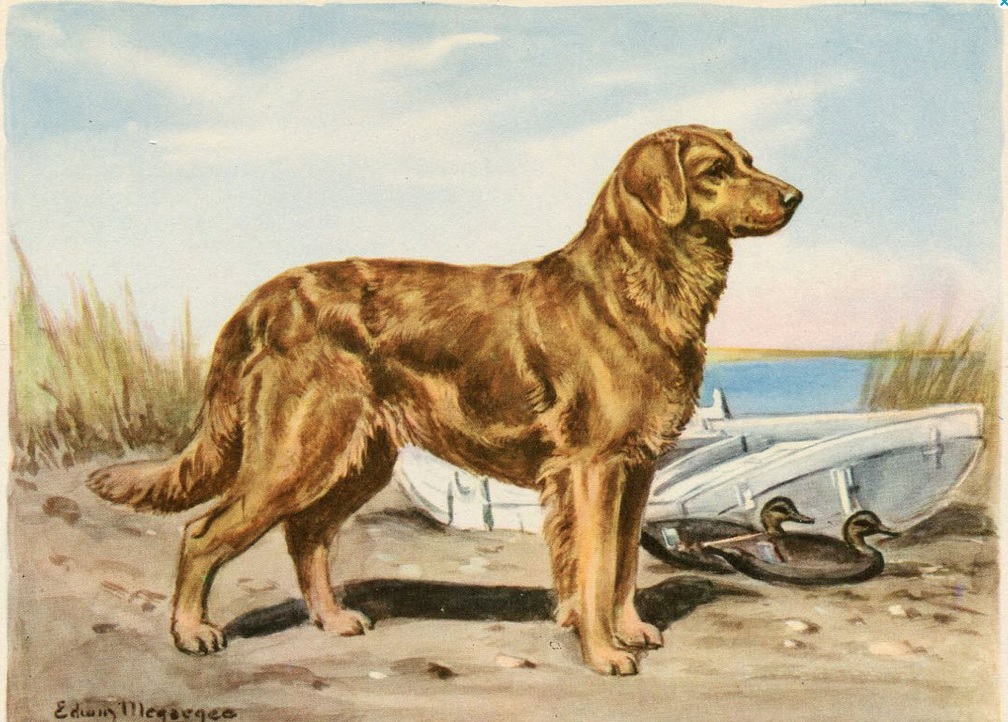
This painting is by the well-known dog artist and dog fancier Edwin Megargee, and it appeared in his book that was simply called Dogs (1942).
In the 1940’s, golden retrievers were quite uncommon in the United States. The only ones that existed were hunting dogs that were largely derived from the darker-colored, more lightly built stock that was common in the UK during the 1920’s and 1930’s. For most of their history in the United States, this is what most Americans would associate with golden retrievers– lithe, wiry, fox-colored retrievers.
In 1942, the received wisdom is that the golden retriever was an off-shoot of some Russian dog crossed with a bloodhound, as Megargee’s text clearly explains:

Of course, it wasn’t until the 1950’s that the Russian story was finally debunked. The golden retriever is just an offshoot of the wavy-coated/flat-coated retriever type.
Also of interest is that Megargee mentions that the dog can e used as a “combined setter and retriever.” Many golden retrievers do point, and some people have trained them for them for this purpose.
Of course, most golden retrievers are used as combination “duck dogs” and flushers. There has never been the strong separation between retriever work and spaniel work in North America as there has been in the UK.
Our hunting culture is more egalitarian, and our waterfowl seasons are more strictly regulated. It’s always been a bit of a tradition in America to keep a retriever for waterfowl but also use it as a spaniel in pursuit of other birds. That way, you don’t have to buy and keep two dogs. One dog can do both tasks.
In the 1940’s, golden retrievers were holding their own with Labradors in retriever trials.
But the golden retriever is a very pretty dog, and it wasn’t long before it became consumed by the pet market and the show ring.
And as a result, working strains of golden retriever are quite a bit less common than working strains of Labrador.
This type of golden retriever still exists, but it’s most common in North America, where, for whatever reason, we’ve been able to hold onto it. Many European working golden retriever strains now include outcrosses to American or Canadian imports.
Most European breeds bred in North America wind up degenerating rapidly. There are no German shepherd breeders importing North American GSD’s to cross with their dogs. I know of no British border collie breeders who are importing American stock to improve their lines.
But you very often see working golden retrievers in Europe with American and Canadian ancestors.
It’s not just with dogs that Europeans shun American-bred domestic animals. The only European-derived domestic animal breed I know of other than the America working golden retriever that has been in demand to improve native European strains is the Vermont strain of the Merino.
This says a lot about American priorities in animal breeding.
Just as Hollywood and much of our new media is a sensationalized distortion of reality, maybe our entire culture is nothing more than a sensationalized distortion of Western civilization.
Maybe that’s why we’re in so much trouble. We can’t even breed domestic animals right!




There are at least a few collie kennels in Europe that have imported American dogs. Reasons are varied – looks, temperament, health, or just a lower COI. Most of the dogs imported are from breeders who value performance and are normal eyed (free of collie eye anomaly), which seems to be a big selling point.
Differences do exist in breeding programs, which can lead to surprises – like a smooth collie producing rough pups (in the US the varieties are regularly bred together), or white pups (which are not acceptable in European show rings).
Typical British show dog:
http://collienet.com/pedigrees/lynmack-stud-dogs.html
American dog with pups in Germany:
http://www.angelfire.com/la3/Earthstar/Earthstar2001sasha.html
When did the Golden really take off as a pet dog? I have a book from the 1949 that states Goldens may make good pets, but are better suited for sporting homes. Even in “The Incredible Journey”, it is Bodger the bull terrier who is a lovable child’s pet, Luath the retriever is a working dog.
Golden retrievers didn’t really become widely known as pets until the 1970’s.
After WWII registrations of Golden rose slowly. In 1955 the AKC registered about 2000 Goldens. The annual numbers showed a steady increase, then In the early 1970 began a precipituous rise (helped along by the presence of Gerald Ford’s “Liberty” in the White House, and the “glamour dogs” in the show rings and in advertisements). Barely 20 years later, in the early 1990s, a record 70,000 Goldens topped the charts. Then, nowhere to go but down. Last year, 2012, a bit over 30,000. (Labradors are still #1 with numbers more than double that of Goldens each year )
1992 was the record year for AKC regstrations of all breeds. That too has fallen considerably (so much that AKC doesn’t even publish the numbers any more, just rankings, but the information is given to club delegates), but Labradors and Goldens have been in the top 5 for some years.
It’s interesting to note that you state the only breed of domestic animal regularly imported into Europe to improve their stock besides the Golden Retriever is the Vermont Merino sheep. Today sheep are everywhere in Vermont, but their numbers are nothing to what they once were. I have read that the demise of the Vermont wool industry was caused primarily by free-running dogs. The way Vermont farmers once pastured their sheep, there simply was no way they could keep dogs away from them, and as Vermont’s population grew, so did the number of free-running pet dogs, and these dogs, with no farm training behind them, killed sheep simply for the fun of it. But the sheep industry is making a comeback in the state, though it will probably never be what it once was.
There are several flocks of high quality Merino sheep in my immediate area (one woman even keeps a Bactrian camel with her flock), but as I look at them, instead of examples of knowledgeable animal husbandry, I see animals mutated by the hand of man for mainly one purpose; to produce prodigious amounts of fine wool. On a whole they’re much like a Shar pei with a very heavy poodle coat. I judge the “quality” of an animal by its natural health: by how well this animal would survive without man’s help. I can’t see flocks of Merinos going wild and creating feral populations like goats can do. So while Merinos may produce the best quality wool, they are a wreck as an animal in whole, and to say they are being imported into Europe because of that, would be like saying American Shar pei are being imported into China because they have even more wrinkles than the original type (the wrinkles being one of the primary things a dog show judge would give a championship to any certain dog for, I would assume): not really a testimony to the skill of American breeders.
We tend to accept less than excellent health in some of our livestock, since most don’t live long enough for any potential health problems to crop up, though in animals like sheep, that produce fiber rather than meat, so should be expected to be on the farm longer than most, it would seem that would be a consideration. But a dog is our life-long friend (even if it does have a job); not stock that can be utilized in some other way once it can no longer function in its original role (an oxen may be primarily a draft animal used for work, but once its legs go, it can still be a lot of hamburger or stew meat), so its long-term health should be more of a consideration that that of a turkey.
A modern egg laying chicken can be expected to lay 350 eggs a year, but only for its first year, then it goes into soup, or is simply ground into fertilizer or some form of animal food, and it is replaced by a freshly hatched clone that can then repeat the process. A success story if you are looking at the number of eggs produce in a year as the end goal. I have a type of chicken that I have bred that one of my friends once labeled ‘Woods Chickens’ many years ago, when she saw a mother hen come out of the woods with a brood of a dozen new chicks behind her. These chickens can practically feed themselves in the right weather (the must be fed during our Vermont winters, of course), they can fly like a grouse to avoid predators, roost high in the spruces at night, and easily raise their own young. But as soon as a hen lays 10 or so eggs she goes broody, and starts setting on the eggs. By the standards of the egg production industry, these birds are a failure, hardly any “better” than the Jungle Fowl all domestic chickens were bred from. And in truth, my birds are much like Jungle Fowl, except they are totally cold hardy. But they are the ideal “back to the land” type meat bird. I can select two roosters and a dozen hens from my flock each fall, butcher the rest for food, let the remaining birds free-range, and the next fall I’ll have 100 to 125 chickens (each hen raises at least two, sometimes three broods a summer) to once again select my breeders from and butcher the rest. My birds are almost totally self-sufficient, and healthy, with many living very long lives: the perfect chicken for my situation.
And that’s what I like in my dogs; they are almost the canid representatives of my chickens (though they’re not allowed to breed at will, of course), a natural, healthy animal not deformed by some humans desire to improve upon nature.
So a quality that makes an animal sought after by one group of people (be it wool producers or show ring debutantes) appears as a horrible mutation to others. I like my ‘Woods Chickens’.
We have all the same founders. It’s actually not that great from a health perspective.
When we bred soft coated wheaten terriers back in the eighties and nineties there was a perceived inbreeding situation and we were lucky to be able to use an American champion dog briefly over in England with its American owner working here. Starting from the one litter in 1983 we were lucky eventually to become Britain’s top breeders of wheatens so our experience of American dog breeding was very positive.
Many years on and now one of our shih tzus is from mainly American breeding and we are extremely happy with her even though we no longer show or breed.
But don’t these American and European (English?) dogs actually come from the same founding stock? There is actually no separate “American” and “English” breed of retriever or spaniel or terrier that can be bred to each other to introduce new “blood” (genes), just American and English versions of the same breed (family), so how can bringing an American dog to England to breed to an English dog help with inbreeding? I don’t mean to disrespect anyone’s beliefs or practices, I’m just curious as to how breeders feel this is advantageous other than to change the phenotype a bit, it can’t change the genotype.
Because there are many breeds which have been divided for almost 100 years now.
For example, there is a patriiline in Swedish Vallhund which went extinct in Sweden which was preserved in United Kingdom:
http://konnunkodon.fi/blogi-en/2013/02/10/the-history-of-swedish-vallhund-part-2-patrilines/
Yes, they’ve been divided for 100 years, but they are still the same genetic stock. Only in rare cases has new genetic material been added, and then that’s quickly been bred away from to get back to the breed standard. My great grandparents migrated here from Scotland over 100 years ago, but I’m still carrying the mtDNA she brought with her. Time (as in generations) only modifies genes through mutation, it doesn’t change the fact that its the same set of genes. Organisms do not absorb genes from the air (with the possible exception of viruses, they break rules), only breeding to an unrelated organism can add new genes.
They may be the same genetic stock, but each population in each country has their own bottleneck effect. For example, is well documented many Australian dogs have inbreeding problems which are remedied (briefly) by importing European or American dogs into the stock– even within the same breed.
The problem is some breeds have very low n (ie. Duck Tolling Retriever) at the very base and are prone to problems no matter where the dogs are located.
There will be differing genetic drift in differing populations. This is why the old, large kennels would often maintain two or more different lines, and cross between them to add vigor (heterosis) lost due to close breeding.
Heterozygote advantage is actually a very simple concept. Dogs have a lot more genes that just the ones that produce the characteristics that we can see or experience.
So some German breeder did the intelligent thing and crossed a Nova Scotia Duck Tolling Retriever with an Australian Shepherd. Problem solved.
Have a read of Borderwars (blog) article on pedigree collapse. In a nut shell, the European and North American populations have had different popular sires…and have thus preserved different parts of the original gene pool. Also, they’ve probably had different – sometimes unrecorded- histories of outcrossing.
The smallest units of inheritance may not “change” much over generations (although they can, via mutation) but they certainly do re-combine to create new sets of characteristics, or controllers of characteristics, that may be inherited as such. Then there is the fascinating subject of epigenes, which is just barely beginning to be understood.
I just think that its interesting that what we outlaw in humans (incest and close relatives marrying), we (well, not me, but “registered” dog breeders) advocate for their dogs. Who would put a hundred people (a large number for the founding stock of most breeds of dogs) on an island and expect to come back in 500 years and find a population of robust, intelligent people? Being stuck on a genetic island in the closed pedigree system can’t be much different. When I wanted to breed a healthy, sound dog, I chose to cross the Irish wolfhound and Alaskan malamute (I like big dogs), two breeds that were about as far removed genetically and geographically (though where they’re from only matters if the original stock was from distant places on the earth) to actually introduce genes that hadn’t been in the same animal for thousands of years, if ever.
Now if some people liked my ‘Alaskan wolfhounds’ so much they chose to make them a breed (the way it worked when most breeds were “developed”) and some went to England, and some went to Africa, and some stayed here in the United States, wouldn’t the descendants of my original dogs (whatever the number of founding there was) all be from the same limited gene pool a hundred years later? Even if some people bred for a more malamute look, and others chose to breed for a wolfhound look, wouldn’t these dogs still be closely related?
We actually did do this. Check out what happened on Tristan da Cunha:
http://bit.ly/ACUktv
Part II: http://bit.ly/13Z6Acq
This is exactly what has happened to dog breeds. Founder effect genetic drift and popular sires!
That video on St. Tristan Island was interesting, but it only looked at the tip of the inbreeding iceberg. An isolated gene pool is probably the cause of the higher rate of asthma in the population of the island; and that’s only after 200 years; what’s that in human generations, eight or ten? 100 years of dog breeding gives you what, 25 to 50 generations? And all starting from a much less heterozygous population than the people on Tristan did. So any purebred dog breed that’s 100 years old has lost a lot of its genetic diversity. The fact that a puppy’s parents both carry almost identical genes is what makes a breed “breed true”; its why a Doberman looks like a Doberman, a Soft Coated Wheaten Terrier looks like a Soft Coated Wheaten Terrier, and a Pug looks like a Pug. Genetically, they all really “want” to look like a pariah dog.
We humans may have all come from the same genetic source, but if we look back far enough we even come from the same genetic origins as pine trees, but each species carried all the genes it needed to survive. And it’s the strict natural law of survival of the fittest that ensures only the most superior of a species will pass on their genes. Dogs do not live under that law; whether or not they breed is all up to Man. And it’s impossible to compare the genetics of a purebred breed of dog with an actual species, since any breed of dog has much less genetic diversity than any species, except those that have reached such a low number of individuals they reached a genetic bottleneck.
Even dogs descended from a critically low number of founding individuals could survive and make a genetic comeback, this has been done on Australia where the Dingo thrives (or did before Europeans came on the scene), yet may have descended from as few founding animals as a single pregnant female. That alone shows that without man making selections in place of nature, even intense inbreeding can be overcome. But none of us are ever going to turn our dogs loose and let nature pick out the best, so we have to be honest with ourselves and concentrate on breeding healthy dogs, and I believe the only way to do this, and certainly the only way to do it without breeding many more generations of unhealthy dogs with that goal in mind, is to out-cross, change some of the breed standards, and free the domestic dog from its isolation on a pedigree island.
“…maybe our entire culture is nothing more than a sensationalized distortion of Western civilization.”
Yup!
Most Americans are horrible dogs breeders but I think our cattle breeding holds up OK by world economic standards. We exported a LOT of Holstein genetics (semen) to the EU countries in the past 20 years (I believe there is now a quarantine).
Americans have done wonders breeding cattle, but if Holsteins were a breed of dog they’d be a worse basket case than most AKC dogs are now. I’ve pulled more still born calves, treated more cases of mastittis, roled more cattle to try to untwist a stomach, and treated mkore cases of milk fever than i care to list. As a massive unatuiral milk producer, holsteins are great, but as
HI DAC,
That a little extreme! Most Holsteins still breed naturally, and do produce a usable product over their short life. At least their breeding has mostly been a response to economic necessity.
Our achilles heel in breeding is often excessive attention to size. We create these big animals that lose longevity and hardihood. Suffolk sheep also changed enormously in my lifetime, gaining size but losing hardihood. However under current economic conditions, that is often what makes money to pay the farm taxes. Especially with dairy cattle, long lived but low producers will not do that. I have been fooling with some Kerry Cross cattle, but I am just a weird old semi retired coot. If I had start again to make money, I would use Holsteins as a starting point for a commercial cross.
Yes, there’s no doubt that dairy farmers must pump out the milk to stay in business, especially with today’s milk prices. My uncles farmed when i was young (back before bulk tanks and pipelines, so i carried many pails of milk), and we raised beef, so i had a lot of experience with cattle. Then i went to work for the local vet for the first four years after graduating. He was mainly a large animal vet, so I got to see a lot more of the down side with these big, heavy producers. As little farmers began keeping larger and larger herds, a lot of guys tried sticking with their Jerseys, mostly because the distance from the stantion to the gutter in their old barn was too short for Holsteins, though I know one guy who even kept them for a while when he built a free stall. But he slowly changed over to Holsteins eventually. You can’t beat a Holstein for producing milk, but as a well put together animal they’re not much to brag about. I raised Scottish Highlanders for years, and could pretty much ignore them as long as they had feed, and it didn’t have to be lush pasture either, though I always kept mine in a hundred acre pasture with a mountain stream running through it that was pretty much a cattle paradise. But even these rugged little cattle had their drawbacks; when the snow got too deep they had trouble moving through it with their short legs, so they’d probably never work well on free range out west where they get deep snow. I used to love going out on the hillside and setting on a rock and just watching my herd. But I always loved the looks and actions of a friends beefalo, too. Those things moved around like Spanish fighting bulls.
I don’t condemn breeders for producing the Holstein for what it is supposed to do. It’s just when people breed compromised animals, whether for producing milk, or winning ribbons in a show ring, and then try to say everything is fine with that animal physically that I take exception. When i was a kid a German shepherd was about the best dog you could own (mine was even named Rin Tin Tin), but I wouldn’t own most of the GSDs I see today. Who could walk around with a dog that can hardly stand on its hind legs and be proud of it?
I’ve seen problems with AKC dogs since I was in high school in the 60s, so when i grew old enough to do my own thing I bred my own dogs, not caring if anybody would register them or not. i always wanted to do an Irish wolfhound – Alaskan malamute cross, so seven years ago i bought Branigan, a male IW, and Denali, a giant AM, and the pups I’ve raised from them are some of the greatest dogs I’ve ever owned. A friend of mine who hunts bobcat, bear and coyote with his hounds visited recently and saw Grizzly, one of my ‘Alaskan wolfhounds’ running in play, and said he bet Grizzly could actually catch a coyote. And Grizzly weighs 120 lbs. So when people tell me how physically fit their AKC dogs are, i just laugh, because their comparing their “Holsteins” to my “Beefalo”. :)
Good luck with your Kerry cross-breeding project. A guy not far from me has some small, horned black cattle that might be Kerry.
I am proud to say I own a golden who looks like and has working lines and no show or bench lines. He looks exactly like the dog in the picture except for he is dark red. I got him to outcross back to the bench line females I had at the time. He is loyal and is great working dog. He doesn’t shed and his coat does repel water. The working lines are very intelligent and gentle.
My field golden is exactly like the old golden in the picture. He is dark red and does point. He is from the lines that tweedmouth son brought in thru Texas many years ago. It is hard to find these lines and I am lucky to have a pure hunting line golden. He is neither hyper and is just a great dog. The bench people have produced a heavy bones golden with much hair. I prefer the slender lines with lots of drive to work.
In race horses, there have been exports both directions. There are a few exports of cattle http://en.wikipedia.org/wiki/Holstein_cattle and (http://www.nytimes.com/2011/10/14/business/us-cattlemen-export-animals-to-rebuild-russias-herds.html?_r=0 ) . In most cases, import/export restrictions make it fairly expensive. There are a few American breeds that are fairly popular in Europe — American version of the Akita, Chihuahuas, AmStaffs. Australian Shepherds (which are American despite the name) are pretty popular in Europe.
To a large degree, Europe tends to reject American imports period (the exception being McDonalds) — in many ways, America is still viewed as “the colonies” with lower level art, music, and animals. This is overcome more often when it is a matter of practical function or real money. When it is a matter of “taste” or aesthetics, it seems to be more one way.
Those are all breeds that originated in America. I was talking about something that originated in Europe. I would go as far as to say that the American Akita is an actual breed unto itself because the Japanese don’t breed dogs like that at all.
Oddly enough, my computer chose to send my last post unfinished, uncorrected and unedited. But as I was trying to say: As a massive, unnatural milk producer, Holsteins are great, but as an natural, healthy animal, they’re a disaster.