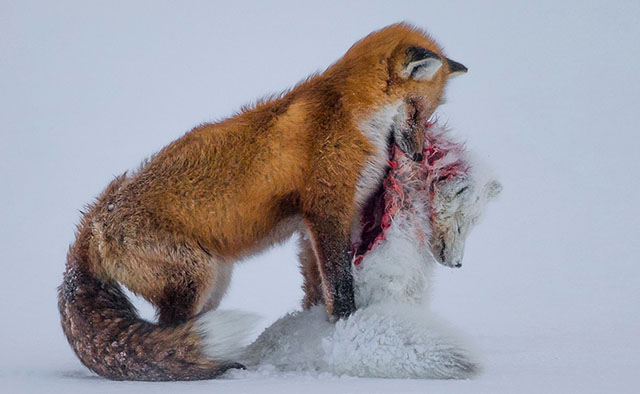
This photo showing a red fox killing an arctic fox was taken at Wapusk National Park in northern Manitoba. The photographer, Don Gutoski, is a physician at an emergency room, but his amateur status didn’t stop him from being named 2015 Wildlife Photographer of the Year f by BBC Wildlife and the National History Museum.
The photo is an epic demonstration of climate change’s effects on an ecosystem. Red foxes are expanding their range north into arctic fox range, and red foxes in those northern regions are known for eating other foxes when they come across carcasses. It’s doesn’t take much for them to start hunting the little arctic foxes, the polar jackals that follow the great white bears across the sea ice.
With climate change, red foxes can come north into areas where they weren’t before, and this is bad news for the arctic fox.
This predation has fascinated me quite a bit. Check out my previous posts:
- Red fox kills arctic fox at Prudhoe Bay, Alaska
- Red fox kill arctic fox
- Red fox kills arctic fox, Part II
These two species actually have produced sterile offspring in captivity, but it should be noted that they aren’t that closely related. Red foxes originated in the Middle East. Their closest relative is Rüppell’s fox. Arctic foxes are have been said to have an Old World origin, but their closest relatives are the swift and kit foxes of North America.
So climate change has thrown these two lineages together, and it’s not looking good for the specialist polar jackal.
And this photo is so amazing. I’m glad Don Gutoski was able to capture it, and I’m quite pleased that he is being recognized for it.




I wonder what the anti-fox hunting campaigners would have to say about that.
I tend to have sympathy for the underdog and don’t like it when a species becomes too widespread and too successful as in the case here with the red fox.
“Polar jackal”. Nice.