Feeds:

Archive for the ‘Human evolution’ Category

This animal is a Serengeti golden jackal.

Yes. They do look like coyotes.

Not all golden jackals look like coyotes, but some really are hard to tell apart from their North American cousins.

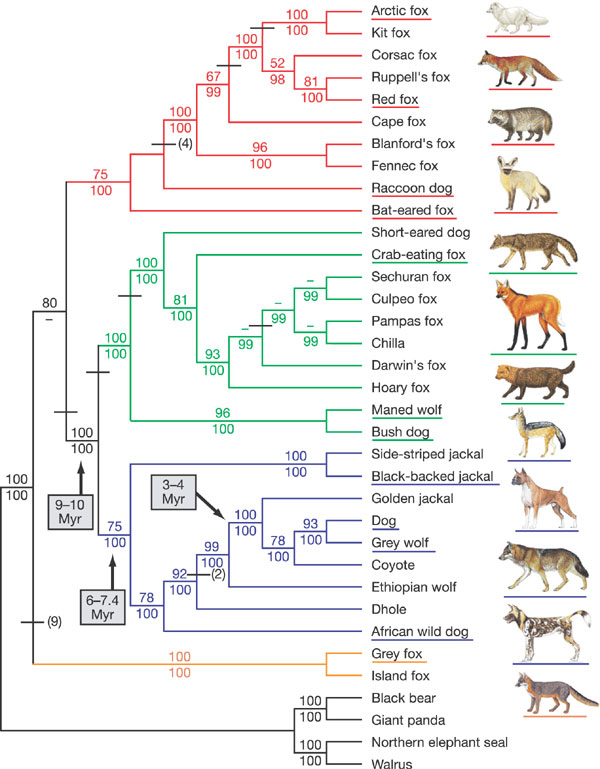
Golden jackals are much more closely related to wolves and coyotes than to the other two species of jackal. The side-striped and black-backed jackals are very distantly related to the other members of the genus Canis.  They are found only in Africa, while the golden jackal is found in North and East Africa, a huge chunk of Asia, including the entire Middle East, and part of Europe.

During the Pleistocene, there are fossil records of what appear to be golden jackals (not coyotes) in North America, which would have been a weird situation. I’d hate to have to identify wild dogs in that particular environment!

I have never seen a verified record of a hybrid between a dog, wolf, dingo, or coyote and one of those two Africa-only jackals.

I have seen photos of dogs that supposedly are, but no one has ever performed any genetic tests of them. It’s just assumed that because certain pariah dogs in Africa have jackal features, then they must have jackal ancestors.

However, it is much more likely that the similarities are  the result of sub-Saharan African dogs evolving to live in the same environment as the black-backed and side-striped jackal.

***

Black-backed jackals are fierce little critters. They totally dominate the side-striped jackals. The two animals are almost never found in the same environments, because the because the black-backed bullies drive the side-striped jackals out.

However, it’s a different story where black-backed jackals and golden jackals share a range in East Africa. Black-backeds must share with the goldens.

***

Many years ago, I saw footage of both black-backs and goldens scavenging the same carcass.

It was really strange to watch.

Here we had the cosmopolitan golden jackal, a close relative of the wolf and coyote, eating with an animal that is the oldest extant member of its genus.

It is almost like humans sharing a meal with Lucy or maybe even Paranthropus.

The two jackals species were about the same size, but the goldens had larger heads.  The goldens also used the “threat gape” and the tucked tail and arched back posture that coyotes use as a dominance display.

The black-backeds were basically just rude guests.

They ran in and out and occasionally got into nasty fights with each other.

Because the golden jackals have bigger heads, I’m pretty sure they really damage a black-backed jackal. And I’m sure the the black-backeds knew this.

They didn’t mess with the goldens.

It was a very weird scene.

It was like watching two branches of an evolutionary family being reunited.

I wonder what these animals think of each other.

I’m sure they know they are not members of the same species, but I can conjecture that they somehow recognize some similarity.

I am reminded of the time when a three-month-old Miley came faced to face with a gray fox– an even more distant relation to her than black-backed jackals are to golden jackals.

The two animals just stared at each other for about 30 seconds. You could read both of their eyes. Both creatures were intrigued and frightened at the same time. This was the first gray fox she had encountered, and I’m sure that this was the first golden retriever puppy this gray fox had ever seen.

These animals have no knowledge of our sophisticated Darwinian theory.

But their noses, their eyes, and their ears surely spoke of some ancient commonality.

A sense that I cannot imagine, but can only catch glimpse of in my psyche.

My mind tells me that I am a primate, that I share a large percentage of my DNA with the chimpanzee and the bonobo, two species that could never safely live in my world. Yet I share my life with dogs, who fit so nicely into our culture constructs and various contrivances we call civilization.

I also am more closely related to that recently discovered titi monkey than I am to the domestic dog, a creature my species has known for tens of thousands of years.

Yet is the dog that feels like a family member.

I know more about those animals than I know about my own primate brethren.

And yet when I look at dog and I look at man, I am still confounded.

We know so much, yet know so little. We are so close, yet so far away.

We are closer than the black-backed and golden jackals feasting on carrion. We consider each other to be social partners, even family members, but the jackals have a common Canisness that I can never experience with another species.

I can’t imagine feeling as close to a chimpanzee as I do to my dog.

I am descended from the ape that became a wolf and then took over the world.

And that may be why I feel this greater commonality with the dog than I do any primate.

Maybe this is why man feels so alone among animate creation. We know no commonality with other species with which we share a close common ancestry, and the species with which we share the greatest commonality in terms of our behavior isn’t a close relative.

So we hold onto dogs to remind us of that one time when we part of something else, when we were not separate from the rest. The dog is our connection to the other creatures, not the chimpanzee.

Read Full Post »

Feeding the ducks

On my last evening at the beach last week, I went out to the pond to feed the turtles and a big Asian carp that essentially made a living out of begging food from people.

As I tossed out the first pieces of bread, I heard a quacking sound from the other side of the pond.

And then I saw six brownish forms motoring across the pond in my direction.

I recognized that I was about to enjoy the company of a few mallard ducks.

I have always been a bit of a duck lover. I had a pet Muscovy hen named Chester, who was so named under the assumption that she was a male. When she laid an egg, she remained Chester. I just couldn’t come up with something else.

I also have a soft place for wood ducks. Every spring, a pair of these ducks check out our pond. With all of those trees growing around it, the pond appears to be an ideal place for these tree nesting ducks. It’s only when they discover that there are no hollow trees in which to make a nest that they move on to more suitable lodgings.  I have often wonder what would happen if we put a nest box in one of the trees. Maybe they would stay. Maybe.

But my mind was not on those birds this evening. My mind had been on turtles, gulls, and scallop shells. It was only from that quacking that my mind began to consider ducks.

My mallard company continued to advance in my direction. I could tell that this was a mother mallard and her five nearly grown offspring. Her orangish bill announced her adult status, as did her quacking and her position in the rear of the swimming phalanx. Her five nearly grown ducklings still peeps as if they were still little down-covered things.

As I tossed the bread into the water for the ducks, it became clear that feeding in the water was not what they had in mind.  They ignored the pieces of bread in the water and kept advancing. As soon as they reached the bank where I was standing, they leaped out and surrounded me.

I dropped a few crumbs for them. Some of these fell at my feet. The ducks ran around at the edges of my toes and gobbled down the bread.

Then, for some inexplicable reason, I knelt down. Perhaps I was just moved at the boldness of these wild ducks. Perhaps I had some primal urge to want to commune with them. I don’t know.

But I got on the ducks’ level. I was looking into their soft brown eyes.

And they were looking into mind.

I made sure that I tossed a little bread to the hen, who stood a few feet behind her charges. She was covering their backs.

Two of the ducklings were quite bold, and it did not bother them in the least to take food from my hand. They seemed to enjoy this behavior.  It may have given them an advantage over their siblings, who were busy squabbling over tossed aside crumbs. From my hand, they were guaranteed a big piece and no competition. They just had to be bold enough to take the bread from my hand.

Twice the bold ducklings’ bills missed the bread and grazed my fingers. I could feel the serrated plates on the inside of their bills gently scrape my hand. I first felt this sensation when I was a young boy at West Virginia state park. I remember being so scared by it that I know that I cried when ” the duck bit me.”

Yet when I felt this sensation from these ducklings, I felt connected. The duckling and I were one for a brief second. I could feel its sensations. I could fully appreciate its essence.

It brought out something instinctive in me that I can’t quite comprehend or fully articulate. It is this deep desire to connect with other living things that suddenly was awakened.

I’m sure that this desire is deep within all of us. That is why we want to feed wild animals. Even if we know that feeding many wild animals makes them more dangerous than the would be otherwise, we still want to. We want to feed the raccoons, the opossums, the skunks, the bears, the deer, and the alligators.

Such a desire probably made us better hunters and trappers, so one can see that it has some evolutionary advantages. Being able to catch small, cute animals also probably helped men win favor with women. Later on, anyone would could domesticate animals would have certain advantages in maintaining as constant source of protein.

But beyond that, I think we just like to connect with non-human beings. We have to put on so many different shells when we deal with others of our species. With animals, we can allow ourselves to be more open.

That’s the main purpose of dogs and cats and other companion animals. They allow us to be ourselves with another being that has a pulse but no ability to make harsh judgments about who we are.

The cheeky ducklings took me back.  No, they didn’t necessarily take me back to my somewhat duck-crazed childhood. They took me into a deeper past.

A past we all share as Homo sapiens, whoever we are or where ever we live. It is the same past we share with domestic dogs. It is the past that existed when we lived as part of the ecosystem and not above it.

It is a past that we will never regain.

But for a few seconds, we can catch glimpses of it. The vestiges that come through when we walk in the woods with our dogs or when we feel the bill plates of a duck gently scraping our skin.

And the trick is learning how to appreciate the glimpses, however brief they may be.

Read Full Post »

Some rational discussion about population

Source.

Read Full Post »

Study revives an old debate

Do modern humans have Neanderthal DNA?

Which of course revives the debate between the Out of Africa theory and the Multiregional Hypothesis?

The consensus is the Out of Africa theory is more likely, although you’re still getting studies that suggest a multiregional origin for modern humans.

If anyone has neanderthal ancestry, I do. My own ancestral roots are in northwest Germany, not very far from where the first neanderthal man remains were found.

Read Full Post »

Hardcore “primitive subsistence hunting”

Vegans do not need to watch this. It’s hard to watch even if you’re non-Vegan!

Source.

This is from an Italian film called Africa Addio, and this film is quite controversial. However, the controversy doesn’t come from these hunting scenes, which were probably contrived. ( However, the elephant  and hippo footage did tick off Roger Ebert.)  The film is essentially an apologia for European colonialism. The message is: “Look at them savages. They like torturing animals for fun!”

However, despite all the controversy. I do have one little question.

How do you think our ancestors killed mammoths and mastodons?

Probably something similar to the this.

Read Full Post »

The way they used to hunt

Source.

I don’t know how these guys do it, but my guess is the San have skills that we’ve just turned over to driving cars and running computers.

Or maybe we’ve lost this knowledge entirely.

The persistence hunt is supposedly the oldest form of hunting. This is how our ancestors got most of their food. Granted, mine probably weren’t chasing Kudu in Northern Europe, but they were hunting red deer, caribou/reindeer, aurochsen, wisent, horses, and marine mammals.

Read Full Post »

The Liger and the Humanzee

Check out the Liger.

This comes from an interesting documentary that is also worth seeing:

Source.

I don’t want to spoil it for you, but Oliver was no humanzee.

I also need to tell you that this film includes some adult content.

I’m not going to post the Stalin’s Ape Men documentary, because it’s a giant let down. It turns out that Uncle Joe didn’t want to breed an army of ape men. The Soviet government just wanted to prove that man and chimp had a common ancestor.

Read Full Post »

« Newer Posts - Older Posts »

Follow