Canadian bush meat:
This is from TheWildNorth channel.
These are spruce grouse.
Posted in birds, Labrador retriever, working retrievers, tagged spruice grouse on October 28, 2012 | 3 Comments »
Posted in Labrador retriever, working retrievers, tagged beaver, Labrador retriever on October 23, 2012 | 8 Comments »
And what do you do with your beaver after you kill it? You eat it:
See related post:
Posted in Labrador retriever, working dogs, working retrievers, tagged American beaver, beaver, Labrador retriever, North American beaver, Northwest Territories on October 21, 2012 | 5 Comments »
Hunting a beaver with a Labrador retriever in the Northwest Territories:
The channel this video came from is called TheWildNorth.
It’s well worth your time to watch the hunting and trapping videos.
They are really amazing.
Posted in Labrador retriever, tagged silver Labrador retriever on October 2, 2012 | 32 Comments »
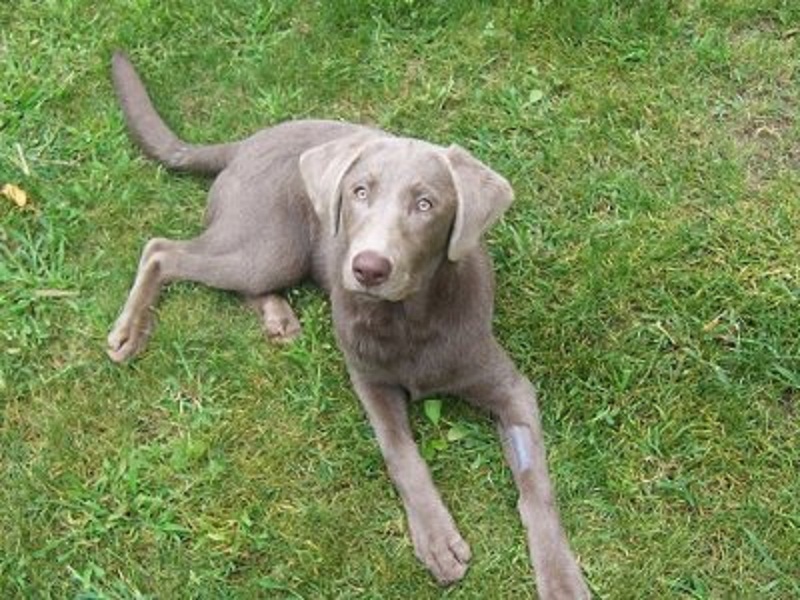
On my recent post in which I worried about the potential for a breed split in golden retrievers over color, I linked to a post in which I suggested that silver Labs become a distinct breed.
I was asked why I made these two contradictory statements.
There are two reasons: the cream color in golden retrievers has long been established in the breed and it is possible to develop a way for cream colored dogs to be accepted in the North American breed.
This doesn’t exist with the silver and charcoal Labs.
The Labrador Retriever Club requires that silver (diluted chocolate) and charcoal (diluted black) dogs be registered as either chocolates or blacks.
But their color does not meet the description of black or chocolate in the AKC Labrador standard– and that’s a big problem:
” Black–Blacks are all black. A black with brindle markings or a black with tan markings is a disqualification…Chocolate–Chocolates can vary in shade from light to dark chocolate.”
I don’t believe you can say that charcoal Lab is black. It looks blue.
And the silvers don’t look like “light chocolate” either. They look steely gray.
And because they don’t look like the colors under which they are registered, how on earth would they ever win at a dog show?
If the Labrador Retriever Club says that they won’t recognize these two diluted colors as they are, then how can we say they have a future in the breed.
Now, the problem is there is a demand for diluted Labradors.
Demand doesn’t go away because a breed club decides the color is wrong. Have a look at white German shepherds if you want to see where that leads.
In the end, I think the only thing that can be done is for dilution factor Labradors to become their own breed.
And if they become their own breed, they can do outcrosses to ash Chesapeakes and weimaraners to increase genetic diversity.
This dilution also exists in Newfoundland dogs, which strongly suggests that it’s been in retrievers since the time they were working dogs in Newfoundland.
But if there is no room for these Labradors within their breed, it sounds like they might be better off on their own.
I suggest they call the breed the silver retriever, even if it includes charcoal ones.
We already have a golden retriever. Why not a silver one?
Posted in Labrador retriever, tagged Labrador retriever on August 4, 2012 | 15 Comments »

Pippa Mattinson is training a new Labrador to work on her shoot.
Her name is Rachael.
And she’s a chocolate.
Chocolate Labradors are generally not well regarded in the British gun dog culture. That’s probably because most chocolates are found in lines that produce primarily conformation dogs.
The decision to use a chocolate Lab as a gun dog was met with polite skepticism:
I passed a member of our shoot on my way down to the meadow the other day and signalled to him that I had something of interest in the car.
“Oooooh!” says he with interest
“is it a new puppy??” says he with enthusiasm as he climbs out of his landrover
“is it a Labrador?” he asks excitedly as he crosses the road and peers in through the window of my truck
“Oh”. he says, as his voice trails away with disappointment. “What a pity” he sighs.
“Its chocolate…”
And he was only half joking.
It’s also somewhat unusual to find a chocolate Lab as a gun dog over here. Most chocolate Labs are in English conformation lines, but there are also found in the giant pet Labrador lines that are very common in this country. I’ve seen many chocolate Labs that look very much like smooth-coated bronze Newfoundlands.
Rachael doesn’t look very much like Tess, Pippa’s working-bred fox red Labrador.
To be fair, fox red is my favorite color in Labradors, but it’s almost entirely found in working bloodlines from the United Kingdom.
It’s virtually unknown over here, where most yellow Labs tend toward the paler end of the yellow to red spectrum. (Golden retrievers tend to be quite the opposite. Darker colors are still more common over here.)
Chocolates, though, are fairly popular in the United States.
There aren’t as many of them as blacks and yellows, but they aren’t exactly rare.
However, for whatever reason, the chocolate dogs are not normally found in any lines that are used for gun dog work.
Or anything else that Labradors are typically used for.
Why chocolates are so underrepresented is a fairly good question.
Could it simply be that the lines that produce chocolates tend not to be those that produce working retrievers, as I am suggesting here?
Or is there something intrinsic to the chocolate color that makes the dogs inferior?
I doubt that the latter hypothesis is correct. The German HPR’s are commonly liver in color, and they have generally been selected for that color over the black (with the exception of the large Munsterlander, of course.) And let’s not forget that Chesapeake Bay retrievers were always selected for the brown skin gene, including both brown-skinned yellow to red and true liver.
British gun dog culture has had a strong preference for black coloration in retrievers. Rawdon Lee had nothing but contempt for “common brown retrievers” in his A History and Description of Modern Dogs of Great Britain and Ireland (Sporting Division) (1894):
The common brown retriever that we see running about the streets, neither curled nor wavy, nor smooth, is a sort of nondescript animal we can well do without. He is usually snappish and ill-natured, and, when not looking in the gutters for a living, may be found chained up to a kennel in somebody’s back yard. Those who own a dog of this kind are recommended to exchange it for a nice little terrier, which will not only cost the owner less in the way of food, but be not so liable to bite his neighbour, his wife, or his children. When anyone is bitten by a dog the odds are two to one that the injury was caused by one of these common brown dogs (pg. 201-202).
It may be that decades of that particular prejudice has had some influence on the bloodlines, and that it may have started a sort of self-fulfilling prophecy through genetics.
But people are trying to breed chocolates into working lines, and they are trying produce decent animals.
Maybe someday, the decades of prejudice against chocolate Labradors in working lines will disappear.
But within Labradors, there are many subcultures, and many different ideas about what is an excellent example of this breed.
It is very difficult to get people to change their minds, especially when tradition says that it’s always been this way.
Tradition can be the worst enemy of dogs.
This one is one of the toughest to overcome.
Posted in Flat-coated retriever, Labrador retriever, Newfoundland, Retriever history, working retrievers, tagged Flat-coated retriever, Labrador retriever, long-haired St. John's water dog, Newfoundland, St. John's Water Dog on August 3, 2012 | 5 Comments »

Tip was an imported “Labrador” whose descendants were top field trial flat-coated retrievers, Pitchford Marshal and Monk.
He was born in 1832 and was imported.
His coat, if one looks closely, might have been feathered. I note a plumed tail, rather than the more typical brush tail of the St. John’s.
I could be wrong about what I’m seeing (and I do NOT want to have a discussion about it).
It’s just very unusual that we see depictions of the ancestral St. John’s water dogs that went onto found strains of retriever. Normally, we find out through some unusual scholarship that a particular retriever was an import, but normally, this information isn’t provided.
This image comes from The Complete English Wing Shot (1907) by George T. Teasdale-Buckell.
And Teasdale-Buckell does provide depictions of his descendants, and they are clearly flat-coated retrievers, though much more robust than the current incarnation.
So he may have been a feathered dog.
One aspect of retriever history that has been overlooked is that St. John’s water dogs came in both smooth and feathered varieties. At least at one point, they did. The settlers were eager to get rid of the feathered dogs, so they very readily exported them, where they were used to found strains of retrievers. This explains why the long-haired wavy-coated retriever was the most common retriever in the British Isles through much of the nineteenth century.
Unfortunately, most of the research on retriever history that has examined these water dogs and their role in founding retrievers has been performed by Labrador retriever historians, and at least subconsciously, they have tended to ignore the feathered variety. If they mention them at all, they assume they must have been crosses with collies, setters, or spaniels, but when one reads of feathered retriever-liked dogs actually being born in Newfoundland, this assumption doesn’t appear to have much validity.
It’s true the Newfoundlanders preferred smooth-coated dogs, and the last remaining “pure” St. John’s water dogs were smooths.
But that doesn’t mean that they always were this way.
See related posts:
Posted in Labrador retriever on July 25, 2012 | 24 Comments »

John Grogan wrote Marley and Me. It is the story of a particularly wild yellow Labrador from performance lines that unfortunately wound up living in a suburban household. As one might expect from a dog of this type in that particular situation, he sort of went wild tearing things up.
As anyone who has read the book or seen this movie, Marley has passed on.
His successors, as of 2009, are two very different Labradors.
The dog on the right is Gracie, a brown-skinned yellow dog from performance lines.
And the other dog is Woodson, a conformation-type Labrador who was among 27 yellow Lab pups played the young Marley in the film.
Gracie is typical of performance-bred Labradors. She’s quite gracile and athletic, designed for speed on both the land and the water. Not many performance Labradors are brown skinned yellows. Brown skin is indicative of chocolate ancestry somewhere in the dog’s history, and most performance Labradors are black and a small percentage are yellows. Virtually none are chocolates.
But she’s still obviously of that type.
Woodson is a pale yellow, which some people think is actually white. It’s not. He’s also a black-skinned yellow. Most conformation-type yellow Labradors are paler in color, and because the standard essentially prefers black skin pigment over brown in yellows, there is a selection for dogs that have this sort of polar-bearish appearance.
The Labrador retriever is the most common dog in the United States. It may be the most common purebred dog in the entire world.
And because they exist in so many different places and are used for so many different things, they have quite a bit of variance in appearance and type.
The performance vs. conformation types is just one division within the breed.
There are many different flavors of Labrador.


 | williewestfall on Bobcat scat |
 | cyborgsuzy on Forgive the gratuitous ne… |
 | retrieverman on Forgive the gratuitous ne… |
 | pondpawed on Forgive the gratuitous ne… |
 | Eugenie on Tailgate |