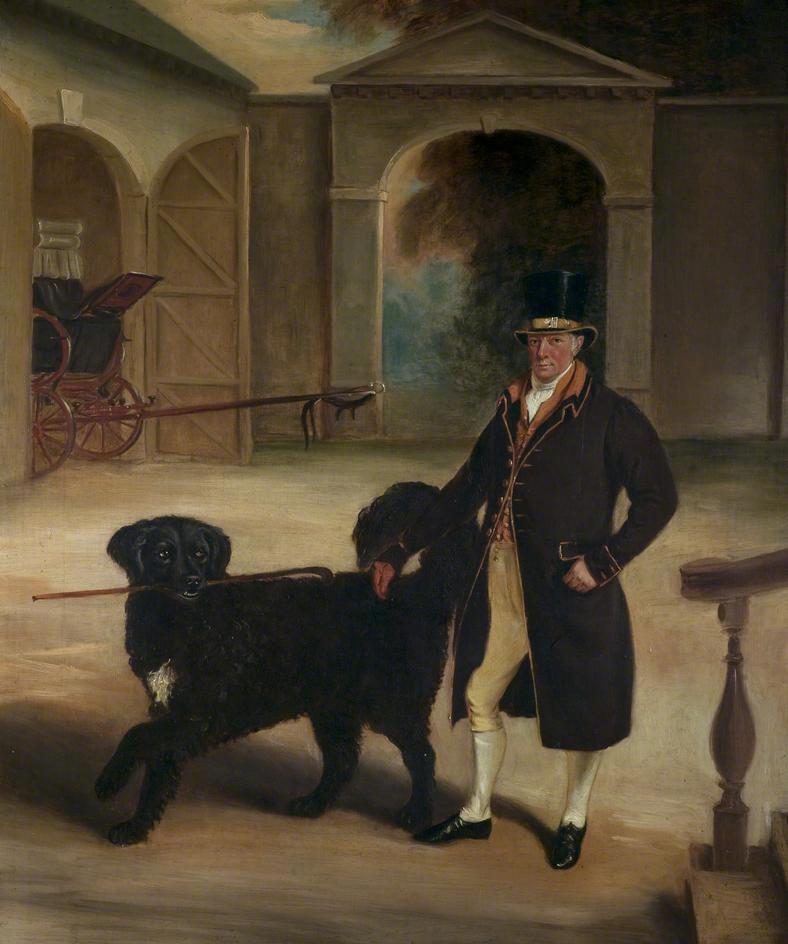
This portrait by Edmund Havell was painted around the year 1840.
It is called “William Stratton, Head Keeper to Sir John Cope of Bramshill Park, Hampshire.”
The original copy no longer exists.
For some reason, it was displayed at the British Embassy in Tripoli.
Earlier this year, when Libya was in throes of a bitter civil war. The United States, Britain, France, and Italy were engaged in supporting the rebels against Col. Gaddafi with air strikes. In a demonstration of their rage against the West, Gaddafi’s supporters stormed and looted the British embassy. They took the fine works of art out of the embassy, and it is believed that they were burned.
The Sir John Cope who employed William Stratton as his keeper was not the famous military commander who lost to the Jacobites at Prestonpans in 1745. This Sir John Cope assume the title in 1812, but he was part of the same Cope family that had owned Bramshill Park since 1700.
The dog is of great interest to retriever history, for here we have an unequivocal example of a red brindle retriever.
Brindle still pops up in Labrador and Chesapeake Bay retrievers today, and it is masked by the e/e mutation in golden retrievers. The only way one can see it in golden retrievers is if a golden with a e/e masking brindle is bred to another breed. (Like these golden retriever/Malinois crosses.) Most golden retrievers are e/e masking dominant black, but black and tan, brindle, and sable can be masked.
This particular dog strongly resembles a Cão de Castro Laboreiro. It is often suggested that the St. John’s water dog or early Labrador is partially derived from this dog. Stonehenge wrote that brindling on an English retriever would be indicative of its “Labrador” heritage:
An English retriever, whether smooth or curly-coated, should be black or black-and-tan, or black with tabby or brindled legs, the brindled legs being indicative of the Labrador origin. We give the preference, from experience, to the flat-coated or short-coated small St. John’s or Labrador breed. These breeds we believe to be identical. The small St. John’s has marvellous intelligence, a great aptitude for learning to carry, a soft mouth, great strength, and he is a good swimmer. If there is any cross at all in this breed it should be the setter cross (pg. 89).
(Note that there is a definite reference to the St. John’s breed having long hair. “Flat-coated” means long haired in retriever parlance.)
Charles Eley in his The History of Retrievers (1921) wrote that with wavy/flat-coated retrievers that “[t]he early specimens had frequently shown tan and brindle.”
In those accounts, the retrievers were only brindle at tan points or on the legs.
This dog is entirely red brindle.
This brindle dog could have been called a Newfoundland, a Labrador, a St. John’s water dog or St. John’s dog, or a wavy-coated retriever, depending upon the context. Because the painting dates to about 1840, it more than likely would have been called Labrador or Newfoundland.
These dogs were developed from stock that belonged to various people living in Newfoundland. One should never discount that the mainstay of English, British, and Irish settlers brought dogs from those countries. However, there were several nations that fished off Newfoundland– most notably, the Portuguese. Most people know that the Portuguese were among the first Europeans to visit the island, and the place called Labrador was actually land that the Portuguese crown granted to a sailor who explored this part of the world in the fifteenth century.
Fishing off the Grand Banks was a stable of the Portuguese economy well into the twentieth century.
The tendency in many official retriever histories was to ignore the possibility that Iberian breeds could have played a role in the founding of the St. John’s water dog. Richard Wolters dismissed the possibility that the Portuguese water dog could have played some role in developing the St. John’s breed, simply because the official concession on the Grand Banks gave the Portuguese different fishing grounds from the British and Irish fishermen.
The problem with this dismissal is that from at least the eighteenth century, English and Irish settlers were living in Newfoundland– in defiance of a law passed in parliament that forbid permanent settlement on the island. Many of these people were pressed into service with the British navy– freed from jails and workhouses, where they may have been sent for poaching on the great hunting estates. These sailors– almost all of them men– lived in defiance of the law, and they called themselves “the Masterless Men.”
These Masterless Men likely wouldn’t have paid any attention to any maritime laws, and they likely occasionally relied upon the Portuguese and sailors from other nations to gain access to new goods.
I don’t see why such people would not have been able to procure Portuguese water dogs, which act very much like retrievers and worked on the Portuguese fleets in almost the exact same fashion as the St. John’s water once did.
I also don’t see why the Cão de Castro Laboreiro or something very similar to it couldn’t have been brought over with the Portuguese.
Cão de Castro Laboreiro is a rustic farm dog from northern Portugal. It is from the village of Castro Laborerio, which it was developed to guard cattle and other livestock from wolves. It can handle cold conditions quite well.
There is a very similar brindle dog on the Azores, Cão de Fila de São Miguel. It’s normally cropped and docked and looks quite fierce, but when undocked, it is very similar. It has a different mtDNA sequence, but since we’re talking about dogs that may have come from the same generalized landrace– and dog from the Azores represents an insular population– it might be possible that these dogs are more closely related than the mtDNA analysis might suggest.

Cão de Castro Laboreiro. This dog is very similar to the retriever in the painting by Edmund Havell. They also come in yellow, and the yellow ones really look like Labradors.
My guess is the rough cattle dog-type from northern Portugal would have been an asset in Newfoundland, which was full of black and polar bears (which were called “water bears.”) Breed this sort of dog with some working English cur dogs, water spaniels, Portuguese, French, Spanish, and English water dogs (poodle-type dogs), and the odd retrieving Native American dog from the mainland. Then allow a rigorous selection from that melange of canines for function and for ability, and you likely get the formula that gave us the St. John’s water dog.
It is even possible that the name “Labrador” that is used to refer to these dogs comes from a misunderstanding of the Portuguese word “Laboreiro.” The St. John’s breed was developed on the island of Newfoundland and then was taken to Labrador. It was not actually developed in Labrador at all.
And the actually modern Labrador retriever, which is always said to be the oldest of retrievers, came into its current form somewhat more recently than the strains of retriever that became golden retrievers. They were developed into their current form in Britain–mainly by the Dukes of Buccleuch in Scotland. Labrador retriever as we know it today is no more Canadian than the other large retrievers are. They all descend from the St. John’s water dog, but the modern Labrador is not the same thing as the St. John’s water dog. (The Nova Scotia duck-tolling retriever actually is Canadian, but it’s not primarily derived from the St. John’s water dog as the others are. It’s actually primarily collie.)
The real problem that some people have with the Cão de Castro Laboreiro being an ancestor of retrievers is the temperament of the Cão is much sharper than any of the retrievers.
But that assumes that all retrievers are as docile as Labrador and golden retrievers and that their ancestors were just as nice. It’s true that the St. John’s water dogs that survived on Newfoundland into the twentieth century were very nice friendly dogs.
But they weren’t always this way. Col. Peter Hawker was British sportsman who was the first person to write about using the St. John’s water dog as a retriever in the United Kingdom. In his Instructions to Young Sportsmen (1824), he describes the temperament of the dogs very differently from what one might expect:
Newfoundland [St. John’s water] dogs are so expert and savage, when fighting, that they generally contrive to seize some vital part, and often do a serious injury to their antagonist. I should, therefore, mention, that the only way to get them immediately off is to put a rope, or handkerchief, round their necks, and keep tightening it, by which means their breath will be gone, and they will be instantly choked from their hold (pg. 256).
That’s a very different temperament from what is normally expected of a retriever.
Over time, these dogs were bred to be much more docile. However, two dogs of this ancestry retain their more aggressive natures. Shooting estates required dogs that were friendlier and more docile, as did the development of retriever trials.
And these two retrievers are likely the earliest offshoots of the St. John’s water dog– the Chesapeake Bay retriever and the curly. These two dogs are known for having a somewhat sharper edge than the other retrievers, although they are not nearly as extreme as the Cão de Castro Laboreiro.
Now, this brindle color could have come from a variety of places. There are lots of brindle dogs from England that could have been crossed in.
However, the similarities between the Cão de Castro Laboreiro and the retriever standing with William Stratton are quite striking.
Of course, we do need a DNA analysis to find out if this possibility is more than a striking resemblance.