
The May sun really brings out that German red coloration. He’s not as dark red as some of them are.
He has the perfect German shepherd temperament. Trainable, smart, very affectionate, and very stable.
The May sun really brings out that German red coloration. He’s not as dark red as some of them are.
He has the perfect German shepherd temperament. Trainable, smart, very affectionate, and very stable.
Posted in German shepherd dog, Sagan, Uncategorized | Tagged german shepherd, German shepherd dog, West German showline German shepherd | 1 Comment »

My birthday present this year is something wonderful. A friend of mine from graduate school alerted me to a well-bred West German showline German shepherd that was available in Southern West Virginia.
We were looking for another male to add to our breeding program, and although I am fully aware of how closely related all German shepherds are to each other, we needed another line that was health-tested to mix into ours.
We have named him Sagan, WRF Made of Star Stuff for Darqueside, and his sire is Ajaks od Slankamena, a top winner in Serbia.
His mother was bred in Serbia and then imported while pregnant to West Virginia. He was well-socialized and trained in West Virginia, because his owners, who run a boarding and training business, were going to keep him as one of their personal dogs.

He was initially named “Edward,” but I always wanted to give a German shepherd a science nerd name. And since it was my turn to name the dog, this one became Sagan.
I have had him a few weeks, and I have to say this is the best dog I’ve ever had. He is biddable and smart. He is gentle and kind. He loves kids. He loves me. I know that he will eventually mature into something more serious and loyal, but right now he is the happy, goofy puppy who fears nothing.
The way he looks at me is the way a smart dog looks at person. He has become my office dog, and he lies by the door while I’m teaching my remote students. He knows that if I rise, the next thing will be a walk or a chance to play with the jolly ball.
He knows no evil. He knows only the joy of his lion paws tearing through the green grass.
I have never had one of this type before. He is a sound moving dog, though not as flashy as our American dogs, but he possesses a profoundly good temperament. He is very similar to Quest, our 100 percent American male.
He is the best birthday present I have received in a long time, and he’s a very special dog.
I am absolutely certain that this is the breed of dog I was always supposed to have. I know there are lots of crappy German shepherds out there, but a good one is an awesome dog to have.
Posted in Uncategorized | 2 Comments »

Dare is one year old today.
COVID-19 means no dog shows for a while, but she’s maturing very nicely.

Posted in Dare, German shepherd dog, Uncategorized | Tagged German shepherd dog |

One of my favorite movies is Jaws. The movie centers around a Northeastern island town that relies heavily upon the tourism industry. A larger than normal great white shark starts attacking people off its beaches, and the initial response of the mayor and town government is to ignore it or blame the attacks on a boating accident.
Of course, such sharks that become habitual human hunters really don’t exist in nature. Usually the shark that eats someone moves on and may never encounter a person again. They are simply predators making a go of it in a sea in which prey avails itself at irregular intervals.
However, the story of Jaws was cribbed from a Henrik Ibsen play called An Enemy of the People. That play tells the story of a resort town that relies upon natural mineral spas for its tourism town. A doctor discovers the mineral water is contaminated by bacteria, but the leaders of the town and the local newspaper do all they can to prevent the story from being known. The town does not want this story being known, because it will cost them their tourism industry.
I have thought a lot about leaders who sacrifice people for economics. I’ve seen it with my own eyes as this COVID-19 disaster unfolds in the United States. You may accuse me of letting my political biases from coming to the fore, and I suppose you are right.
I have tried to avoid political discussions in this era of depressing developments– at least on this space. But this time, I have decided to let some of my reticence slip.
The era in which I have come of age is the age of the precariat. The precariat is that sector of society which does not have much and is always on the edge of potential disaster.
Healthcare prices continue to soar, and suddenly, we are thrown into a situation where a contagious virus spreads through the population and the only way to combat is to force the bulk of the population to stay home. Staying home means no paychecks and massive layoffs. Health insurance that is tied to employment is lost.
And the virus continues to spread. People die and will continue to die. We are left precarious. The future is uncertain.
No one has any idea how to fix anything. The ruling ideas of the past 40 years don’t make any sense. Indeed, they have no solution at all.
Americans have this idea of invincibility. We have insulated ourselves from the greatest risks of our many wars. Only the relatively few combat soldiers know any real risk from battle death or injury.
We have lots of great technology, and we believe that our economy is the best in the world. We think of ourselves as durable against it all.
But we are being felled by a mere micro-organism. It is even more mindless than a shark. It merely replicates within our cells and passes on to the next victim.
All of that advancement, all of that intellect and culture, all laid bare by the most random of things.
Wildlife always live with the specter of epidemics. Canine distemper will flow through gray fox population. In 2016, canine distemper wreaked havoc among the Yellowstone wolves, and I can remember years when epizootic hemorrhagic disease knocked out the white-tail population.
But humans live with the fiction that we are not part of nature. We have vaccines and antibiotics. We have sanitation. We don’t suffer the plagues like we used to.
But this time, a plague has come upon us. It should knock us off our pedestal a bit. As much as we like to think that we are not part of nature, sometimes nature comes for us. It comes to us with no malice, no concept of revenge. It comes for us the way that it comes for that adorable gray fox kit when distemper hits it.
Our intellect should call us to question the ruling ideas. Already, that questioning is going on. But that questioning must not just be centered in the concept of how our economic and healthcare systems have left us so exposed.
The truth is we are always exposed. We are always at risk. We are ultimately mortal. We are not terrestrial gods.
We are the smartest animal. But we are still animals. The processes of nature still come for us. Though we can deflect and insulate against these forces, sometimes, we just can’t stop it.
So it has come. It is the Time of the Plague. And we must think and consider as we fall into such humility.
We should accept this humility for now. We must reconsider and retool– for that is what the future ultimately holds.
Posted in deep thought, Uncategorized | Tagged Coronavirus, COVID-19 |

We have our sit, stays down.
Dare is now 11 months old. When the plague ends, we will go to some shows.
Posted in German shepherd dog, Uncategorized | Tagged German shepherd dog |

Our lives are ultimately caught in a kaleidoscope, and as it twists, the shapes and colors that are facts and experience shift in and out of our view. As the twisting goes, we soon see before ourselves a new image, a new reality, and perhaps a new ethos, a new understanding. This process is known to all of us older than the age of 30, and it is such a profound part of living that if we were to live a few centuries, the same individual would be fundamentally a different person every couple of traditional lifetimes. We would be reborn many times without ever dying.
My worldview has changed greatly in recent years. The long screeds against show dogs have disappeared. They aren’t worth the time to write, and I honestly no longer agree with their theses.
And I have had to atone for my own myopia. It is difficult. I find it almost impossible to read what I wrote even three years ago. I am that much different from what I once was.
Back in 2015, I was on a tear about the German shepherd that won best of breed at what we call “the National Dog Show.” It is an event that is held in November, but it is televised after the Macy’s parade on Thanksgiving.
The dog that won BOB was Kysarah’s Pot of Gold, better known as a Patrick or Paddy. A German dog expert had declared his locomotion to be among the worst he’d ever seen, and the various blogs that were touting the “evils of dog shows” were quick to lambaste Paddy, his owners, and his breeder.
I left a stupid comment on Pedigree Dogs Exposed that it was shocking that they were turning the dogs plantigrade. You know, pretty much all the things you read on these sorts of blogs (including mine, if you dig a little bit).
German shepherds were never my thing. I generally left this breed alone on here. I was much more interested in the great crusade against brachycephaly, which (newsflash) has been lost and was lost long ago..
But I did get a hair stroppy about German shepherds and sloping backs and hock-walking back in the day.
It was good for my ego, good for my hits, and good for my pathetic little soul.
I didn’t know that Paddy was a beloved pet. He had been a junior handler’s dog, and his young handler had done well with him.
I didn’t know that Paddy had a wonderful life chasing the ball and leaping in the bogs of Eastern Massachusetts. I didn’t know how much he was loved. I didn’t know that he was a loyal and sweet and intelligent dog.
He was merely a victim of my horrid ideology. I had no idea that the animal rights fanatics were sending death threats to the family, including his junior handler. I had no idea that my ideas could be feeding into something that toxic.
What’s more is that the twisting of the kaleidoscope aligned my vision a bit differently.. I had come to, through circumstance, to live with Paddy’s nephew. I never considered Quest to be my dog, though I was on his papers. Jenna could have her dream dog, and I would focus more on the golden retrievers.
But I came to see that Quest was truly special. He is smart and protective, but he is good with other dogs, even other males. I cam to realize that he is a damned good dog, and I have since come to live with Dare and Miami, both of whom count Paddy as an uncle.
Have since come to count Paddy’s owner, Pamela Martin, as a good friend. She was very close to Anya, Quest’s breeder, and she mourned with us when found out that Anya had been killed in a truck accident.
And if that sorrow wasn’t bad enough, we received news that Paddy was euthanized on Sunday.
I never met Paddy, but I know his kin. I know his people.
They jokingly called him the “Broken Brown Dog,” the leaping bog dolphin.
But he was always unbroken.
Though the haters were always going to hate, he was always going to be loved.
Posted in German shepherd dog | Tagged German shepherd dog | 6 Comments »
We lost one of the greats this week. And one of our best friends.
I don’t know how to go on. I don’t know how to care about anything. First, in December, I lose Courtney. Nothing could ever be the same. I haven’t even been able to post about losing her. My heart did not have a moment to begin to recover, and then this. This.

Anya went off the road on her way back from some shows and time with one of her dearest friends in Florida. She was headed to my house to drop off a dog. She had only made it to South Carolina. We didn’t understand why she wasn’t messaging us back, as it wasn’t like her.
Then the news came. 2PM on a random Wednesday. I was doing all the dogs’ toenails. I sat down for a break.
“Jenna, Anya’s gone.”
Screaming. Screaming. NO! Scottie running in, confused, “What’s wrong? What happened?” ANYA. NO.
No.
I rode in that…
View original post 582 more words
Posted in Uncategorized | 4 Comments »

One common trope that exists in old breed histories is an attempt to connect extant dog breeds with ancient ones. These stories were fanciful, and with the advent of the molecular revolution in biology, almost none of these stories can be taken seriously.
Among these stories are those that connect “greyhounds” with the Middle East. Often cited are the texts in the Bible, which you may have noticed, were not originally written in English. English Bible translations were done long before we had established breed or a firm understanding of dogs in other countries, so when one reads about greyhounds in the Middle East in the Bible, it is important to understand that “greyhound” was a translated term. The dogs in the original source are not the same as the greyhound known in England and Northern Europe at the time. They are most likely referring to salukis.
Salukis and greyhounds are often thought of as being similar dogs, but having lived with both, I can tell you they are quite different dogs. Salukis are distance dogs. They don’t have lots of round muscle over their body. Greyhounds are sprinters.
Further, if I were going to pick one to train as a pet, I would go with the greyhound. They are far more biddable. Indeed, I find myself losing my temper far less with the greyhounds than I ever did with the salukis.
The reason for this difference is that the two breeds are out of entirely different stock. We know this from study of their genomes. We know that greyhounds–and whippets, Italian greyhounds, and borzoi– are from a root-stock that is most closely related to herding dogs of the general collie-type. This discovery came about through study of genetic markers.
This same study found that salukis and Afghan hounds are in a whole other clade with several livestock guardian breeds. The prick-eared sighthounds of the Mediterranean– the so-called Pharaoh hound of Malta, the Ibizan hound, and Cirneco dell’Etna– are in a different part of this same clade. They, too, are related to livestock guardians. Their closest relative is the Great Pyrenees.
In Edmund Russell’s work on the history of the greyhound in England, there is careful attention paid to the real history of these animals.
Russell contends that there is no real history of the greyhound in England until 1200, when they become common place in Medieval hunting art and literature. The archaeology of British dogs shows that there was not much morphological variation in them until the Romans arrived. Indeed, the only main morphological variation observed in dogs in Britain before the Romans is that one specimen from the Iron Age had a shortened muzzle.
So Russell spends more time on the “greyhound” as a term that means the ancestors of these various British sighthounds, which we know from genetic data are most closely related to various herding dogs that originated in Britain.
He follows the evolution of these hounds from Medieval hunts, where there were many regional and quarry-specific strains, to the beginnings of club coursing to the modern racing and coursing greyhound. He clearly understands that some of these regional dogs become distinct breeds through political and cultural memes. The dog we call “the greyhound” today is a very specific animal that evolved through club coursing into modern racing and dog showing. The whippet is a subset that evolved from working class racing and rabbit coursing. The Scottish deerhound is a subset the was used to hunt red deer in Scotland on those large estates.
These three breeds have intertwined histories, and their evolution as breeds need to be understood within the cultural and political ideas of the societies that produced them.
Russell’s work is an environmental history, which means that he attempts to understand dog breeds and human tasks within the concept of a niche. “Niche” in this case means exactly what it does in ecology– a particular place or task within an ecosystem.
Hunting cultures will create niches. The gun dog breeds of Britain are all divided into three niches: pointer/setter, flushing spaniel, or retriever. We could try to understand their evolution in much the same way as Russell attempted with “the greyhound.” The spaniel started out as the original dog, but some were good at stopping before the flush. These dogs became the setters and pointers. Later, with the advent of firearms, there was a desire to produce dogs from spaniel and setter stock that were good at picking up shot game. Having large numbers of dogs on a shoot that did different tasks was a symbol of patrician largess, and because British hunting cultures were patrician-based, these breeds evolved in this way.
This basic dog became something different in Germany, where hunting became much more egalitarian following the failed revolutions of 1848. Commoners were given access to the forests in the various German states, as a way of alleviating class antagonisms. Because commoners could not keep vast hordes of specialized dogs, German hunters bred all-rounders. Even dachshunds have been used to pick up shot game and flush birds and rabbits. The various Vorstehhund of Germany not only did the gun dog’s task, but they were bred to flush and bay wild boar, dispatch badgers and foxes, and to retrieve any manner of game.
Russell might have made his work stronger if he had looked at other Northern European sighthounds. Dogs of this type were widespread across the North European Plain into Russia and Ukraine. Some societies lost their traditional sighthound. France, Germany, and the Benelux are without their traditional sighthounds, but Hungary and Poland have their hounds. Russia has several breeds of these type, including the widespread borzoi. Of course, Russell’s main area of focus is the British Isles, specifically England, where the coursing greyhound was developed.
So the real histories of breeds are often a lot less fanciful than what we read in old dog books. The truth of the matter is that it is complex, and we should try to avoid putting the cart before the horse when trying to figure out the truth.
Assuming that we can piece together a breed history based upon folklore or what was written in one of those all-breed books from fifty years ago is an act of folly. We need to understand that the molecular revolution is changing how we understand how dogs evolved, and right now, it is tearing away much of our understanding of how dog breeds themselves came to be.
Posted in dog breeds, Uncategorized | Tagged dog breeds, dog history | 3 Comments »
Yesterday, I picked up a young golden retriever puppy from European show bloodlines. Her name is Aspen.
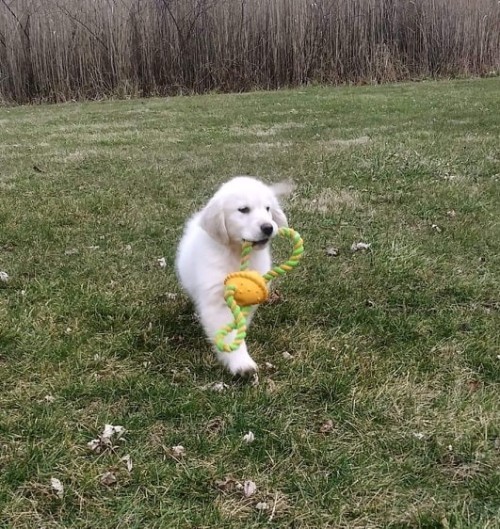
She is a natural retriever. She will already put that toy in my hand!

Yes. I said I’d never own one of these. I said the same thing about German shepherds.
And cats.
And here we are.
Posted in aspen, golden retriever, Uncategorized | Tagged cream golden retriever, golden retriever | 5 Comments »

You cast a line into a trout stream. The water runs black and then spumy white around the riffles and rocks. The bait disappears below the surface. You know nothing about the bait. The stream-bed gravel or the submerged limbs can more easily catch the bait than a fish’s lips can. And that is often what happens, but you keep casting and casting. Maybe the bait will pass in just such a way as to draw the fish in for a little taste. And then you’ll catch him.
So goes the theory anyway.
The truth about writing a blog is that is so much like fishing a black-water trout stream. My prose goes out into the ether, passing through the search engines and Facebook shares, and usually no one clicks. No one nabs my bait. But sometimes they do bite, and they keep coming in for more.
In 2012, this blog was its height of popularity. I had not monetized it yet, and I had time, back in those days, to throw out more writing than I ever could now. I honestly don’t know how I did it.
But maybe I do. In 2012, I was more cocksure, and I was so woefully ignorant that I thought I could be brave and speculate about things I didn’t understand.
I was 29 that year. It is amazing how much you think you know when you’re not yet 30, when you’re still wet behind the ears but still know enough to be interesting.
And I suppose that is the dilemma I now face. I have changed my mind. I have grown. I am less sure of myself, not because i am more ignorant but because I know my limitations.
Writing in a forum such as this for as long as I have means that I can see the transformation. I can see the young idiot whose only real skill was in playing around with prose. Now, I sometimes feel that this is my only skill, and knowing what damage a clever phrase or cultivated meme can produce means that I take it way more easy than I used to.
Since I have matured, the readership has dwindled a bit. I don’t throw out my speculations as much as I used to, and much of my invective is toned down.
In the end, I know that my true muse will always be nature, and the animals will be my truest characters. I know that whatever I will write must have those features looming in it somewhere.
My writing for 2020 will better than it was eight years ago. It might not get as many hits, but it will be more mature and more reasoned.
New adventures lie before me. I can feel their pull in this oddly instinctual way, but they are coming. New chapters in my life are about to be written. What’s past is prologue. The rest is still unwritten but coming into view. Through the haze of existence, I can see what lies ahead.
Maybe the reader will like it. Who knows?
But I cast my line into to the stream. Maybe I’ll get a nibble or two.
Posted in deep thought | 2 Comments »


 | markgelbart on Retiring this Space |
 | oneforestfragment on Retiring this Space |
 | The Evolving Natural… on So does the maned wolf break t… |
 | SWestfall3 on So does the maned wolf break t… |
 | Ole Possum on So does the maned wolf break t… |




