Feeds:

coyote pupps.jpg

I have a lot of quibbles with Dan Flores’s book, Coyote America. Among them is a contention that coyotes howl because it allows them to “take a census.”  If no other coyotes howl back, the females wind up releasing more ova and having larger litters. This description, which Flores calls an “autogenic trait,” cannot be found anywhere in the coyote literature. His account is not described in the book, but it is mentioned in his interview with National Geographic and on The Joe Rogan Experience.

I have no idea where Flores got this idea, but it’s not really what happens. The literature on why coyotes have larger litters in areas where they have been heavily hunted says that the larger litter sizes are associated with better access to food resources. The best-known paper on this issue comes from Eric Gese, a researcher with the USDA, who studied coyote population dynamics in an area of Colorado.

Gese contends that what happens with coyotes in pressured areas is that the surviving females are healthier, simply because they have access to more food resources. This greater health causes them to release more ova during the estrus cycle, and this increase in ova results in greater litter sizes.

It is not because the coyotes are taking census and can somehow magically figure out that they should produce more young.  It is simply that the coyote females’ own bodies respond to greater food resources by becoming more fertile.

What has possibly evolved in coyotes is that they have a tendency to become significantly more fertile when the females are at their most healthy. This is a great trait for a mesopredator to have.

After all, coyotes evolved in North America with dire wolves and a host of large cats breathing down their necks. Natural selection favored those that could reproduce quickly if populations were dropped dramatically.

But it’s not because of some “autogenic trait.” It is simply how coyote populations expand as mesopredators with increased or decreased access to prey.

So yeah, my take on Coyote America is that it is mostly a science fiction book. Not only does he mess up the exact genetic difference between a wolf and a coyote, which is not equivalent to the genetic difference between a human and an orangutan (as he claims),  he also messes up that coyotes really do hunt down and kill cats and eat them. They are not just killing a competitor. They are using cats as a food resource.

This was a book I was so looking forward to reading. It got good press, but the actual science in it was so lacking.


andsdell deerhound

The dogs we call “greyhounds” today are smooth-coated. Some, like Drake, grow pretty thick winter coats, but they are all smooth-coated dogs.

This breed feature, one would think, would have been well-established in the breed, but it did not become a feature until the rise of “club coursing” in England. English patricians were part of clubs that had vast holdings where hares were managed to abundance, and each club member would come and run dogs on these hares in what were greyhound field trials.

In his book Greyhound Nation: A Coevolutionary History of England, 1200-1900, Edmund Russell writes about how memes affected greyhound evolution in England. One of these memes that arose in the 1820s was that no rough-coated greyhound could be entered. Russell even quotes the rule-book from the Swaffham that “No rough-haired dog to be deemed a greyhound.”

The reason for this dismissal of rough-coated greyhounds is that rough-coated greyhounds were better suited to the North of England and to Scotland and Ireland. The wire coats protected against thorns, rocky terrain, and the cold weather. Smooth-coated dogs were better for the open land, which was more easily found in the South of England.

And it also fit within the general prejudicial views of the elite society of the South of England, which saw itself as being “better-bred” than the North.  This division is one that sort of posits the Anglo-Norman parts of the country against the areas where Celtic people held on the longest. This same view was even more exaggerated when these elites looked at the traditionally even more Celtic lands of Scotland and Ireland, where rough-coated greyhounds were the rule, not the exception.

Further, Russell points out that was about this time that lurchers began to be stigmatized among elite coursing circles. The lurcher was seen as the poacher’s dog, and the poacher’s dog very often was a rough-coated creature. Never mind that the intellectual ancestors of these elite coursing men were very much into the business of crossing greyhounds with lurchers, Italian greyhounds, and bulldogs. The lurcher and the wire-coated greyhound began to be seen as debased and low-class and Celtic.

One should also take into account the coursing men were never running hares for food. This was sport. The lurchermen was always running dogs on what could feed him and his family the next day. The wealthy coursing men were interested in the dogs as sport, not survival, and for this difference, they castigated the rough greyhound as a lurcher too.

So these ideas permeated what became the modern greyhound breed. Wire coats are dominant, and it is quite easily to expel them from a breeding program.

Thus, what became the greyhound resulted from the prejudices of the elites in the South of England and Yorkshire, rather than any practical reason.

In the Scottish Highlands, the “deer greyhounds” of that region remained wire-coated, and they eventually became the basis of the modern Scottish deerhound breed. By the time these dogs became part of the modern kennel club registry system, no one really thought of them as being related, and no one really considered the bizarre class and regional reasons why the two breeds wound up with different coats.

The deerhound retained the wire coat because it was practical for running deer in the Highlands. The greyhound lost its wire variety because the elite who coursed them saw them as a sign of debasement and excluded them from the breed.

Human whims and prejudices affect so much of how our breeds evolve. In this case, it is the deep division of the South of England vs. the rest of the British Isles.

Update: Apparently, when a real historian looks at the history of a dog breed within the context of the culture and with a clear understanding of canine genetics, it upsets the apple cart with the Sir Bufton Tufton Brexit and Boris set. I don’t have have time for to approve your comments and show you why the lore is not the same as actual history.

(And here is the genome-wide study that has a phylogenetic wheel in it that places Western sighthounds as close to British herding dogs.)


Epic Wolf Encounter

What happens when you catch a wolf out mousing in Montana:


Posted in wolves | Tagged gray wolf, Wolf |

A wolf pack could be roaming Colorado

northwestern wolf

A lot of attention is being paid to the initiative that will be on the Colorado ballot this year. The question is whether the state will reintroduce wolves to Colorado, and various interests are queuing up for a rancorous debate about whether the state should begin this process.

The neighboring state of Wyoming, though, has a decent wolf population, and one argument against the reintroduction measure is that the wolves will do the reintroduction on their own. They will simply walk down from Wyoming and enter Colorado on their own.

Well, yesterday, there was news that wolf tracks were spotted in the snow in the northwestern corner of Colorado. There have also been sightings. An elk carcass has also been found, and wolf howls have been heard. So it is very likely that some wolves are now roaming Colorado, and they may be establishing a pack.

However, this does not change the debate on the ballot question, because if it is passed, these wolves will likely be joined by others.

And, it makes something else more interesting. The ballot question is about gray wolves, but there were historically two subspecies of gray wolf that roamed Colorado.

The ones in Wyoming are Northwestern wolves, but Colorado was also the northern terminus for the Mexican gray wolf’s range. If this ballot question is approved, then a real discussion should be had about restoring Mexican gray wolves to parts of southwestern Colorado.

A huge debate exists about the wolf subspecies of North America, not just with the potentially coyote introgressed “species.”  A real debate exists about whether the Northwestern wolf is the same as the Southern Rocky Mountain wolf, which was also a fairly large wolf.  This also where you get these big debates about giant Canadian wolves with the anti-wolf opposition in much of the West.

What would happen is that you probably would have a gene flow between Northwestern wolves and Mexican gray wolves, and natural selection would favor those that had the adaptations to handle the local prey.

But this probably would cause lots of issues, because Mexican gray wolves are seen as such a unique subspecies that a whole line of them was euthanized for merely showing some dog-like characteristics.

So wolf taxonomy is always an issue with recovery, even if you leave out the domestic dog and coyote introgressions.


Posted in Uncategorized, wolves | Tagged Colorado wolves, Mexican gray wolf, Mexican wolf |

Stacked

Dare doing some show training.

dare good stack.jpg

Posted in Dare, German shepherd dog, Uncategorized | Tagged German shepherd dog | 4 Comments »

Turning into a dog all of a sudden

dare 8 months old.jpg

Posted in Dare, German shepherd dog | Tagged German shepherd dog |

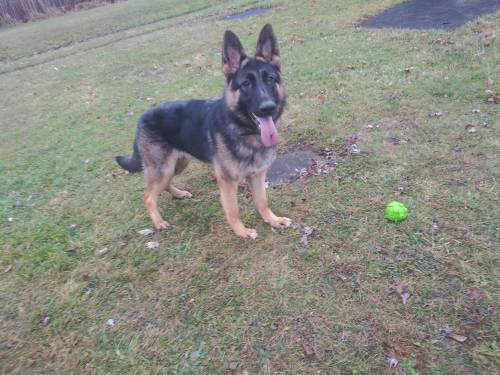
Playing ball

Dare blue ball

The throw the damned thing face.

throw the damned thing

Posted in Dare, German shepherd dog | Tagged German shepherd dog | 1 Comment »

And your solution is?

wasabi

A quite a bit of social media buzz about the pekingese that won the AKC National Championship last month. The show was televised on Animal Planet this week, and the pekingese won it.

Pekingese are, to put it mildly, an extremely derived form of domestic dog. They are brachycephalic and achondroplastic. They are not my favorite kind of dog, and if you go through the old posts on this blog, you will see that I generally hated them. When you’re doing the angry dog blogging, this breed is great cannon fodder.

But the truth is I have very limited experience with pekingese. I have spent some time with a backyard-bred one, but I seriously doubt that he is representative of the top-level show dogs in this breed.

And this is a problem. Most of the people making these health claims about this breed have never been around one.  This backyard-bred one does have some health and  grooming challenges. He also does not possess the best temperament, which these show dogs clearly do have.

Most of the commentary I’ve seen suggest that we return to the days of yore, when the British were smuggling pekes out of the Forbidden City.  You know, the time when the dogs had less coat and more muzzle, and we could all be satisfied and happy if we just went back to those days.

This is a common trope in this sort of commentary. The original dogs were always better, because they are less derived, less exaggerated. It’s a trope that I once parroted without considering the dynamics as carefully as I should have.

Someone might want to return to that older style of pekingese, which is interesting. Very few pekes are show-bred. The vast majority of them are bred as pets, and most of those have that desired Forbidden City phenotype.  If you want one, you can buy one.

But the idea that we can somehow force the show community to accept that aesthetic as the new standard of excellence is a bit off. It is the case of someone thinking they know better than someone else and then forcing that opinion into some sort of edict.

And that is a recipe for any concerns to fall on deaf ears. There are issues with pekingese. There are issues with all breeds. To address them rationally requires a certain understanding of the subculture of the breed, and the social media and internet commentary takes almost no time to do this.

Instead, it’s a game of playing with aesthetics.  If your aesthetic is a dog that is only barely derived from a wolf, like a West Siberian laika or a basenji, then a pekingese will never match it.

But not everyone has that aesthetic, and grown-ups in free societies are okay with others having aesthetics that differ from our own.

We also need better science around the issues of dog welfare and conformation. Studies about the welfare issues surrounding brachycephaly do exist. We need more of those, and we need better ones, ones with large sample sizes and even more rigorous statistical methodology.

But even if we had all the science in the world that suggests the pekingese phenotype is somehow cruel, the breeders would want to produce them. They would be open to suggestions, I’m sure, but I don’t think they would want to change the pekingese fundamentally.

And this raises a simple question. We have all these people spouting about dog health and conformation issues these days, but not a single one has come up with a practical solution to the problem, other than, of course, shaming the breeders who produce those dogs.

And you know what those breeders do with those shaming rants? They ignore you, and they double down. They will not take you seriously.

The solution, then, is more nuanced. The solution is understanding that we don’t know everything and that our chest-thumping will lead us nowhere.

So in my long apology tour for the damage I once did here, I offer yet another mea culpa.

I don’t think I served the dogs very well, even though I thought I did. I was just spinning my wheels and asking for adulation. I got the adulation, but I did so without considering the impact of my words.

And for that, I will always be sorry.


Posted in dog breeding | Tagged dog shows, pekingese | 3 Comments »

Tibetan fox vs. marmot photo earns photographer prestigious award

tibetan fox vs. marmot

The 2019 winner of the London Museum of Natural History’s “Wildlife Photographer of the Year” is Bao Yongqing, who took this amazing predator-prey action shot on the Qinghai-Tibetan Plateau. It shows a Tibetan fox (Vulpes ferrilata) trying to catch a Himalayan marmot (Marmota himalayana).

In an interview with the photographer, it was revealed that the fox was a vixen with young that needed meat. Even after a long stalk on the marmot, the prey was not easily subdued. Other marmots came to its defense, which is something that our groundhogs would never do. The fox had do dive around the defensive marmot to get at its prey, but eventually, the targeted individual collapsed and fell to the fox’s jaws.

Tibetan foxes have only recently become well-known. The initial descriptions of them were based upon pelts, and it is only now that we have a popular concept of these foxes with their oddly-shaped, squared-off heads.

I was surprised that this species of marmot would engage in altruistic behavior. The marmot species I know best, the groundhog (Marmota monax) does not do this. They are way more solitary than those marmot species of Central Asia, though, and this social behavior can be of great benefit for life on the exposed ground.

This is a pretty cool photograph that reminds me of another winner. In 2015, a photograph of a red fox killing and eating an arctic fox in Canada won earned the photographer this same award.

So foxes killing things– well, that’s an award winner these days.

Posted in wild dogs, wildlife | Tagged Himalayan marmot, Tibetan fox |

Dare looking good

She was 8 months old on Christmas Day.

dare looking good

Posted in Dare, German shepherd dog, Uncategorized | Tagged German shepherd dog |

%d bloggers like this: