
This dog is a Portuguese water dog.
What?
Yes.
It’s a Portuguese water dog.
But I thought they had poodle-type coats.
Well, some do. This one is an “improperly coated” Portuguese water dog.
What’s improper about them?
Portuguese water dogs have two correct coats. One is wavy, and one is curled (like a poodle). Both are constantly growing coats, just as you’d find on poodles and other water dogs.
This particular dog has a coat that is more like a flat-coated retriever– more like a “normal” long-haired dog.
I know this particular query got people guessing in all different direction. Most people thought it was some kind of gun dog, but Christopher and Sam eventually figured it out.
The famous person who owns one is President Obama. However, his dog is of a “proper” coat, but Bo is the same color as this dog.
***
A dog with an improper coat cannot be shown. However, the correct coat appears to be in some way dominant to the improper coat, which means that correctly-coated Portuguese water dogs can occasionally produce puppies with these faulty pelts.
Where this coat comes from is open to conjecture. Portuguese water dogs almost went extinct. They were revived through outcrossing with the Spanish water dog (which is actually a herding breed that moonlights as a water dog). It is likely that other breeds were mixed in– some of which may have been long-haired dogs.
However, it is possible that dogs of the typical long-haired type always existed in the Iberian water dog population. I will get to some reasons for why this might be possible later on.
For years Portuguese water dog breeders have been trying to breed away from this coat. Now, no one breeds the improperly coated dogs. That is a given. But this coat remains persistent in the Portuguese water dog gene pool.
A few months ago I was alerted to the discovery of the genes that determine what kind of coat a dog has. It turns out that it is just variation on three genes that determines the coat type.
Once that was figured out, it wasn’t long before a test was developed to determine whether a Portuguese water dog with a normal coat is carrying the genes for an improper coat. In fact, the test is based upon the same research that found the genes responsible from the coat type. (I have not looked it closely, but it seems to me that they are using an SNP chip.)
What is this going to mean for Portuguese water dogs?
Well, it means that the breeders have a tool that will allow them to cull away from this faulty coat.
The problem is Portuguese water dogs have genetic diversity issues.
In the 1980’s, it was listed as the rarest breed on earth. They had to be saved, as I wrote earlier, through outcrossing with Spanish water dogs. The dogs do have some real issues with genetic diversity and genetic disorders. The breed club, to its credit, has a very nicely funded and pro-active health foundation to really understand these disorders.
The problem is that now that the breeders can cull dogs carrying this coat, it means that the genetic diversity of this breed is probably going to get even more truncated. Potentially, it would could eliminate the improper coat in just a few generations.
But because they have eliminated carriers of that coat from the gene pool, they will have lost a part of the gene pool. It means fewer unrelated dogs from which a breeder can choose to outcross. It means a greater chance in bad recessive genes coming together.
Of course, it doesn’t have to happen this way. It is possible that some breeders will tolerated the odd improper coat in their lines just to hold onto some good genes. My guess is that this is very likely. The club is very clear on keeping carriers in breeding programs.
After all, white boxers are a byproduct of breeding for the much sought-after flashy markings for the show wrong. Predominantly white boxers are often pilloried in Boxer circles, but if they would stop breeding for flashy markings, they would eliminate the white coloration entirely.
My other hunch is that Portuguese water dog fanciers tend to be better informed about genetic issues. Maybe the breeders will tolerate the occasional appearance of a retrieverish Portuguese water dog in their litters just to hold onto some genetic diversity.
Maybe.
We’ll have to wait and see. It’s up to the Portuguese water dog fancy right now.
Right now the club is very clear in telling its members not to cut out carriers of improper coat from the breeding programs, but I wonder if people will listen. Just knowing that you have the ability to produce this coat is a powerful piece of information. I don’t know if people are going to be thinking of the big picture enough to not cull carriers. I’d like to think they are, but my own niggling suspicions are that the breeders will cull carriers.
Maybe President Obama needs to weigh in on this issue (LOL).
***
Now, as I noted earlier, there is a possibility that the long-haired genes were always in the Iberian water dogs.
My evidence comes from a somewhat unusual inference.
The Portuguese water dog is probably an ancestor of the St. John’s water dog. Canadian author and St. John’s water dog lover Farley Mowat believed he had traced the origins of his beloved Albert to the dogs of Iberia.
If you look at these last two St. John’s water dogs, you can see some similarities with the improperly-coated Portuguese water dog in the photo at the top of this post:

The dogs are both black and white, and historically, the St. John’s breed came in liver, as do some Portuguese water dogs.
The Portuguese fishing fleet was among the first to fish the Grand Banks off Newfoundland. Indeed, the name for Labrador (the place) actually comes from a Portuguese explorer named João Fernandes. The Portuguese king gave him the title of “Lavrador” over the lands he discovered, which included Newfoundland and that place that became known as Labrador.
Portuguese water dogs were used to retrieve nets and lines from the sea, exactly as the St. John’s breed did. Indeed, the Potuguese water dogs were used as far north as Iceland, which means that they were very good cold water dogs.
Some of these dogs likely were left behind in Newfoundland, where they lost their poodle-type coats. Perhaps this happened due to cross-breeding. Perhaps it was due to natural selection.
But we do know that St. John’s water dogs that were being used on Newfoundland were mostly smooth-haired dogs– something like modern Labradors.
However, it is also likely that there were long-haired dogs of this type. I have a depiction of one:

This dog is listed in a mid-nineteenth century text as a “St. John’s Labrador.” It is long-haired. I don’t think it is a setter cross. The same text depicts as setter-retriever cross that has far less shaggy hair than this dogs does.
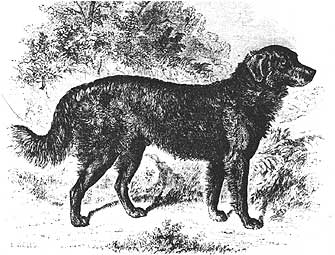
It seems to me that the “St. John’s Labrador” is the long-haired variant of the St.John’s water dog. The long-haired dogs probably were more likely to be sold to English fishermen and traders. Short-haired animals were much more preferred in hunting game and working on fishing boats. They were more streamlined in the water, and they didn’t get bogged down with ice and frost when working in frigid conditions.
As someone who knows what happens to golden retrievers in the snow, I can say that this is not an idle concern. These dogs collect snowballs.
Take a look at the “St. John’s Labrador.”
Doesn’t it look a lot like the improperly-coated Portuguese water dog?
Perhaps these improperly-coated dogs were always part of the Portuguese water dog gene pool.
Perhaps they are the link between the St. John’s water dogs and the retrievers and the Iberian water dogs?
Portuguese fishermen may not have liked these dogs with improper coats, so they left them at Newfoundland or traded them to fishermen from other nations. And is from these dogs that the mostly smooth-haired St. John’s breed developed.
***
See Earlier Posts and Links:
- Farley Mowat’s St. John’s Water Dog
- Farley Mowat DID try to save the St. John’s water dog!
- Telescope: Farley Mowat (Features St. John’s water dog footage)
- The history of water dogs
***
I am intrigued that Mowat has an unpublished manuscript about these water dogs and his beloved Albert. I wish he would publish it, but I don’t think it is very likely.
***
Hat tip to Pai for alerting me to the test for improper coat. The historical part of this post has been in me for a while, but I have had a hard time finding good photos of Portuguese water dogs with improper coat.




Ahh, then my spouse was right. The second I showed her the pic… she said Portuguese Water Dog. Still “Bo” is a bad name for a dog don’t you think…. too close to the word “no”.
Anyhow, there is a Chattie hanging out there on occasion with the first dog…
This I know for a fact. ;-)
I have a book “The History of Retrievers” by Charles C. Eley that speaks of the injustices done to early curly coated retrievers due to dog fanciers concentrating on appearance as opposed to purpose. He explains how the curly was deemed hard mouthed and bad tempered by 1899 due to bad out-crossing. He feels that good out-crossing begins with the breeds purpose and not with cosmetics such as the coat. He writes that this early curly disappeared due to the fact that it was not genial, inclined to bite, with a dour expression and had an “evil-smelling” coat. …I wonder if that is the curly in the picture that you have?
from this author’s writings, it sounds as though there must have been a revival of the curly coat… I find it a little confusing.
The reference to the curly is to an extinct breed. It is not a reference to any of today’s curly coated dogs…
I’ve found all of that stuff on the curly, and I’ve been trying to compile it into a post.
The curly-coated retriever is an enigma, wrapped in a mystery, wrapped in a riddle.
Trust me.
I tried to do a series of history posts on them.
But I kept running into crappy things that said, “Well, the curly is useless compared to the flat-coat.”
That’s because the grand poo-bahs of the early kennel club were all flat-coat people.
I read that, and I was going to do a post on it.
Oh, me… Iyou have a St. John’s dog there… that is definitely not an early curly!
always trying to multi-task…
Most people don’t realize that genetic recombinations aren’t finitely small and precise, i.e. our genes are shuffled like a 6 year old with chubby fingers shuffles a deck of cards, not a Vegas hot shot who can cut to 26 and fold them one after another.
Breeding away from a single gene doesn’t just lose that gene and maintain everything else. We also cut out numerous other genes that are in proximity to that gene. In the case of improper coat, the researchers say this:
___
Research scientist Kevin Chase: “This is an important regulatory gene. There are also some 30 other genes in close proximity to it. Removing this variant of the gene from the breeding population would remove a tremendous amount of genetic diversity in the breed. This would be very
dangerous.”
___
This means that you can’t just throw out the bath water. 30 times as much baby is going down the drain as dirt.
Wonderful.
I wonder if Obama is going to say anything about it.
I’m so glad the club is saying no to cutting out the carriers for that gene.
I wonder if they are going to listen.
I wonder if the breeders are going to follow the club’s advice.
To me, it seems that knowing a dog is carrier is powerful information.
And it seems to me that that this would affect breeding decisions.
I don’t know how having this sort of information would not.
I think I’d be much more inclined to get a PWG if it looked like this as opposed to a ‘normal’ coat. I’ve never really been a fan of really curly haired dogs.
regarding the coat issue – a similar thing occured regarding color in herding dogs. Prior to registration, a lot of folk identified American herding dogs by color — if it was a merle, it was an “Aussie” if it wasn’t merle, it was an English Shepherd. Merle is a dominant but it can also be “cryptic” — the merling so minor that it isn’t seen. There are more differences between Aussies and English Shepherds now, but there was also a LOT of crossover. it would seem to me that the curly simply got or retained more of those curling genes. There was an article years ago in the AKC gazette that mentioned a long coated Mastiff — it just happened to have parents with the genes after umpteen generations.
Since herding dogs come in all coat types, it’s been an interesting study on why they do. There seemed to be a rough pattern to it – short hair (smooth collies, Malinois, Beaucerons) tends to be “easy maintenance” — foxtails, ticks, etc are more easily found and removed. BUT it’s also less heat and cold tolerant and it’s less protection in brush. “wiry” coats (Briards, Bouviers, Lakenois, etc) have the most protection for the dog but the highest maintenance of the coat (even if you annually shear the dog like the sheep) and while fairly good for cold weather, it’s not a heat tolerant coat. The original “wolf type” long straight hair (collies, Groenendael & Tervuren, Australian shepherds) is the most capable of weather variants, easier maintenance than the wiry coat but harder than the smooth/short coat. You almost get the entire spectrum in herding dogs. It’s rare that a single breed ends up retaining all the variants (Briards and Beaucerons divided and now don’t have either the same coat or colors. Belgians have a wiry (but not wiry long like a Briard), short and long –but not in all colors. BCs come in both short and long coat and I’ve seen one curly coated dog, but the “show standard” doesn’t address it, and you don’t see them. And so forth.
Incidentally, YEARS ago, I saw a Belgian Sheedog that had a curly coat. And yes, it was a purebred dog.
VR, Peggy Richter
These Iberian water dogs are derived from some kind of herding dog– maybe something like the Puli, Pumi, and Mudi type. I think there you have almost exactly the same situation with those Hungarian breeds, plus throw in the Croatian sheepdog for good measure.
yes. The Mudi can sometimes look strikingly like a Belgian that was left in the dryer too long (including the curled coat). There was, at one time a midsize between the Schipperke and the Groenendael/Tervuren/Malinois/Lakenois. I expect that this dog had looked almost identical to a Puli/Pumi/Mudi type dog. The “verboten” crossing of Lakenois/Groenendael, Malinois/Groenendael yields coat types and colors not “allowed” in the show ring but, like the brindle, were colors and coat types that once existed in the “Belgian herding dog” landrace.
The thing is that before the advent of studbooks and “purity police”, one probably had everything in the spectrum of size from sheltie to Bouvier coat lengths (very short as in the Beauceron to very long as in the Briard) and coat types (curly, straight, wire). There’s several “virtually extenct” cattle dog (Bouvier) types that ranged in size from Standard Schnauzer and up, many with a wire coat.
Jeanne Hartnagle has a new book out “stockdog savy”
— in doing the research on it, she got quite an extensive amount of data on various herding breeds on her blog. check out for example the bouvier at
http://stockdogsavvy.wordpress.com/2010/01/21/bouvier/
Vr, Peggy Richter
Regarding boxers and white markings, the “blame” is by no means only on shows and show breeders. The typical pet buyer loves white markings (and often the more extensive the better), and most of them have never been to a dog show.
That’s very true.
People in the US will buy “rare white boxers” for a higher price than brindles and fawns.
In the lines we have here, 30 percent of all white boxers are in some way deaf. Most are just deaf in one ear.