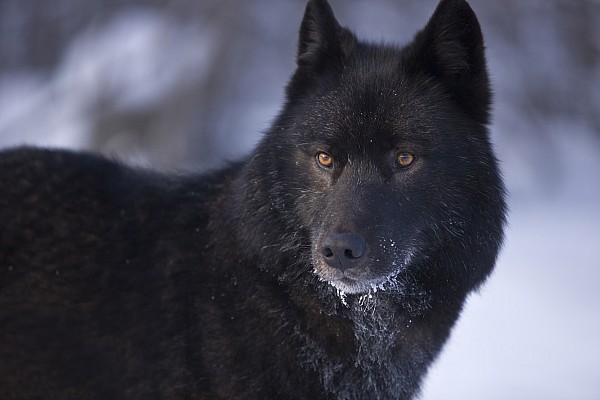
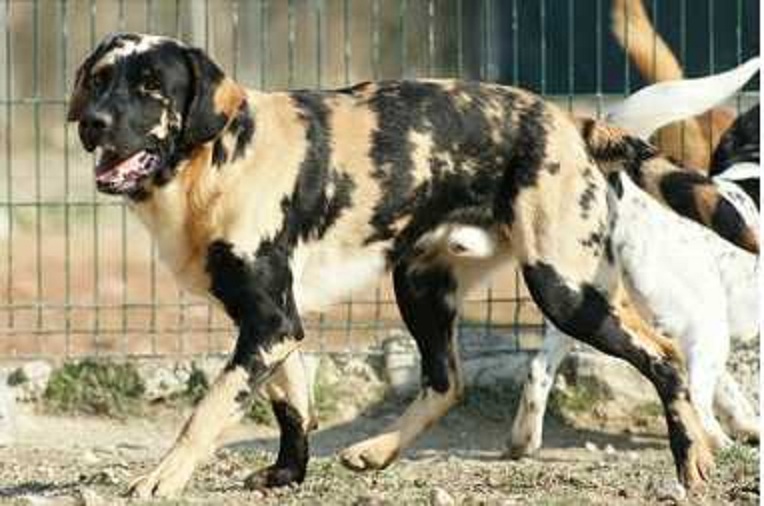
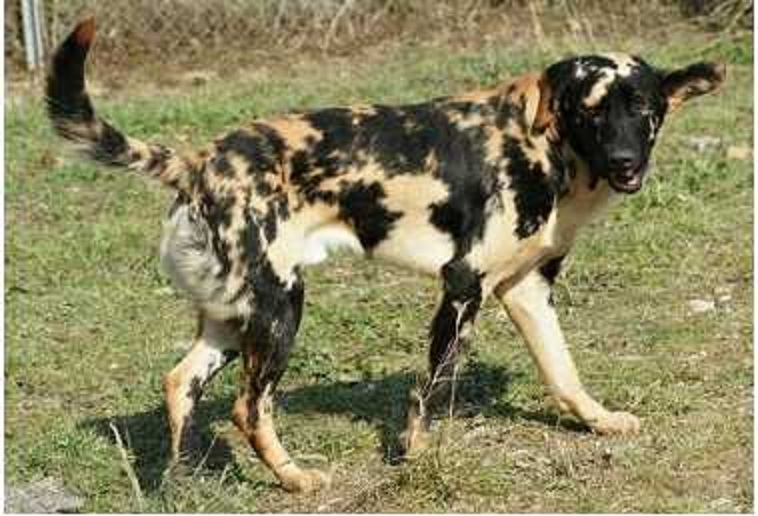
Two dogs killing a deer in Ohio.
(Source for images)
I’ve noticed that dog people like to view their animals through reductionist paradigms. It’s really an easy way of trying to make sense of what is really a complex matter: the relationship between humans and dogs. The relationship between our two species is as complex as it is ancient, and because it has both complexity and antiquity, it is mysterious.
But in order to explain this relationship, paradigms have developed to explain why dogs and people like each other. Inherent in trying to understand this relationship is trying to understand what a dog actually is. We also try to figure out ways in which it differs from its wild ancestor, which should give us some understanding of what its innate nature actually is.
Sadly, trying to answer these questions has resulted in the development of reductionist paradigms, which often ignore evidence that disputes the essential assumptions of the paradigm.
Two really problematic reductionist pardigms have developed in recent years. Both are in response to each other, and both have very big problems when actually applied to understanding what dogs are.
The first of these is dogs is the one that says dogs are not wolves. Dogs never form packs, they say. They are never capable of cooperative hunting because they are perpetually wolf pups.
Usually, someone throws in some of Raymond Coppinger’s neoteny theories, which say that all dogs are simply juvenilized wolves and that Western working breeds are juvenilized only so they exhibit stunted predatory motor patterns. Pointers are stuck making stalking behavior. Herding dogs can only chase and stalk. Andd retrievers can only catch prey and bring it back. Because these dogs are juvenilized wolves, they can never exhibit wolf cooperative hunting behavior.
Much of the acceptance of this claim comes from a reaction to the crackpot variants of what is called “dominance theory.” Dominance within ethology is a very specific term that refers only to an animal getting “priority access to limited resources.” Unfortunately, dominance has become a catch-all for some pseudo-dog experts. Some of these people claim that virtually any time a dog doesn’t obey instantly it’s being “dominant” to you, and the best thing you should do is put him back in his place in the hierarchy.
This paradigm comes largely from observing unrelated wolves that were kept in enclosures together. Trying to make assessments about how dogs ought to behave through observing stressed out, reactive wolves is a fool’s errand. Dogs are very happy to be in captivity– which is exactly what you’d expect from them being the oldest domestic animal. They are also much more tolerant of strangers of their own species than virtually all wolves are. Wolves often kill other wolves that wander onto their territories, and if dogs were as aggressive with strangers of their own species as wolves are, dog parks would be an impossibility. Further, dogs bond with and learn from people much more easily than wolves do, so one cannot understand how dog “ought” to behave without trying to understand how they interact with people.
This one doesn’t try to make a claim that dogs are wolves. It merely assumes that because we have studies on wolves that show this behavior that we should be able to apply it to dog and human interactions. This is not a good assumption.
Virtually everyone who has read the literature and has also spent time with lots of dogs rejects the crackpot dominance paradigm.
However, some people have replaced it with the other paradigm, which is just as problematic.
The biggest problem is that domestic dogs can learn to form packs and hunt, kill, and consume large prey.
Ask any sheep producer about the problem of packs of stray dogs. They will tell you that sheep are quite vulnerable to attacks from wandering bands of domestic dogs. Some dogs get very good at hunting sheep together, and they often surplus kill, which means that a couple of dogs can wipe out an entire flock in pretty short order.
Secondly, I’ve heard a great many stories of dogs killing deer. My grandfather was a foxhound enthusiast in the 50’s, and every year, the local foxhound club held a field trial. They’d buy a permit from the state DNR, and they turn out 60 foxhounds into the woods. The dogs got scored for scenting the fox and running it close for a long distance.
But a great many dogs were disposed toward deer chasing. When you turn out that many dogs, it doesn’t take much encouragement for them to take off after a deer. Out of that 60 dogs, there might be 20 that take off after deer, and of these, about half will cooperatively run down the deer in exactly the same manner as one would expect from wolves.
He told me that one year, the dogs killed something like 3 or 4 deer. One they ran nearly ten miles before they killed it. They just so happened to have dropped the deer in the middle of a pasture, and the farmer who lived there was quite upset. There were about a half-dozen foxhounds eating on a deer carcass in his pasture, and he wanted the DNR to shoot the dogs. The local conservation officer said that he would not. The foxhound club had paid for the permit, and if the dogs killed a deer, it just was part of the game.
Now, when I read someone parroting the line that dogs never pack up to hunt prey, I am reminded of these stories about the old foxhound trials. Foxhounds may not be a particularly specialized breed in the way that Coppinger suggests. He specifically says that scent hounds don’t have any real behavioral specialization at all.
But even the breeds that have specializations in their predatory behavior are capable of hunting in packs.
Take this story of a pack of retrievers killing a deer in Alaska:
A doe had to euthanized after it was attacked by four dogs at a Juneau wetlands.
Local resident Frank Rue called animal control officials Sunday morning to report the attack.
Rue said the dogs were two golden retrievers, a yellow Labrador retriever and a skinny black lab mix with a curly tail. The dogs appeared to be wearing collars.
“I found it very disturbing that people’s pets — and that’s the main thing, pets — would be running loose,” Rue said.
He spotted the dogs from his home about a quarter mile away and used his binoculars to see if there were any people with the animals, but saw none.
His wife then saw the doe. Rue believes the dogs chased the deer from Douglas Island.
“My reaction was, the deer looked like it was in trouble,” he said, “so I figured I would go out and see if I could catch a couple of the dogs, because I had some leashes, and find out who their owners were and get them away from the deer.”
It was low tide, so Rue walked across the wetlands and whistled to the dogs, who took off running.
Rue said the doe had a torn back leg and kept falling.
Authorities determined the deer had to be put down. The carcass was donated to the Juneau Raptor Center.
“When we examined the deer, all the injuries came from the dogs,” said Brian Weed with the Gastineau Humane Society animal control. “The deer didn’t seem to have any damage from anything else.”
At the scene, Weed and State Troopers Nick Massey and Shaun Kuzakin saw two golden retrievers running toward Douglas Island. They searched the area but couldn’t find the dogs.
Retrievers are supposed to have juvenilized predatory motor patterns, and thus, they would not be able to form a pack like these dogs did and inflict such injuries on a deer.
But they did.
Furthermore, these retrievers are all derived from ancestors on Newfoundland that had strong retrieving behavior but were also required to hunt for their own food at certain times of year. Free-roaming, “off-duty” water dogs in Newfoundland retarded the entire sheep industry on the island. The dogs were notorious sheep killers, even though they also were hard driving retrievers that would dive in to freezing water to fetch nets, lines, fish, seabirds, ducks, and even seals.
I happened to have owned a golden retriever that would retrieve anything with a soft mouth, including eggs. However, she learned from a Norwegian elkhound how to hunt, kill, and consume rabbits, and she would readily hunt rabbits for food. Her retrieving behavior did not keep her full hunting behavior stunted. It was like she had both behavior, and she knew when to use both– just as her ancestors in Newfoundland clearly did.
The other problem with the theory that dogs don’t hunt cooperatively is that they fall back on studies of street dogs from either urban areas or from developing countries. Street dogs don’t get much of a chance to hunt because they live where there aren’t a lot of prey species. Further, they haven’t had any reason to learn how to hunt. Scavenging off the fat off human civilization is much easier. Dogs from developing countries also often have access to open garbage dumps, which are much easier feeding opportunities than what they’d get from hunting.
The only exception to these studies are the ones that look at stray and free roaming dogs in Italy, but then again, the dogs don’t have any reason to learn cooperative hunting. There are not many large game species in Italy, so even the wolves are forced to scavenge at garbage dumps. The dogs are more tolerant of each other than wolves are, so they are able to form huge packs around their garbage dumps and keep the wolves at bay. The dogs and wolves sometimes exchange genes, resulting in wolves with black coats and dew claws on the hind legs.
No one seems to get that there are dogs that evolved to live free of large garbage dumps.
We just don’t call them dogs.
They are better known as dingoes.
Dingoes are East Asian domestic dogs that went feral in the Australian bush. They are not missing links between dogs and wolves. They are truly feral domestic dogs that are most closely related to street and village dogs in Indonesia. They form packs to hunt larger macropods, and they occasionally formed relationships with indigenous Australians in order to hunt cooperatively.
To debunk the crackpot dominance paradigm, some well-meaning people have attached themselves to a series of assertions that are just as problematic as what they are debunking.
People are trying to come up with hard and fast delineations between what separates a dog from a wolf. So far, I’ve come across only two that clearly separate them. Wolves have an active supracaudal gland. Dogs don’t. Dogs sweat through their feet. Wolves don’t. Well, at least northern wolves don’t. I would not be surprised to find out that southern wolves from the Middle East or the Indian subcontinent sweated through their feet. These are the subspecies most closely related to the domestic dog, and it would make sense that dogs and these wolves wold share this trait.
Clear delineations between dogs and wolves simply don’t exist.
The only really good way to understand dogs is to think of them as a subspecies of wolf that is specially adapted to living in a human environment.
The claim that dogs are just neotenous canids that never can hunt cooperatively in packs sounds very convincing on paper, but the real animals don’t read the books.
They are capable of learning many different behaviors from each other and from us.
If hunting together in a pack is something dogs obviously have learned to do, well, it sort of shoots the hole paradigm down.
And just as we reject the crackpot dominance theory, we have to reject the reactionary theory that came out in response to it.
Dogs are too complex for our attempts to simplify them.
That ought to be our rule whenever we try to consider them and their relationship with us.