Feeds:

Archive for June, 2012

Rodent ribbon chasers

Chris has a neat post up on BorderWars.

It’s about the mice showing culture.

Yes. Competitive conformation shows for domestic house mice.

They do exist.

I think the most interesting aspect isn’t how naked and disturbing and bizarre the ideals of the subculture actually are.

The most interesting–and much more disconcerting– aspect of the piece is it reveals the id of the competitive animal showing and breeding practices.

Mice are not intelligent animals.

They are short-lived, tolerate inbreeding very well, and have very short gestation periods.

They are also often bred solely to feed other animals and for research purposes.

And no one really cares about mice as individuals.

Because individual mice are largely expendable, the moral restrictions that might hold back that id in its rawest and most naked forms with other animals simply aren’t there.

Thus, one can breed mice with no real concern for their genetic health, their quality of life (in the case of the “waltzing” mice), or their intrinsic value as individuals.

One can use whatever breeding and culling practices one wants in order to produce that ribbon winner, and if today’s ribbon winner is inferior to his sons or grandsons, then slam him up against the wall!

This nonsense would not be tolerated in dogs, but like all ids, it can’t be truly hidden.

It’s held back by certain moral strictures, but if dogs were valued in the same way mice are, they would be bred exactly like this.

And they were bred like this in the early days of the fancy.

The ribbon chasing id has only be ameliorated through the growing status of dogs in the West, and as dogs become more and more valued, it’s likely that the values of the entire system will be questioned.

It’s already happening.

People are beginning to wonder if breeding animals for competitive exhibition has resulted in vast improvements of animals themselves.

The evidence simply isn’t there, and in terms of genetic load and inbreeding depression issues, breeding animals for these purposes has  made things worse.

The mice fancy shows us what would happen if the ribbon-chasing id were allowed to exist in other animals without any moral strictures.

The revelations of their exact values are quite disconcerting.

And they should be.

They tell us what could happen if people hadn’t been questioning the axioms and platitudes of the dog fancy.

Dogs would be in far worse shape now.

And that’s why we should keep on challenging the dog fancy as it exists in its various subcultures and permutations.

Otherwise, the ribbon-chasing barbarism would take over.

And that would be quite bad for dogs– the animals we like to call our best friends.


Read Full Post »

Central African hunter shares water with his hunting dog

People hunt with dogs all over the world.

It doesn’t matter the technology used in the hunt or the game pursued.

Hunting with dogs has proven to be a very efficient way of procuring meat throughout history.

Read Full Post »

Lions killing dogs in Nairobi

Nairobi National Park’s lions sometimes wander into residential areas.

The city of Nairobi is very close to a national park, which is called Nairobi National Park.

Nairobi is a growing metropolis, and it’s now spreading into areas that were used as corridors for wildlife migration.

Although the park is fenced on the city side, the inhabitants can wander out on the other sides.

So now there are lions roaming the Nairobi suburbs.

Discovery News reports:

“There have been no attacks on humans — only dogs — but as the encroachment increases the probability of attacks grows,” said Francis Gakuya, chief vet for Kenya Wildlife Service (KWS), as captured lion cubs growled in the background.

Pacing in a cage at the KWS headquarters in Nairobi, four orphaned cubs hiss and snarl at vets taking care of them — then give a surprisingly powerful roar for a two-month-old baby already the size of a small dog.

Wildlife rangers were forced to shoot dead the cubs’ mother after it was spotted in Nairobi’s Karen suburb and it charged before it could be darted. The cubs are now being looked after.

But it is not the only recent case. Conservationists warn of the growing likelihood of closer interaction between wildlife and humans if development is not managed in a sustainable manner.

Another lioness captured last month later escaped back into the park, a 117 square kilometre (45 square mile) wilderness where buffalo and rhino roam just seven kilometres (four miles) from the bustling high-rise city centre.

Wildlife officials have issued warnings to residents near the park to call them “should they see another lion in their area as it is possible more than one lion had strayed from the park.”

Traps are set out when a big cat is reported but the wily lions have so far avoided the baited cages — sparking concern in residents, fearful at night when guard dogs howl that a lion could be hunting in the back yard.

“Lions can hide invisible in the long grass so it’s frightening they could be around waiting to pounce,” said Mary Okello, who lives close to where recent lions were caught.

Visit the park and one is rewarded by the bizarre sight of long-necked giraffes running through wide plains of yellow grass with the gleaming skyscrapers of Nairobi’s business district rising in the distance.

Although fenced in on the city side — some bars even have terraces where one can view animals over a cold drink — the park is open-sided everywhere else to allow the annual migration of wildlife in search of grazing.

Nairobi is not entirely dissimilar from Anchorage, Alaska, which has a population of brown bears roaming the city’s parks.

Of course, brown bears normally attack people as a defensive response.

Lions attack people because they’ve figured out that people are easy prey.

And they’ve just now figured out that suburban dogs are very easy prey.

It’s not a big jump from hunting dogs in backyards to hunting people in those same backyards.

So it won’t be so much fun.

Of course, Kenya has a solution to some of these problems.

They recently let some Masai spear six lions just outside of Nairobi.

So maybe those lions will think twice before eating a person.

That person could be packing a spear!

Read Full Post »

There could be as many as 79 cryptic species of shark

So says a new genetic study that examined samples from 4,283 individual sharks.  It found 574 species, and 79 of these are likely new species.

These new species are actually cryptic species.  A cryptic species is one that is suddenly discovered from a population of what appear to a species already known to science, or it can happen when two populations that have been classified as the same species turn out to have quite a bit more genetic diversity than was previously thought.

For example:

For example, Naylor’s work suggests that the endangered scalloped hammerhead (Sphyrna lewini) is actually two separate species. “Scalloped hammerheads in general have taken a huge hit, so it may be even worse than has been documented if there’s more than one species out there,” he says.

Now, this is really an interesting find.

I’ve often wondered if our traditional classification of shark species would withstand molecular genetic analysis.

It doesn’t look like it will.

For example, I’ve often questioned whether all the sand tiger sharks (Carcharias taurus) are all really of the same species. These sharks are found only near coasts, and they are found in quite isolated populations in different parts of the world.

I bet there isn’t much gene flow between those populations– if any– and they likely have been reproductively isolated for a fairly long time.

Sharks have been around for a long time, and even modern species have had more than enough time to experience multiple divergences from a common ancestor.

Read Full Post »

It takes a village to raise a golden retriever

Djanick Michaud of Zomarick golden retrievers has a new litter.

And like many golden retrievers, these particular goldens have very strong parenting instincts. If you peruse the photos on his site, you can see that even his big stud dog, Sir Hobson, likes to parent little puppies.

In general, golden retrievers like puppies, and if one golden retriever in a “pack” has a litter, the whole rest of the pack will often try to offer its services as babysitter.

Even though they have very strong parenting instincts, goldens tend not to guard newborns. Some do, but most do not.

And so it’s really not unusual to find a whelping box with several dogs in it besides the mother.

This says a lot about the true golden retriever temperament. They are usually very good with other dogs, and one normally doesn’t have problems with the bitches raising their puppies.

I think most dogs would like to parent puppies that aren’t their own, but normally, the mothers are too protective of them to trust another dog near them.

With this particular breed, there is a convergence of strong parenting behavior and general social tolerance that makes this possible.

***

I’d be remiss to say that only golden retrievers exhibit this behavior.

Jess has some photos of her Italian greyhounds in the same whelping box as salukis and her Afghan hound hybrids.

Wolves do help assist in the raising of puppies.

But as far as I know, there are no records of bitch wolves allowing other wolves into the den where her newborn puppies are.

There may be a case or two somewhere, but from what I’ve read in all the available literature, bitch wolves won’t let their packmates into the den.  Even though they may want to help care for the puppies, the other wolves aren’t getting into the den.

I don’t think the majority of domestic dogs are as tolerant as the cases I’ve mentioned in this post.

I’ve never known a Jack Russell bitch that wasn’t in some way quite protective of her newborns. I knew one in particular that really didn’t like any other dogs in the same room as her newborns. People could handle her puppies, but she wasn’t about to let another dog near them.

Read Full Post »

Beaten up gray fox

This old gray fox has seen a few battles:

For some reason, the person who took this photo thinks this animal is a kit fox.

This is not at trivial error. Kit foxes (Vulpes macrotis) are true foxes that are very closely related to swift foxes (V. velox).  Both are closely related to arctic foxes (V. lagopus, fomerly Alopex lagopus).

Although gray foxes (Urocyon cineroargenteus) look like foxes and are called foxes in the English language, they aren’t foxes at all.

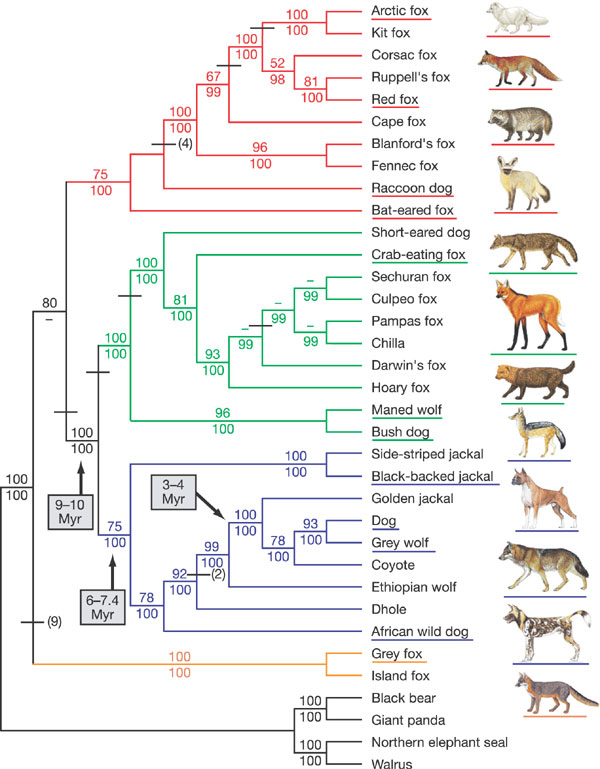
They are actually an offshoot of the canid lineage that has no close relatives, save the Island fox (U. littoralis), which may be a subspecies of the gray fox.  This lineage split off from the rest of the extant canids 9 to 10 million years ago.

The best way to tell these two species apart, which have an overlapping range, is to look at the tail. Gray foxes have a ridge of black hair on the dorsal surface of their tails, which they can raise when alarmed. Further, gray foxes have a lot more gray on them than kit foxes, but this feature can vary with each individual fox. And if you’re seeing only one fox, you really can’t make a comparison.

Kit foxes don’t have a strip of black hair running down the dorsal surface of their tails.

Gray foxes have a ridge of black hair running down the dorsal surface of their tails. No other species of fox on the North American mainland has this feature.

Grays also have a very distinct head, which is broader than all the Vulpes foxes. The muzzle also  isn’t nearly as slender and pointed.

The old fox in the top photo has likely seen a few battles over territory.

Life in nature isn’t quite as nice as the Disney specials implied.

Several battles, and his ears won’t even stand up anymore!

Read Full Post »

The complex status of red foxes in North America

Red foxes are native to North America.

They were also introduced.

That sounds like a contradiction, but let me explain.

First, we should look at the North America red fox distribution map. Red foxes in North America have several subspecies.

Click to make larger.

Subspecies number 6 is Vulpes vulpes fulva.

It was traditionally believed that it didn’t exist until the seventeenth century, when English colonists introduced red foxes for hunting purposes.

I’ve often said that red foxes are not native to most of the Eastern United States and that they all derive from imports.

The trouble is that there have been few genetic studies on red foxes in the Eastern and Southern US that have made tried to figure out exactly where they came from.

Well, it turns out that this assertion may be wrong.  A recent mtDNA study revealed that North American red foxes, including those found in the Southeastern US, don’t have Eurasian red fox mtDNA haplotypes. That means that the matrilines of red foxes living in the Eastern US are derived from indigenous vixens, most likely those from Eastern Canada that colonized the United States in the middle of the nineteenth century.

Now, an mtDNA study cannot tell us everything about the genetic make-up of red foxes in North Ameriaca, and it is possible that some of their genetic material came from imported red foxes that were introduced in the seventeenth and eighteenth centuries.

A larger sample of red fox DNA is needed to see exactly what the ancestry of these foxes actually is.

However, this study is making me reconsider some of my assumptions about the local red fox population.

It’s true that red foxes weren’t here at the time of colonization. However, red fox remains that date to the time of time of the Wisconsin glaciation have been found in Virginia and Tennessee.  When glaciers retreated, the red fox moved north in Canada, where it remained until European colonization.

The traditional account states that red foxes in the Eastern and Southern US came from those imports, but there is a large gap between those introductions in the seventeenth and eighteenth centuries and the establishment of red foxes in this part of North America in the  middle of the nineteenth century.

It is possible that our foxes have a mixture of native and European blood.

But it is also possible that the imports never really became established, or if they became established, they became swamped with native red fox blood as they came pouring down from Canada. My guess is there never were that many imported red foxes. Foxes are wild dogs, and they would not have taken well to confinement on their way from England to North America. Further, foxes that evolved to live in a benign marine climate may not have been able to thrive in a place that has such extremes in heat and cold.

Compared to wolves and coyotes, we know next to nothing about how the different populations of red fox are related to each other. We’ve only recently been able to determine how coyotes colonized Virginia through the Great Lakes and Canada, and we’ve also been able to figure out that certain propose wolf species are actually derive from recent hybridization between coyotes and wolves.

These studies looked at a lot more genetic material than mtDNA haplotypes, and we’re going to need studies like these on red foxes to determine what their exact ancestry is.

But if our assumptions about red wolves can be challenged through extensive nuclear DNA studies, then our assumptions are likely to be challenged when we start looking at red foxes.

Maybe we should consider red foxes native to the Eastern US after all.

I think we need to see how much “native” ancestry they have before making that assertion.

But this mtDNA study is certainly a major affront to the tradition account of how red foxes colonized the Eastern United States.

Read Full Post »

« Newer Posts - Older Posts »

Follow