Feeds:

Archive for May, 2013

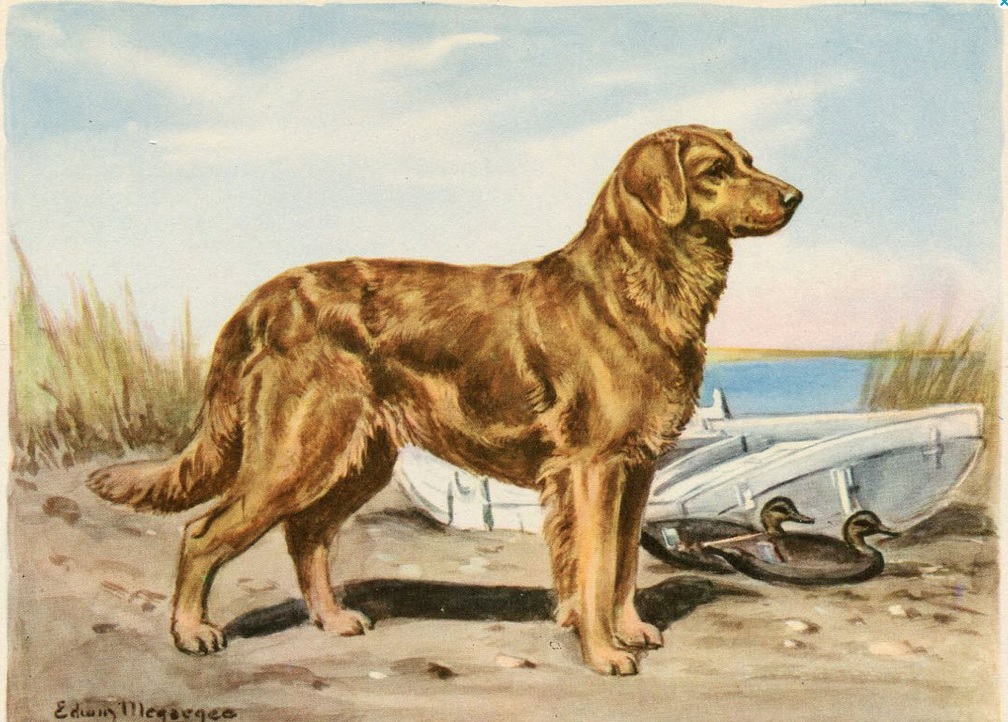
Golden retriever by Edwin Megargee, 1942

Golden Retriever Edwin Megargee 1942

This painting is by the well-known dog artist and dog fancier Edwin Megargee, and it appeared in his book that was simply called Dogs (1942).

In the 1940’s, golden retrievers were quite uncommon in the United States. The only ones that existed were hunting dogs that were largely derived from the darker-colored, more lightly built stock that was common in the UK during the 1920’s and 1930’s. For most of their history in the United States,  this is what most Americans would associate with golden retrievers– lithe, wiry, fox-colored retrievers.

In 1942, the received wisdom is that the golden retriever was an off-shoot of some Russian dog crossed with a bloodhound, as Megargee’s text clearly explains:

Megargee text golden retriever

Of course, it wasn’t until the 1950’s that the Russian story was finally debunked. The golden retriever is just an offshoot of the wavy-coated/flat-coated retriever type.

Also of interest is that Megargee mentions that the dog can e used as a “combined setter and retriever.”  Many golden retrievers do point, and some people have trained them for them for this purpose.

Of course, most golden retrievers are used as combination “duck dogs” and flushers. There has never been the strong separation between retriever work and spaniel work in North America as there has been in the UK.

Our hunting culture is more egalitarian, and our waterfowl seasons are more strictly regulated.  It’s always been a bit of a tradition in America to keep a retriever for waterfowl but also use it as a spaniel in pursuit of other birds. That way, you don’t have to buy and keep two dogs. One dog can do both tasks.

In the 1940’s, golden retrievers were holding their own with Labradors in retriever trials.

But the golden retriever is a very pretty dog, and it wasn’t long before it became consumed by the pet market and the show ring.

And as a result, working strains of golden retriever are quite a bit less common than working strains of Labrador.

This type of golden retriever still exists, but it’s most common in North America, where, for whatever reason, we’ve been able to hold onto it. Many European working golden retriever strains now include outcrosses to American or Canadian imports.

Most European breeds bred in North America wind up degenerating rapidly. There are no German shepherd breeders importing North American GSD’s to cross with their dogs. I know of no British border collie breeders who are importing American stock to improve their lines.

But you very often see working golden retrievers in Europe with American and Canadian ancestors.

It’s not just with dogs that Europeans shun American-bred domestic animals. The only European-derived domestic animal breed I know of other than the America working golden retriever that has been in demand to improve native European strains is the Vermont strain of the Merino.

This says a lot about American priorities in animal breeding.

Just as Hollywood and much of our new media is a sensationalized distortion of reality, maybe our entire culture is nothing more than a sensationalized distortion of Western civilization.

Maybe that’s why we’re in so much trouble. We can’t even breed domestic animals right!


Read Full Post »

Startled Grouse and Golden Retriever, Owen Gromme, 1973

Startled Grouse-Golden retriever Owen Gromme

This scene makes me quite nostalgic.

I had a dog that looked just like this one who loved to flush ruffed grouse. If there was a grouse in the woods, she’d find it!

Americans have no real problem with using retrievers as spaniels. In fact, because our hunting culture is much more egalitarian than that of the UK, it would make sense that Americans would prefer to have a dog capable of doing multiple tasks.

After all, waterfowl hunting in the United States is very strictly regulated by federal law, and the limits and seasons are quite finite.

Why own a dog that only hunts those birds?

All of these retriever breeds are very easy to train dogs, so we’ve usually let them moonlight as spaniels (and other things, including coonhounds!)

In fact, golden retrievers in particular are often used solely as flushing dogs in parts of the Midwest, where their prowess in hunting grouse and pheasant and very high trainability makes some people prefer them over traditional spaniels.

***

 According to The Art Barbarians website, where you can see a much higher resolution image of this painting:

This flushing Rough [sic] Grouse And Golden Retriever was painted by and released as a signed and numbered Artwork on sale by Owen Gromme. Born in 1896 in Fond du Lac, Wisconsin, Owen Gromme went to work at the age of 21 as a taxidermist at the Field Museum of Natural History in Chicago. After World War I, Gromme worked at the Milwaukee County Museum as a taxidermist, collector, photographer, movie editor, background painter, botanist, geologist, sculptor, and finally curator of birds and mammals. He retired in 1965 to devote full time to his painting. He first gained acclaim in 1945 when he won the Federal Duck Stamp competition. In 1963 Gromme completed to world acclaim a volume of scientific paintings called “Birds of Wisconsin,” He is referred to as the “Dean of American Wildlife Artists.” Owen Gromme died on October 29, 1991, at the age of 95.

Wisconsin and Minnesota were early bastians of the golden retriever in the United States, and a lot of working line dogs can be found in those two states today.


Read Full Post »

Cream-colored American badger

Interesting little color phase:

It looks to me that it’s one of those erythristic mutations that makes it unable to produce black pigment.

Read Full Post »

Into the misty

The mists after the rain:

IMG_1148 - Copy

A little-known fact is that “Into the Mystic” was originally entitled “Into the Misty,” which I shamelessly stole here.


Read Full Post »

Feral land

IMG_1195

I make no excuses.

I am a forest person.

Most of West Virginia is nothing  more than a continuous expanse of woodland.

This is not primordial forest from the days before Europeans came.It’s nothing more than what happens when land that was once intensely grazed by livestock is left to return to its own devices.

Forest is the natural condition of the land. Pasture is not.

It’s really feral land.

But these forests aren’t like the ones of yore.  Introduced species prevail. Most of the thickets here are made up of autumn olive, a native of Northeast Asia that tends to do well in this climate. Another native of Northeast Asia that has done well here is the multiflora rose, which was actually introduced in the vain attempt to give North Americans natural fencing.

All of this vegetation is grazed by white-tailed deer.

They are the only large ungulate in this area, but they were only of secondary importance when Europeans came.

When Europeans came, there were vast herds of Eastern bison and elk.

The game trails here are just little cuts through the undergrowth that are big enough to accommodate white-tailed deer and maybe the odd passing black bear.

But in those days, I bet the trails had a much larger cut.  A huge bison would need much more  room to maneuver through the brush than a white-tailed deer does, and as a browser, I be they kept much of the lower understory much more pared back than it currently is.

The land is now feral.

It’s not a pristine wilderness, but it something different.

As rural America has died, the ecosystem slowly comes back.

Not restored.

But with a new life of sorts.

Read Full Post »

The enchanted forest

The way the sun is hitting the ferns here make it look like a scene from a story book.

IMG_1188

Read Full Post »

Did kangaroos ever live in the Middle East?

OMG:

Source.

The only fossils of kangaroos that have ever been found are in Australia and New Guinea and the islands near there.

They have never been in the Middle East.

EVER!

Seriously.

They don’t give you any evidence here. They just say that they have to have been in the Middle East because that’s where the ark landed.

If you want to know the real story of kangaroo evolution, check out Tim Flannery’s Chasing Kangaroos.

This is the worst I’ve ever seen it.

Read Full Post »

« Newer Posts - Older Posts »

Follow